EV & EV Charging EMI Filter Solutions
Ensure EMC compliance, reduce interference, and improve system stability in high-power EV applications
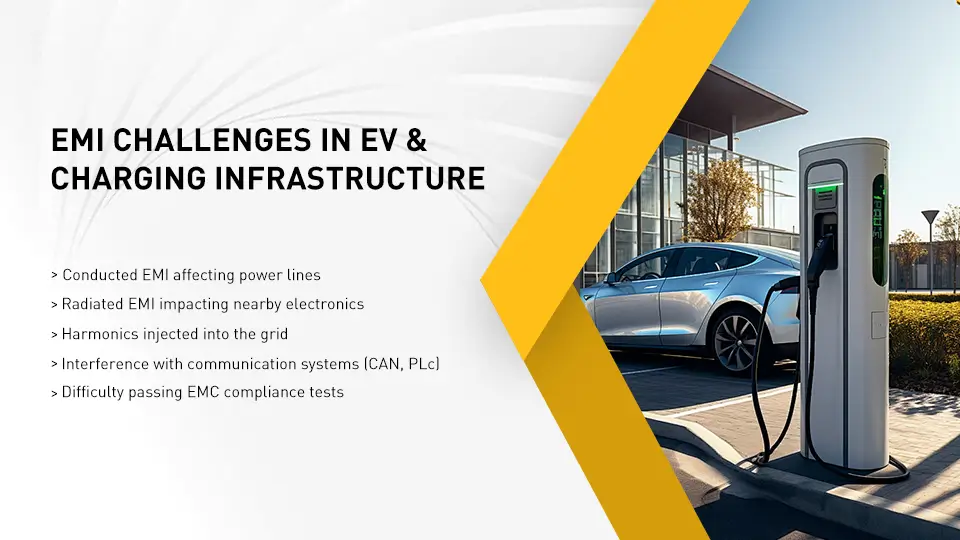
EMI Challenges in EV & Charging Infrastructure
Electric vehicles (EVs) and charging stations rely on high-frequency power conversion systems such as AC/DC rectifiers, DC/DC converters, and inverters. These systems generate significant electromagnetic interference (EMI), which can affect both internal electronics and external equipment.
As charging power levels increase—especially in DC fast charging systems—EMI becomes more complex and harder to control.
Typical EMI Challenges:
✔ Conducted EMI affecting power lines
✔ Radiated EMI impacting nearby electronics
✔ Harmonics injected into the grid
✔ Interference with communication systems (CAN, PLC)
✔ Difficulty passing EMC compliance tests
Without proper EMI filtering, these issues can lead to system instability, certification failure, and reduced product reliability.
EMI Solutions for Key EV Applications
Reliable EMI filtering solutions for OBC, DC fast charging, energy storage, and wireless EV charging — optimized for space, current, and EMC compliance.
🚗 On-Board Charger (OBC)
⚠️ Challenge:Space constraints • High-frequency noise • Strict EMC
✅ Solution:Compact filters • High attenuation • Optimized thermal design
⚡ DC Fast Charging Stations
⚠️ Challenge:High current/voltage • Strong switching noise
✅ Solution:High-current DC filters • Multi-stage • HV insulation • Custom solutions
🔋 Energy Storage & PCS
⚠️ Challenge:Bidirectional conversion • Grid harmonics • Complex EMI paths
✅ Solution:Three-phase filters • High attenuation • Grid-compliant EMC
📶 Wireless EV Charging (Optional)
⚠️ Challenge:High-frequency fields • EMI/EMF leakage
✅ Solution:Special shielding + filtering • High-frequency suppression
Where Does EMI Come From in EV Systems?
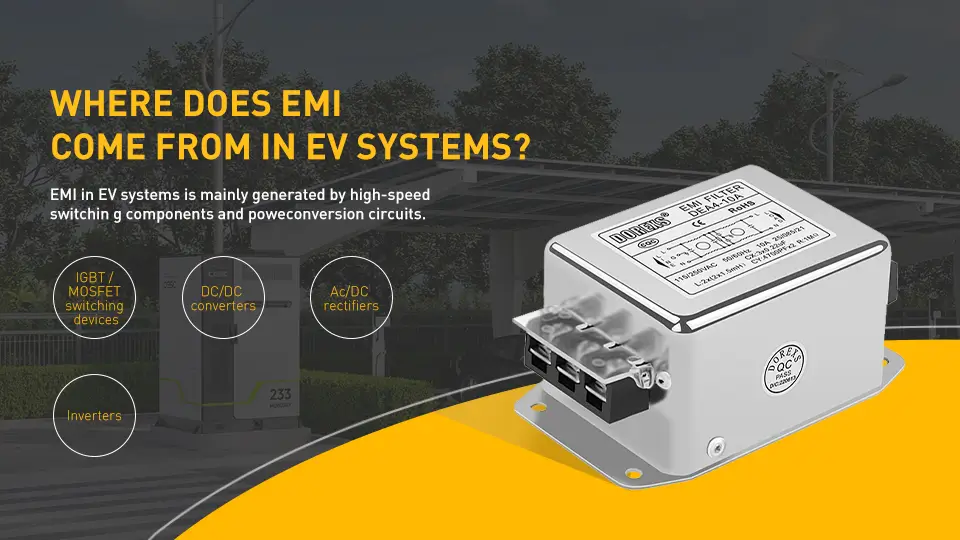
EMI in EV systems is mainly generated by high-speed switching components and power conversion circuits.
Primary EMI Sources:
· IGBT / MOSFET switching devices
· DC/DC converters
· AC/DC rectifiers
· Inverters
· High-frequency switching edges (high dv/dt, di/dt)
· Long DC bus / cable connections
EMI Propagation Paths:
· Conducted EMI through cables and power lines
· Radiated EMI through air and surrounding structures
Understanding these sources is essential for designing effective EMI filter solutions.
Our EMI Filter Solutions for EV Applications
DOREXS provide a full range of EMI/EMC filters designed specifically for EV and charging infrastructure.
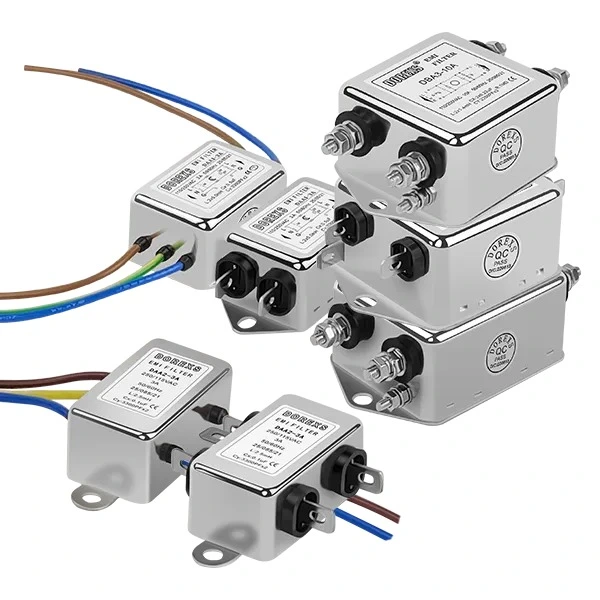
Single-phase and three-phase filters for input-side interference suppression at the EV charger front-end.
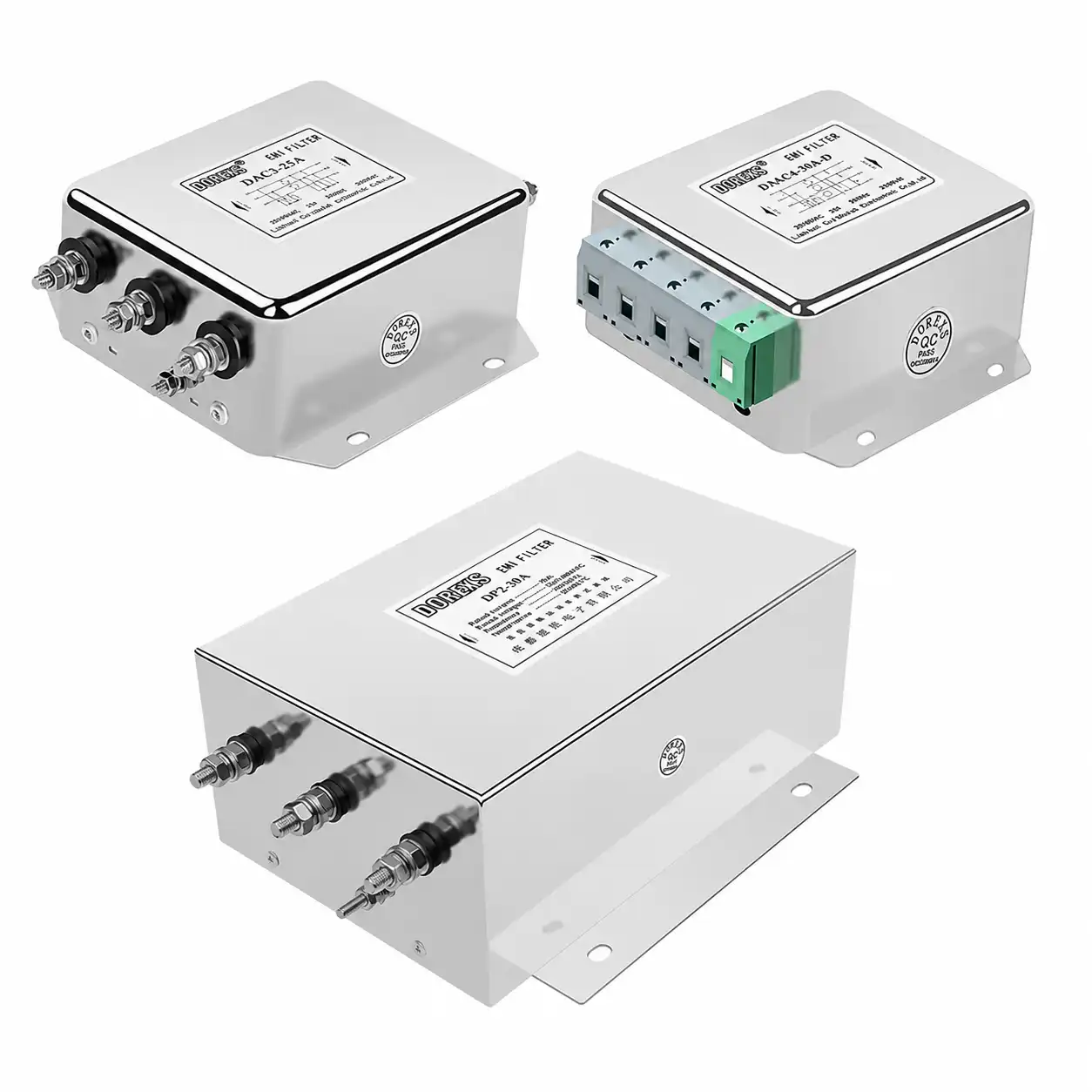
Suppress conducted noise at the AC input of DC fast-charging stations and other high-power electric vehicle charging equipment.
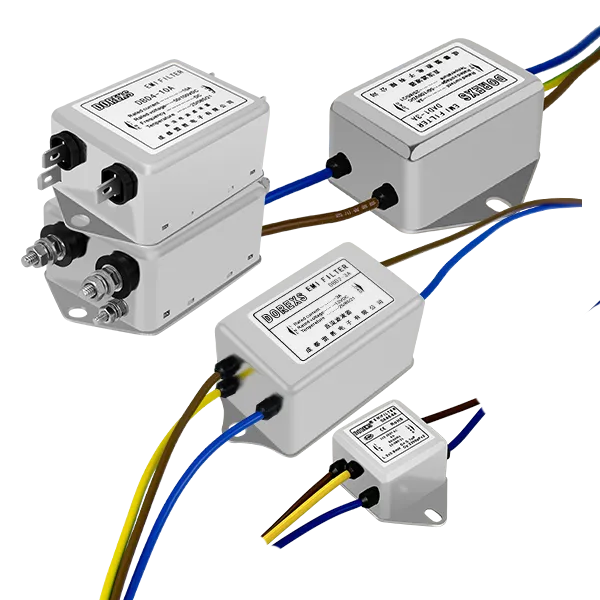
High-voltage DC filters up to 1500VDC and 1600A+ for EV charging station EMI/EMC optimization in high-power DC fast charging systems.
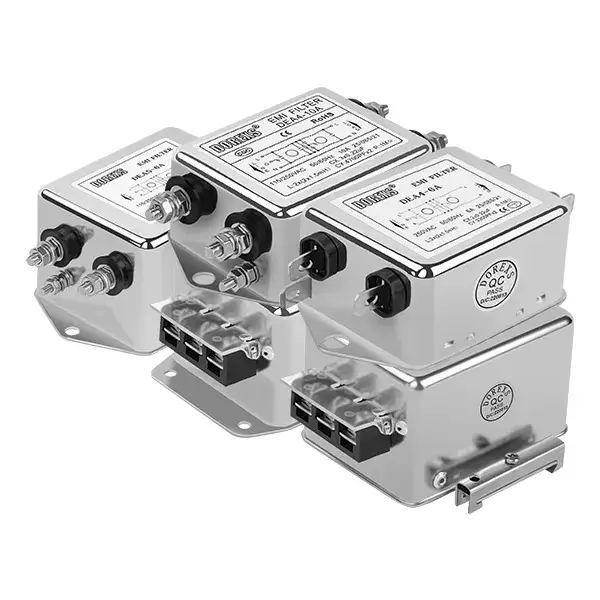
Multi-stage EMI power filters with enhanced attenuation to meet strict EMC standards in high-power applications.

DOREXS offer fully customized designs covering electrical parameters, mechanical structure, EMC testing, and rapid prototyping.
EMC Standards & Compliance Support
EV charging equipment must meet different EMC and safety requirements depending on charger type, power level, charging mode, installation environment, and target market.
For off-board conductive charging systems, IEC 61851-21-2 defines EMC requirements for EV charging equipment. Other applicable emission, immunity, safety, and market-access standards may vary by product classification and region.
DOREXS supports EV charger manufacturers with EMI filter selection and application-oriented filtering solutions based on operating voltage, current, switching topology, EMC test results, installation layout, and target compliance requirements.
Selected DOREXS product series are available with applicable certification and compliance options according to project requirements.
Why choose DOREXS EV & EV Charging EMI Filter Solutions?
Your Trusted EMI Filter Partner

Leveraging our extensive experience in EMI/EMC technology, DOREXS provides reliable, high-quality EMI filter solutions to EV charging and electric vehicle clients worldwide.
Contact DOREXS today to learn more about our EMI filter products and discover the high-performance EMI suppression solution best suited to your needs.

15+ Years of EMI/EMC Engineering Experience
Strong R&D and customization capability

Fast prototyping and short lead times

Engineering support throughout your project
Proven solutions for high-power applications
DC Fast Charger EMC Optimization Case
Custom EMI filter design and rapid prototyping enabled the customer to complete EMC optimization within a short development cycle, avoiding costly redesign delays.
Case 1 —⚡ 30kW EV Charger
Case 2⚡ 120kW DC Fast Charger
Case 3⚡ 350kW Ultra-Fast Charger
🧩 Challenge
📶 Conducted EMI exceeded limits
⚠️ Unstable charging performance
🛠 Solution
🔌 Compact AC EMI Filter
📐 Optimized layout & grounding
✅ Result
✔ EMC compliant
✔ Stable operation
✔ Faster project delivery
🧩 Challenge
📡 EMI failure during testing
🔄 Communication interference
🛠 Solution
🔌 AC + High-Current DC EMI Filters
📊 Multi-stage filtering design
✅ Result
✔ CE & EMC compliant
✔ Stable communication
✔ Improved system reliability
🧩 Challenge
⚡ Severe EMI from high-power switching
🚫 Failed EMC requirements
🛠 Solution
🔌 Custom High-Voltage DC EMI Filter
🛡 Enhanced shielding design
✅ Result
✔ Passed strict EMC standards
✔ Zero charging interruptions
✔ Reliable high-power operation
FAQS
A: EV chargers typically use both AC input EMI filters and high-current DC EMI filters to suppress conducted and radiated interference.
A: By using multi-stage EMI filters, proper grounding, shielding, and optimized circuit design.
Applicable EMC and safety standards depend on charger type, charging mode, power level, installation environment, and target market. IEC 61851-21-2 is commonly relevant to EMC requirements for off-board conductive charging systems.
A: Yes, custom EMI filters are often required to match specific power levels, voltages, and system designs.
DC fast chargers typically require EMI filtering on the three-phase AC input, and in some designs additional filtering may also be needed on the high-voltage DC side. The correct filter depends on charger power, input voltage, current, converter topology, switching frequency, grounding, cable layout, and EMC test results.
For high-power systems, a three-phase EMI filter is commonly used at the AC input to reduce conducted common-mode and differential-mode noise generated by AC/DC conversion stages. High-voltage DC EMI filters may also be used where significant noise is present on the DC output or internal DC bus.
Not every EV charger requires EMI filters on both sides. The required filtering configuration depends on where the dominant noise is generated and how it propagates through the system.
The AC input side is usually the primary location for filtering conducted emissions entering or leaving the charger through the mains connection. DC-side filtering may be added when high-frequency noise from DC/DC converters or switching devices propagates onto the DC bus, charging cable, or vehicle interface.
In high-power DC fast charging systems, AC-side and DC-side filtering may be used together when system-level EMC testing shows that a single filter stage is not sufficient.
Start with the electrical requirements of the charging system, including operating voltage, rated current, charger power, number of phases, and DC bus voltage.
Then evaluate the main EMI characteristics, such as switching frequency, converter topology, common-mode and differential-mode noise, cable length, grounding, leakage current limits, and available installation space.
For high-power chargers, it is also important to consider filter current margin, thermal performance, insertion loss, mechanical mounting, and the applicable EMC requirements for the target market.
If EMC test data is available, conducted-emission results can help determine the required attenuation more accurately.
EMI filters can help reduce power-line noise that may contribute to CAN, PLC, or other communication instability, especially when interference is coupled through the power system.
However, communication problems are not always caused only by conducted EMI. Grounding, shielding, cable routing, common-mode current, connector design, and separation between power and signal cables should also be evaluated.
In EV charging systems, the most effective solution often combines appropriate power-line filtering with improved grounding, shielding, and wiring layout.
Get Your EV EMI Solution Today
Looking for a reliable EMI filter for your EV or charging system?
Request a custom solution from our engineers today!