How to Suppress EMI from Charging Piles
Would you like to understand the critical EMC/EMI considerations for charging equipment?
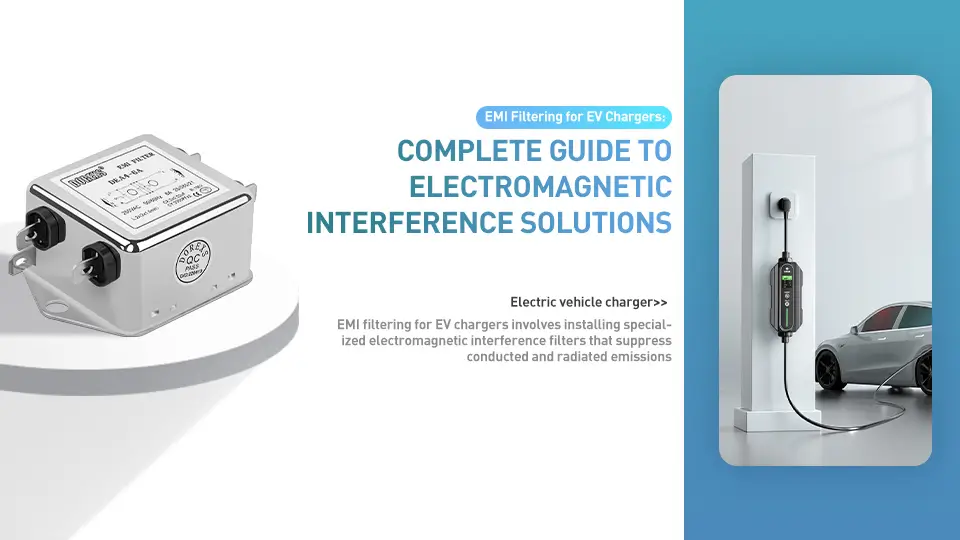
The fast adoption of electric vehicles brings with it an increased demand for charging stations. DOREXS have been ahead of this trend for many years with power filters in charging stations– operating different standards, supporting AC and DC charging.
New EMC/EMI POWER LINE FILTER from DOREXS are now being launched, better fit for growing EMC requirements in this area.
When fast charging an electric vehicle on a highway rest area, high amounts of energy are transferred in a short time.
Electrical safety and EMC compliant currents protect the user, the electric vehicle, and the electrical grid.

What causes EMI On EV Charging Station?
The EMI often come from devices that operate using a wireless signal but also emanate from a variety of other electronic appliances.It can still cause annoying disruptions to EV Charging Station and lead to poor performance of electronics.
Here are a few common causes of EMI :
- Power converters and switching power supplies
- High voltage and high current
- Insufficient electromagnetic compatibility design
- Electronic control systems and communication modules
- Grounding and connection issues
- Cell phones
- Laptops
- Wi-Fi devices
- Bluetooth devices
- Lamps
Introduction to Charging Infrastructure
EMI filters are a critical component of modern EV charging infrastructure. These filters are designed to reduce EMI and protect vehicles and charging equipment from potential interference. As the industry grows, it is critical to adhere to international standards, such as those set by the International Electrotechnical Commission (IEC). These standards guide the design, testing, and implementation of EMI filters to ensure that charging stations and charging posts operate safely and efficiently. As the demand for electric vehicles continues to grow, the importance of rugged, standard-compliant EMI filters in charging infrastructure cannot be underestimated.
Understanding Electromagnetic Interference

To address these issues, EV charging stations are equipped with specially designed EMI filters that eliminate interference within specific frequency ranges. The effectiveness of these filters depends on careful consideration of the specific requirements of the charging infrastructure, including power source type, voltage, and current levels. Proper grounding and shielding are also critical to minimizing EMI to ensure reliable and safe operation of the charging station. By addressing these factors, EMI filters help maintain the performance and life of EV charging stations and the vehicles they serve.
How to suppress EMI interference from charging piles
- Use shielding material (copper foil) to wrap key components such as power converters
- Correct ground wire installation design
- Designed with built-in EMI filters at the input and output ends
- Circuit filter design
- Choose a location away from other sensitive equipment and signal lines
The DOREXS Filter Model DAC41 delivers ultimate safety for the vehicle at the charging station.
And this power filter can protect the EV charging station from those interference
Meanwhile it cleans the power that charges the car ensuring a safe charging experience up to 800 VDC
This means that fast charging with 500 kW is possible with only one EMC POWER FILTER from DOREXS.
How to Select an appropriate EMI Filter?
The design parameters of EMI Filter include:
- Attenuation (insertion loss)
- Rated Current
- Rated Voltage
- Product quality certification
Meanwhile in order to get the most efficiency, reliability, and proper operation from the EMI Filter. To design a good filter, the pass band must be defined just as the potential interference frequencies. As any filter schematic only an approximation of the filter circuit especially at higher frequencies, in real life the filter components exhibit tolerance, and saturation.
DOREXS EMI Solutions can help you to mitigate the risk of EMI
In order to reduce manufacturing costs, manufacturers should consider EMI shielding issues at the earliest stage of product design. The best solution to this problem is to use an EMI power line filter and install a power line or EMI filter at the power entry point of the device. An EMI Filter can not only with conducted emissions, but also in meeting immunity and fast transients requirements along with radiated emissions too.
Customer application case: Solving electromagnetic interference problems at 500kW fast charging stations in Europe
- Up to 800VDC withstand voltage
- Strong resistance to common mode and differential mode interference
- Compliant with CE, UL, RoHS and other certifications
Testing and Verification: How to Measure EMI Performance?

Accurately measuring the electromagnetic interference (EMI) of charging stations is critical to maintaining the performance and reliability of EV charging infrastructure. This process ensures that charging stations meet regulatory standards and helps identify sources of interference that may affect system operation. Specialized equipment such as spectrum analyzers and EMI receivers are used to assess the strength of the electromagnetic field and the frequency range of any interference.
The measurement process includes pinpointing the source of EMI, characterizing the electromagnetic environment, and evaluating the effectiveness of EMI filters in suppressing interfering signals. These insights are critical to optimizing filter design and ensuring that EV charging stations meet stringent electromagnetic compatibility requirements. By regularly measuring and analyzing EMI, manufacturers and operators can improve the reliability and safety of charging stations, supporting the continued development of EVs and charging infrastructure.
Regulatory Compliance
Ensuring regulatory compliance is a cornerstone of a safe and reliable EV charging infrastructure. The design and implementation of charging station EMI filters must comply with international standards and regulatory requirements, such as those established by the International Electrotechnical Commission (IEC) and the Federal Communications Commission (FCC). These standards specify the maximum levels of electromagnetic interference allowed and provide detailed guidelines for the design, testing, and verification of EMI filters.
Compliance with these regulatory standards is critical to preventing EMI-related issues, ensuring electrical safety, and protecting sensitive equipment connected to the charging infrastructure. EMI filter manufacturers must obtain certifications such as UL (Underwriters Laboratories) and CE (Conformité Européenne) to demonstrate that their products meet all necessary safety and performance standards. By prioritizing regulatory compliance, the EV charging industry ensures that charging stations remain reliable, safe, and efficient for all users.
Future Developments
The future of EV charging infrastructure promises exciting advancements, driven by evolving technology, stricter regulatory requirements, and the growing demand for EVs. Innovations in materials such as wide-bandgap semiconductors and advanced magnetics are paving the way for more efficient, compact, and powerful EMI filters. The need for advanced EMI filter technology will continue to grow as the EV market expands and renewable energy integration becomes more prevalent.
Smart charging systems and the seamless integration of EV charging infrastructure with the grid require EMI filters that can handle complex power flow scenarios and minimize electromagnetic interference. As regulatory standards continue to evolve and demand for high-power, fast-charging solutions grows, manufacturers will continue to develop new filter designs to meet these challenges. Ultimately, the continued development of efficient, reliable, and cost-effective EMI filters is critical to supporting the safe and reliable operation of EV charging infrastructure, which will ensure a bright future for electric vehicles and their charging stations.
DOREXS EMI Industry Leader
FAQ about EV Charging Equipment and EMI Filters
Why do EV charging equipment need EMI filters?
How to choose an EMI power filter for 800V fast charging?
- Rated voltage: ensure that the filter supports voltage levels up to 800VDC or higher;
- Rated current: match the maximum current output of the charging pile;
- Insertion loss (Attenuation): the attenuation performance of the filter in the key frequency band;
- Certification standards: whether it has passed international electromagnetic compatibility certifications such as UL, CE, and IEC;
How do EMI filters help devices comply with IEC 61000 standards?
- Reduce conducted interference (Conducted Emissions), in line with IEC 61000-4-6 specifications;
- Suppress fast transients (EFT) and lightning surges (Surge), in line with IEC 61000-4-4/5;
- Improve the anti-interference ability of the equipment to ensure stable operation in complex electromagnetic environments;
EMI and EMI Filters in Industry
Solve EMI/EMC of EV charging stations and improve charging efficiency
Related Article