Solar Inverter EMI Filter Solutions: Professional EMC Solutions for Grid-Tied and PV Inverter Systems
author: DOREXS
2026-01-06
Overview
Solar inverters are the core power conversion units in photovoltaic (PV) systems, responsible for converting DC power from solar panels into grid-compatible AC power. Due to high-frequency switching, increasing power density, and the widespread use of IGBT and SiC devices, electromagnetic interference (EMI) has become one of the most critical challenges in modern solar inverter design.

Uncontrolled EMI can lead to:
-
EMC test failures
-
Grid compliance issues
-
Interference with nearby electronic equipment
-
Reduced system reliability
EMI from solar power systems can affect the performance of sensitive electronic devices, such as computers, medical devices, appliances, electrical devices, and other devices. Solar power systems often emit high amplitudes of transient harmonic voltages that can interfere with the function of these electrical devices. Severe EMI can even cause permanent damage to sensitive equipment.
DOREXS provides professional EMI filter solutions for solar inverters, helping manufacturers reduce conducted and radiated emissions and meet international EMC standards efficiently.
Why EMI Is a Critical Issue in Solar Inverters
Solar inverters inherently generate EMI due to their operating principles:
-
High-frequency PWM switching
-
Fast voltage and current transitions (high dv/dt and di/dt)
-
Long DC and AC cables acting as unintended antennas
EMI is a concern in both AC and DC systems, as both can be affected by conducted and radiated interference. Control lines and control systems within solar inverters can also contribute to or be affected by EMI, making it essential to address these paths for comprehensive suppression and compliance.
As inverter technology evolves toward higher switching frequencies and SiC-based designs, EMI problems become more severe and more difficult to control without a system-level approach. EMI must be carefully controlled to ensure reliable operation of the entire system.
EMI in solar inverters is not a single-component problem—it is a system-level engineering challenge.
Understanding Power Electronics in Solar Inverter Systems
Power electronics are at the heart of every solar inverter system, serving as the bridge between the DC power generated by solar panels and the AC power required by homes, businesses, and the utility grid. By leveraging advanced components such as insulated gate bipolar transistors (IGBTs) and metal-oxide-semiconductor field-effect transistors (MOSFETs), solar inverters can efficiently manage the conversion process while maintaining compact size and high performance. These components are engineered to operate at elevated frequencies, which not only enhances the efficiency of the inverter but also helps meet the specific requirements of modern solar installations.

However, the high-frequency operation of power electronics can introduce electromagnetic interference (EMI), potentially affecting the reliable operation of the inverter and other nearby electronic systems. Effective design and integration of power electronics are therefore essential—not only to optimize power conversion and system reliability, but also to ensure compliance with stringent EMI regulations. By understanding the interplay between power electronics and EMI, engineers can develop solar inverter systems that deliver stable output voltage, minimize interference, and maintain consistent performance across a wide range of operating conditions.
Common EMI Problems in Solar Inverter Systems
Conducted Emissions (150 kHz – 30 MHz)
- Noise injected into the AC grid through power lines
- Common-mode noise propagating back to PV arrays via DC cables
- EMC test failures caused by insufficient attenuation at low and mid frequencies
Radiated Emissions (30 MHz – 1 GHz)
- Long DC and AC cables radiating common-mode noise
- Poor grounding or enclosure coupling
- High-frequency switching noise from IGBT or SiC devices
These issues often appear during EMC testing and require effective EMI filtering combined with proper grounding and layout.
System-Level EMI Filtering Strategy
Successful EMI suppression in solar inverters requires a system-level filtering strategy, including:
-
Noise source control (switching behavior optimization)
-
EMI filtering on both AC and DC sides
-
Proper grounding and shielding design
-
Optimized PCB and power layout
Implementing a multi-layered approach can achieve optimal noise reduction in solar inverters. Solar inverter EMI solutions use passive filters, chokes, capacitors, shielding, and grounding to block high-frequency noise in solar systems. DC filters are designed specifically for filtering DC power and control lines, providing targeted protection for solar panels, battery systems, and DC motors. Proper installation of the inverter and cables is essential to reduce EMI. Proper grounding involves mounting filters directly to a grounded metal panel to create a low-impedance noise dissipation path. Proper grounding of the inverter is essential to minimize the risk of EMI and prevent noise coupling into the system.
Among these, EMI filters play a key role in blocking noise propagation paths and stabilizing EMC performance.
Among these, EMI filters play a key role in blocking noise propagation paths and stabilizing EMC performance.
High Frequency Oscillations and Their Impact on EMI
High frequency oscillations are a frequent challenge in solar inverter systems, especially those utilizing switching power supplies. These oscillations, which can span a frequency range from several kilohertz up to many megahertz, are often generated by the rapid switching actions required for efficient power conversion. As a result, high frequency noise can be introduced into the system, potentially radiating through cables or coupling into other electronic devices and equipment, leading to electromagnetic interference (EMI).

The presence of high frequency oscillations not only threatens the performance of the solar inverter itself but can also disrupt the operation of other sensitive devices within the same electrical network. To address this, designers employ a variety of mitigation techniques, including the use of EMI filters, ferrite cores, and carefully selected noise-reducing components. Proper filtering and grounding are critical for effectively blocking unwanted noise and ensuring that high frequency oscillations do not compromise system reliability or cause radio frequency interference (RFI).
By proactively managing high frequency oscillations, solar inverter systems can achieve more efficient operation, reduce the risk of interference with other electronic devices, and maintain compliance with international EMC standards. This approach is essential for ensuring the long-term performance and reliability of both residential and commercial solar power installations.
DOREXS EMI Filter Solutions for Solar Inverters
DOREXS specializes in EMI and power line filters designed for industrial and renewable energy applications. Our filters are cost-effective, made with high-quality components, and are widely used in solar inverter systems to suppress both common-mode and differential-mode noise.
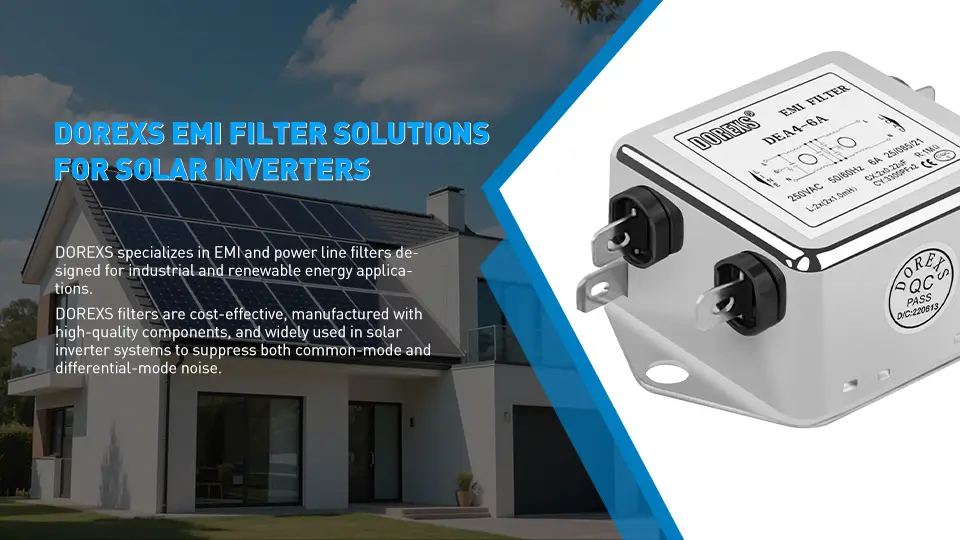
EMI filters are effective across a broad frequency range, typically between 150 kHz and 30 MHz. They play a critical role in reducing EMI in motor drives, medical devices, appliances, and frequency inverters, ensuring reliable operation and compliance with industry standards.
Astrodyne TDI offers a wide selection of quality off-the-shelf EMI filters for various applications, including solar inverters.
AC Output EMI Filters for Grid-Tied Solar Inverters
The AC output of a solar inverter is directly connected to the utility grid, making EMI control on this side essential for grid compliance. Line filters are also placed on the AC input of inverters to reduce EMI before it enters the system.
DOREXS AC EMI Filters are designed to:
DOREXS AC EMI Filters are designed to:
-
Suppress conducted emissions from 150 kHz to 30 MHz
-
Reduce both common-mode and differential-mode noise
-
Prevent noise injection into the power grid
Key Features
- Single-phase and three-phase EMI filter options
- High attenuation performance
- Low leakage current (grid-compliant)
- Compact, inverter-friendly mechanical design
- CE and RoHS compliant
- Pi filters offer high-level attenuation for high-frequency noise on the AC output, ensuring clean power delivery. Pure sine wave output is important for compatibility with sensitive equipment, and the supply of clean AC power is a key benefit of using these filters.
Typical Applications
- Grid-tied solar inverters
- Central inverters
- Three-phase string inverters
DC Input EMI Filters for PV Side Applications
The DC side of a solar inverter is often overlooked, yet it is a major source of EMI radiation due to long PV cables and common-mode current leakage. DC EMI filters are installed between PV panels and the inverter to reduce conducted emissions and protect the panels. High-frequency leakage currents can cause premature aging of solar panels; DC-side EMI filters reduce these currents. DC filters are designed specifically for filtering DC power and control lines, including those used in solar panels and inverters.
DOREXS DC EMI Filters help:
DOREXS DC EMI Filters help:
-
Suppress common-mode noise on PV input lines
-
Prevent EMI propagation along long DC cables
-
Reduce radiated emissions caused by PV wiring
Design Advantages
- Suitable for high-voltage PV systems (1000V / 1500V DC)
- High insulation and reliability
- Stable performance in harsh outdoor environments
- Optimized for low leakage current
DC-side EMI filtering is essential to prevent common-mode noise from spreading through PV arrays and cable systems.
Customized EMI Filter Solutions for Solar Inverters
Every solar inverter design is different. DOREXS offers custom EMI filter solutions tailored to specific inverter requirements.
Customization options include:
Customization options include:
-
Rated current and voltage
-
Leakage current optimization
-
Mechanical size and mounting structure
-
Filter topology matching inverter architecture
Our engineers work closely with customers to ensure optimal EMI performance with minimal impact on system efficiency and size.
Why Choose DOREXS
- Specialized manufacturer of EMI and power line filters
- Extensive experience in solar and renewable energy applications
- In-house EMC engineering support
- Fast sampling and technical response
- Solutions designed to simplify EMC certification
Typical Solar Inverter Applications
- Grid-tied solar inverters
- String inverters
- Central inverters
- Hybrid inverters with energy storage systems
- Off-grid PV inverter systems
Compliance with International EMC Standards
DOREXS EMI filter solutions support compliance with major EMC standards, including:
-
IEC 61000-6-3 / IEC 61000-6-4
-
EN 55011 / EN 55032
-
CISPR standards
Our filters are designed to help solar inverter manufacturers pass EMC testing more efficiently and reliably.
Engineering Results
1500V Photovoltaic Inverter Conducted Emission Exceeding Limits - Rectification
A 1500V three-phase photovoltaic inverter failed EMI testing, with conducted emissions exceeding limits by 8–12 dBμV in the 150kHz–500kHz frequency band and common-mode peak exceeding limits by 5–8 dBμV in the 2–10MHz frequency band. The following steps were taken for rectification:
Problem Identification: Through spectrum analysis and current testing, it was determined that the exceeding limits in the 150kHz–500kHz frequency band were due to differential-mode noise caused by the PWM fundamental frequency and its low-order harmonics, while the exceeding limits in the 2–10MHz frequency band were due to common-mode noise, mainly originating from common-mode current leakage on the DC side. In solar inverters, EMI filters mitigate high-frequency noise generated by fast-switching power semiconductors like IGBTs or MOSFETs. Y-capacitors provide a path for common-mode noise between phase lines and chassis or ground, helping to divert unwanted signals. Common-mode chokes are used on both DC and AC cables to absorb common-mode noise while allowing desired signals to pass, and are crucial for suppressing common-mode noise to meet grid compliance. Ferrite beads attenuate high-frequency noise by absorbing it and are often added to cables. Filters suppress high-frequency leakage currents, reducing stress on solar panels and improving their longevity. Effective filtering lowers radiated emissions, preventing interference with other electronics. Filters also ensure the inverter meets international EMC standards, which is mandatory for grid-connected systems.
Rectification Measures:
① Optimized the DC side EMI filter, replaced the common-mode inductor with a high-permeability type, and increased the capacitance of the high-voltage Y capacitor (to control leakage current to meet standards);
② Optimized the chassis grounding, shortened the Y capacitor grounding path, and used copper busbars to achieve 360° grounding. Proper grounding involves mounting filters directly to a grounded metal panel to create a low-impedance noise dissipation path, which is essential for effective EMI suppression and compliance.
③ Optimized the power layout, reduced the area of high di/dt loops, and installed the busbar capacitors close to both ends of the SiC devices.
Rectification Results: After rectification, the conducted emissions in the 150kHz–500kHz frequency band were reduced by more than 15 dBμV, and the common-mode peak in the 2–10MHz frequency band was reduced by more than 10 dBμV, both meeting the IEC 61000-6-4 standard limits; and the results remained stable during load testing, with no recurrence of exceeding limits.
Problem Identification: Through spectrum analysis and current testing, it was determined that the exceeding limits in the 150kHz–500kHz frequency band were due to differential-mode noise caused by the PWM fundamental frequency and its low-order harmonics, while the exceeding limits in the 2–10MHz frequency band were due to common-mode noise, mainly originating from common-mode current leakage on the DC side. In solar inverters, EMI filters mitigate high-frequency noise generated by fast-switching power semiconductors like IGBTs or MOSFETs. Y-capacitors provide a path for common-mode noise between phase lines and chassis or ground, helping to divert unwanted signals. Common-mode chokes are used on both DC and AC cables to absorb common-mode noise while allowing desired signals to pass, and are crucial for suppressing common-mode noise to meet grid compliance. Ferrite beads attenuate high-frequency noise by absorbing it and are often added to cables. Filters suppress high-frequency leakage currents, reducing stress on solar panels and improving their longevity. Effective filtering lowers radiated emissions, preventing interference with other electronics. Filters also ensure the inverter meets international EMC standards, which is mandatory for grid-connected systems.
Rectification Measures:
① Optimized the DC side EMI filter, replaced the common-mode inductor with a high-permeability type, and increased the capacitance of the high-voltage Y capacitor (to control leakage current to meet standards);
② Optimized the chassis grounding, shortened the Y capacitor grounding path, and used copper busbars to achieve 360° grounding. Proper grounding involves mounting filters directly to a grounded metal panel to create a low-impedance noise dissipation path, which is essential for effective EMI suppression and compliance.
③ Optimized the power layout, reduced the area of high di/dt loops, and installed the busbar capacitors close to both ends of the SiC devices.
Rectification Results: After rectification, the conducted emissions in the 150kHz–500kHz frequency band were reduced by more than 15 dBμV, and the common-mode peak in the 2–10MHz frequency band was reduced by more than 10 dBμV, both meeting the IEC 61000-6-4 standard limits; and the results remained stable during load testing, with no recurrence of exceeding limits.
Get Your Solar Inverter EMI Filter Solution

If you are developing or manufacturing solar inverters and facing EMI or EMC challenges, DOREXS is ready to support your project.
Contact us to receive:
Contact us to receive:
-
Customized EMI filtering solutions
-
Free samples for validation testing
DOREXS – Your Trusted EMI Filter Partner for Solar Inverter Applications
EMI Filtering for EV Chargers: Complete Guide to Electromagnetic Interference Solutions
EMI Interference in CNC Equipment & DOREXS Industrial Filter Solutions
Related Article
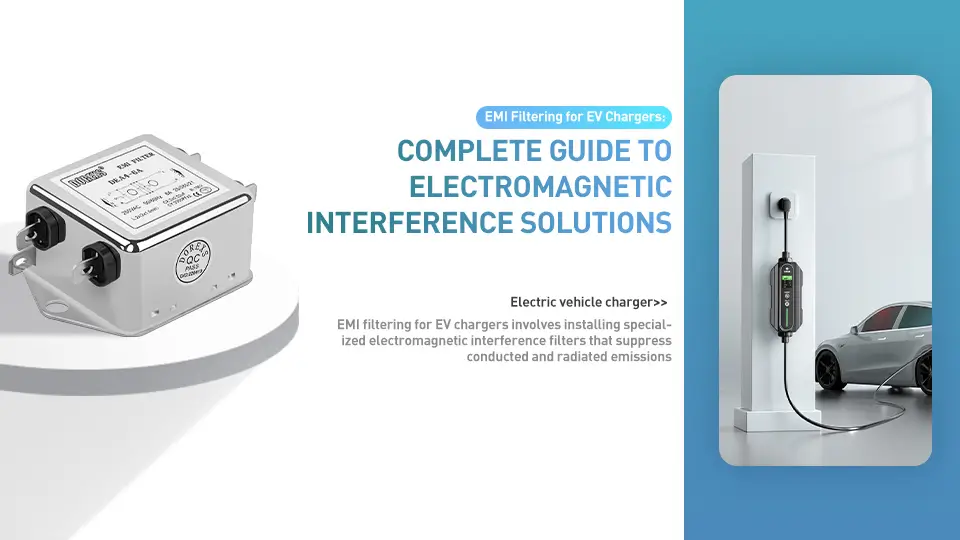
This guide covers DC and AC EMI filtering solutions, regulatory compliance requirements, and practical implementation strategies for charging station operators, OEMs, and facility managers.
EMI Filtering for EV Chargers: Complete Guide to Electromagnetic Interference Solutions

In today’s fast-growing smart manufacturing era, CNC machines are expected to deliver not only machining capability but consistent precision, long-term stability, and zero-downtime reliability.However, as machine power increases and electronic components operate at higher speeds, EMI (Electromagnetic Interference) has become one of the most serious hidden threats in CNC systems.
EMI Interference in CNC Equipment & DOREXS Industrial Filter Solutions
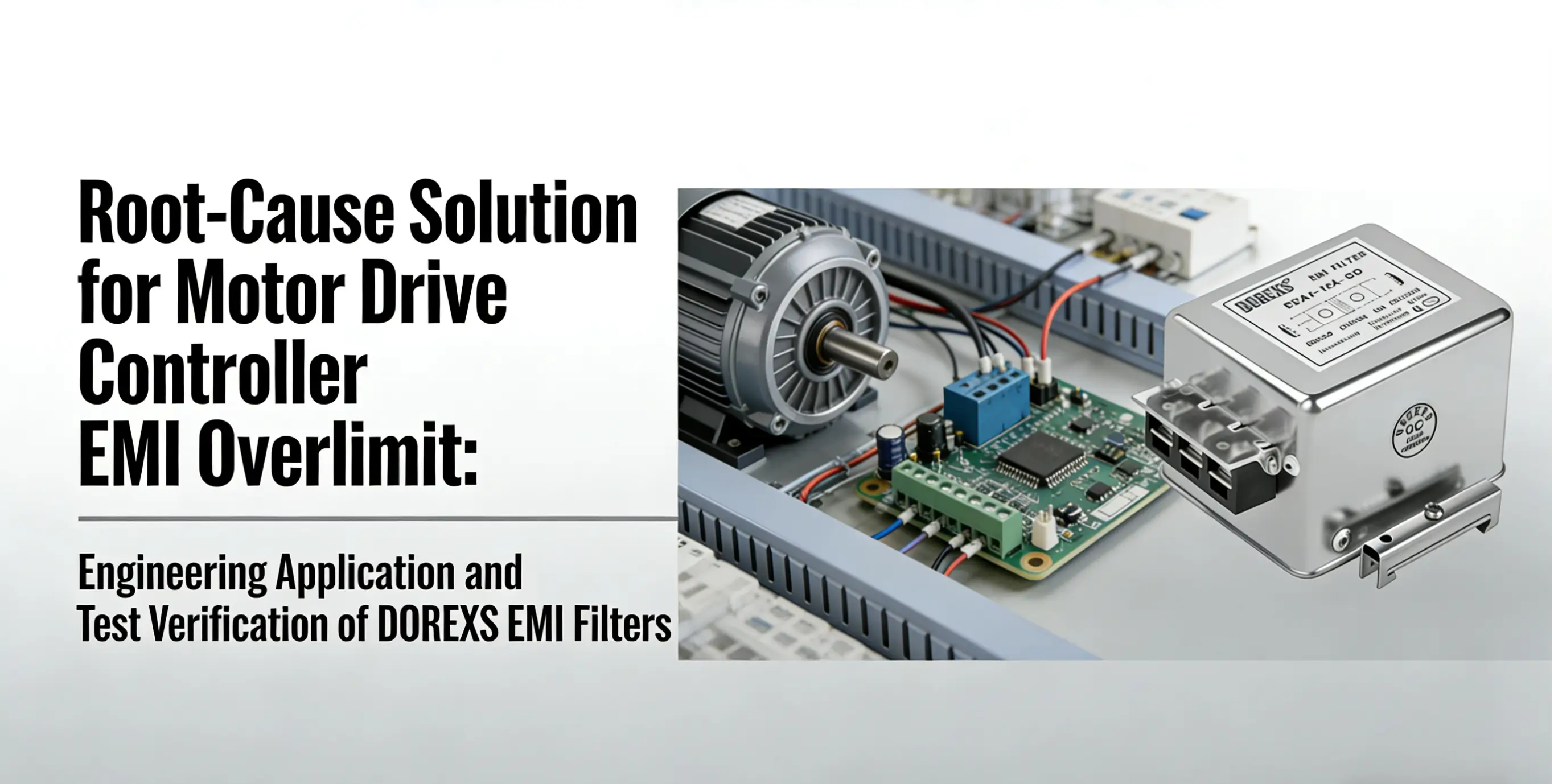
Based on an actual mitigation case, this article systematically explains the EMI generation mechanisms in motor drive controllers, the functional role of DOREXS EMI power filters, and an engineering-proven combination of filters + PCB design + grounding measures.
EMI Over-Limit Mitigation for Motor Drive Controllers: Engineering Application and Field Verification of DOREXS EMI Power Filters
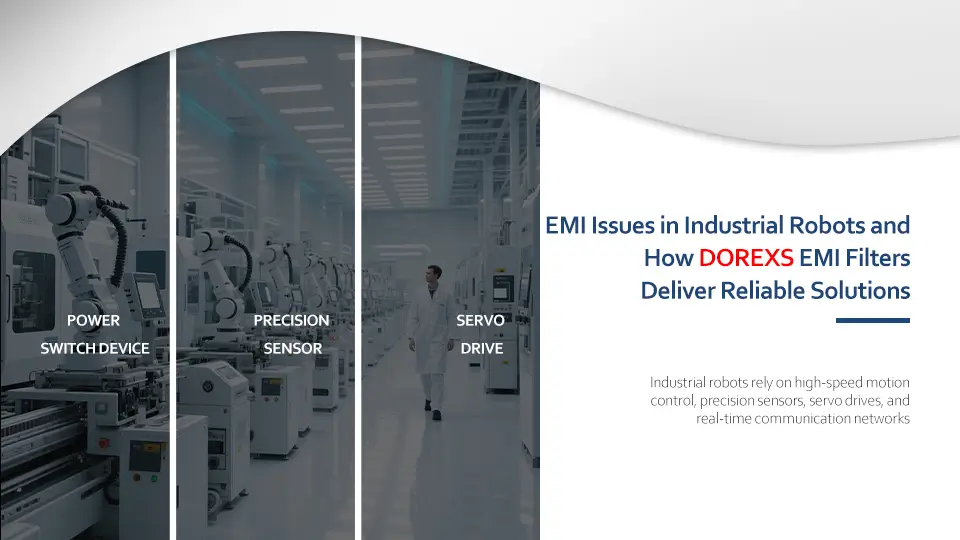
Industrial robots rely on high-speed motion control, precision sensors, servo drives, and real-time communication networks. These components make robotic systems extremely sensitive to electromagnetic interference (EMI). Ensuring electromagnetic compatibility is critical for reliable robot operation.
EMI Issues in Industrial Robots and How DOREXS EMI Filters Deliver Reliable Solutions