

Model No: EIT
EI core transformer 10VA-1.5KVA
10VA-1.5KVA
Support customization
Support customization
Quantity :
Subscribe to our Newsletter
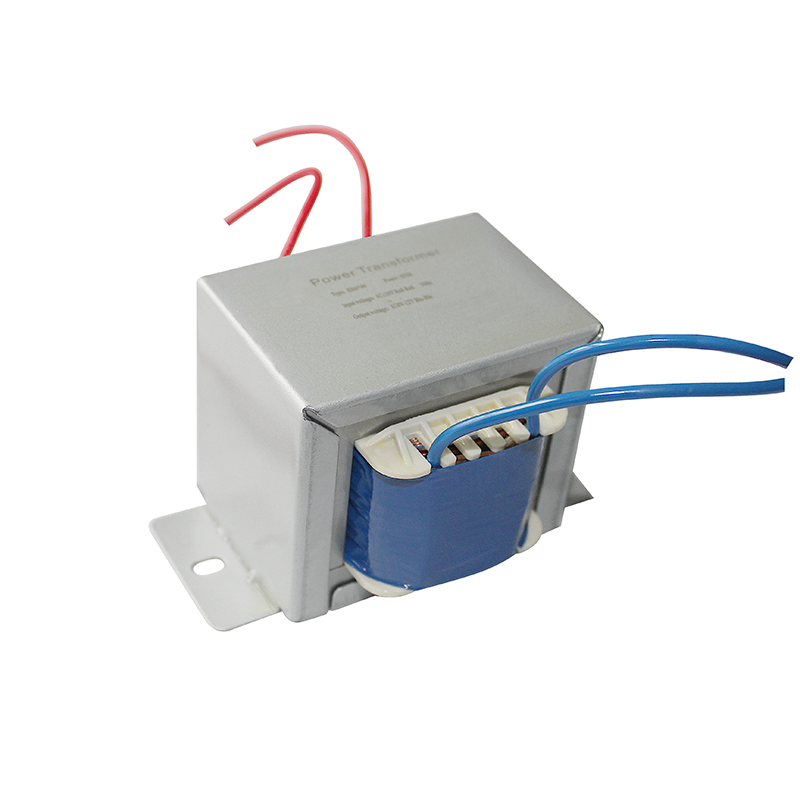 | EIT Series EI Core Transformer | |
Certification: CE、Rohs | Capacity: 10VA-1200VA | |
| Temperature Rise:<60K | Rated Voltage: <660V | |
| Sound Level:<60dB | Insulation Resistance:>100MΩ(DC1000V) |
EI core transformer is a traditional low frequency transformer. Because the iron core of EI transformer is composed of"E"type sheet and"I"type sheet, it is called EI transformer. It is composed of iron core and its frame bracket, support frame and iron base, and is widely used in electronic and industrial equipment.
Features
- Simple structure and easy maintenance.
- Cost-effective, economical and practical.
- Strong structure and strong impact resistance.
- Good heat dissipation performance
- Stable performance
Technical Parameters
| Model | Watt | Input | Output | Length*Width*Height(mm) | Installation Dimensions |
| EIT-1 | 1W | customization | customization | 58*26*27 | 46 |
| EIT-2 | 2W | 58*40*32 | 47 | ||
| EIT-3 | 3W | 66*35*35 | 54 | ||
| EIT-4 | 4W | 66*38*35 | 54 | ||
| EIT-5 | 5W | 66*44*35 | 54 | ||
| EIT-6 | 6W | 76*40*42 | 67 | ||
| EIT-8 | 8W | 76*43*42 | 65 | ||
| EIT-10 | 10W | 76*50*42 | 65 | ||
| EIT-15 | 15W | 86*52*50 | 76 | ||
| EIT-20 | 20W | 96*60*57 | 76 | ||
| EIT-25 | 25W | 96*68*57 | 82 | ||
| EIT-30 | 30W | 96*71*57 | 82 | ||
| EIT-35 | 35W | 96*75*57 | 82 | ||
| EIT-40 | 40W | 96*75*57 | 82 | ||
| EIT-50 | 50W | 96*80*57 | 82 | ||
| EIT-60 | 60W | 78*86*88 | 65*63 |
EI Core Transformer FAQ
1. What is an EI transformer?
The EI transformer is a traditional power transformer named after its core shape that resembles the letters"E"and"I". EI transformers are generally industrial frequency (low frequency) transformers (50HZ or 60HZ) and are widely used in electronic and electrical equipment and industrial equipment.
2. What are the advantages and disadvantages of EI transformers?
As a representative of traditional transformers, EI transformers have the characteristics of simple structure, durability, high cost performance, easy maintenance, and excellent heat dissipation performance. However, due to the core structure, the magnetic leakage is large, and the efficiency is lower than that of toroidal transformers. At the same time, at the same power, the EI transformer is larger in size and weight, and occupies more space.
3. What are the main application areas of EI transformers?
Power system: used for power distribution and power transmission.
Electronic equipment: used as a power transformer.
Industrial control: used in industrial control systems.
Electronic equipment: used as a power transformer.
Industrial control: used in industrial control systems.
4. How to install the EI transformer?
- Fixing method: usually fixed to the equipment base or mounting plate with bolts or screws.
- Pay attention to heat dissipation: ensure sufficient ventilation and heat dissipation space to avoid overheating.
5. How to choose a suitable EI transformer?
- Power requirements: Choose a suitable transformer according to the power requirements of the equipment.
- Voltage requirements: Make sure that the primary and secondary voltages meet the requirements of use.
- Environmental conditions: Consider factors such as temperature and humidity in the working environment.
- Safety standards: Make sure that the transformer meets relevant safety standards and certifications.
6. What is the difference between EI transformers and toroidal transformers?
- Efficiency: EI transformers have lower efficiency, while toroidal transformers have higher efficiency.
- Leakage flux: EI transformers have large leakage flux, while toroidal transformers have small leakage flux.
- Structure: EI transformers have a simple structure, while toroidal transformers have a compact structure.
- Cost: EI transformers have low cost, while toroidal transformers have relatively high cost.
- Applications: EI transformers are suitable for low-frequency and low-power applications, while toroidal transformers are suitable for high-frequency and high-power applications.
Comprehensive score