

Model No: LHY1
R Core Transformer 15-3800VA
≤1140V
Suitable for 50-400Hz operating frequency
Support customization
Suitable for 50-400Hz operating frequency
Support customization
Quantity :
Subscribe to our Newsletter
 | LHY1 R Core Transformer | |
Certification: CE、Rohs | Capacity:15-3800VA | |
| Rated Frequency: 50~400Hz | Input voltage: 1140V | |
| Sound Level: <60dB |
R core transformer is composed of silicon steel core, high temperature resistant frame, anti-oxidation metal parts, all-copper enameled wire and high-quality insulated wire. It is suitable for working frequency of 50-400Hz and is widely used in frequency conversion, photovoltaic, wind power generation, renewable energy, measuring instruments, medical equipment, etc.
R core transformers offer low noise, high efficiency, and superior performance. Their unique circular magnetic circuit design minimizes magnetic leakage and extends life. They are widely suitable for audio equipment and noise-sensitive electronic applications. Customization is also available.
Features
- Unique feature: Rectangular core with a round cross-section and continuous magnetic path for low leakage flux and noise reduction.
- High safety: Surface insulation and robust construction ensure user protection and reliability.
- Long service life: High-quality materials and construction provide durability and extended operational life.
- Good conductivity: Copper wire and components offer efficient electrical performance and reliability.
- Shield: Copper shield reduces noise and protects against electromagnetic interference.
- Moisture-proof and waterproof.
- Small magnetic leakage and low loss.
- High structural strength and good short-circuit resistance.
- Low noise.
- More efficient than EI type transformer.
- Widely used in scenarios requiring high efficiency and low noise.
Product Parameters
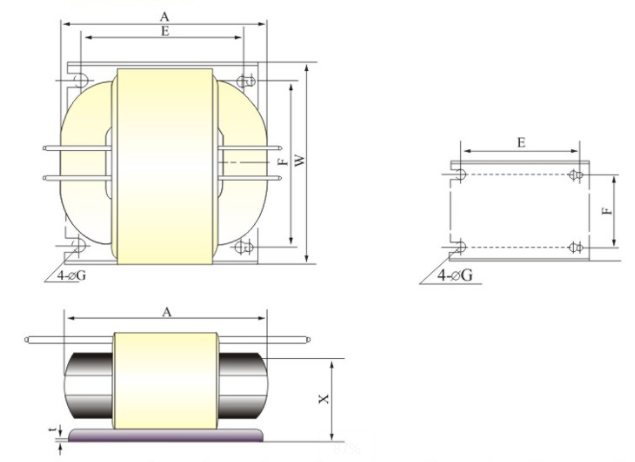
Model | A | W | X | E | F | G | t | VA | Kg |
LHY1-10 | 74 | 63 | 34 | 68 | 48 | 4.2 | 1 | 15 | 0.4 |
LHY1-20 | 80 | 70 | 39 | 50 | 55 | 4.2 | 1 | 20-28 | 0.5 |
LHY1-30 | 94 | 77 | 42 | 70 | 60 | 5.2 | 1 | 30-45 | 0.7 |
LHY1-40 | 96 | 80 | 44 | 70 | 60 | 5.2 | 1 | 35-55 | 0.9 |
LHY1-50 | 97 | 85 | 50 | 75 | 65 | 5.2 | 1.2 | 50-65 | 1 |
LHY1-80 | 122 | 89 | 52 | 90 | 70 | 5.2 | 1.2 | 70-100 | 1.4 |
LHY1-100 | 123 | 104 | 58 | 100 | 80 | 5.2 | 1.5 | 90-130 | 1.7 |
LHY1-160 | 136 | 115 | 63 | 100 | 85 | 5.2 | 1.5 | 150-200 | 2.0 |
LHY1-260 | 150 | 117 | 66 | 130 | 95 | 5.2 | 1.5 | 200-300 | 3.1 |
LHY1-320 | 156 | 128 | 70 | 135 | 95 | 5.2 | 1.5 | 280-380 | 3.8 |
LHY1-600 | 178 | 145 | 83 | 145 | 115 | 5.2 | 1.5 | 380-650 | 6.5 |
LHY1-800 | 190 | 157 | 92 | 150 | 125 | 6.2 | 1.5 | 650-900 | 9.2 |
LHY1-1000 | 212 | 172 | 99 | 178 | 140 | 8.2 | 2.0 | 650-1200 | 10.5 |
LHY1-1500 | 224 | 186 | 108 | 175 | 145 | 8.2 | 2.0 | 1300-1800 | 15.2 |
LHY1-2000 | 238 | 200 | 117 | 185 | 160 | 8.2 | 2.0 | 1800-2500 | 19.5 |
LHY1-3000 | 260 | 215 | 136 | 200 | 175 | 8.2 | 2.0 | 2500-3200 | 25 |
LHY1-3500 | 234 | 234 | 136 | 200 | 1800 | 8.2 | 2.0 | 3200-3800 | 26 |
The dimensions and weights listed above are for reference only and may vary depending on the VA value, lead type and number of circuits.
The R core transformers provided are available in both standard and special specifications.
The R core transformers provided are available in both standard and special specifications.
R Core Transformer TIPS
What is an R core transformer?
The R core transformer is a new kind of dry-type transformer whose core is made of continuous silicon steel strip and has a circular cross-section, which is a unique feature that sets it apart from other transformer types. The R-Core design features an absolutely continuous magnetic path with no gap or gaps in the core, which absolutely eliminates flux leakage and enhances magnetic performance. The core consists of two parallel legs, and the windings are arranged symmetrically on these two parallel legs to ensure balanced magnetic flux and further reduce noise and leakage.
Compared with the traditional EI core transformer, this kind of transformer offers lower noise, lower leakage, lower no-load current, lower loss, and higher efficiency. When compared to a toroidal transformer, the R core transformer provides lower noise, reduced flux leakage, higher efficiency, and greater explosive power. Its low noise and minimal electromagnetic interference make it especially suitable for protecting and optimizing the performance of critical electronic components.
Compared with the traditional EI core transformer, this kind of transformer offers lower noise, lower leakage, lower no-load current, lower loss, and higher efficiency. When compared to a toroidal transformer, the R core transformer provides lower noise, reduced flux leakage, higher efficiency, and greater explosive power. Its low noise and minimal electromagnetic interference make it especially suitable for protecting and optimizing the performance of critical electronic components.
Where can the R core transformer be used?
R core transformers are widely used in applications that require high efficiency and low noise, such as:
- Industrial control
- Home appliances
- Signal equipment
- Office equipment
- Communication equipment
- Testing instruments
- Medical instruments
- Audio equipment (including use as an amplifier power supply, audio receivers, and systems requiring precise wattage and voltage regulation)
- Power supplies and adapters
- Telecommunications
- Consumer electronics
They can be customized to meet different requirements for various applications.
R core transformers are also ideal for protecting critical electronic components in noise-sensitive and high-performance equipment.
R core transformers are also ideal for protecting critical electronic components in noise-sensitive and high-performance equipment.
How does the R core transformer compare to the E-I type transformer?
R core transformers have higher efficiency and lower noise than EI type transformers, making them more suitable for audio applications. R core transformers provide complete isolation between the primary and secondary windings by placing them on separate bobbins, which enhances safety and reduces electromagnetic interference. High-quality components, such as OFC copper wire and precision two-part bobbins, are used in their construction to ensure optimal performance and reliability. These transformers are designed to meet various safety and performance requirements, making them ideal for sensitive electronic applications. At the same time, R-type transformers can achieve the same power in a smaller size, but due to the high precision of the R core transformer construction, the cost may be higher.
Can R core transformers be used for high-frequency applications?
Yes, R core transformers can be designed for high-frequency applications. However, the core material and winding technology need to be optimized to effectively handle higher frequencies. Dividing windings into multiple layers can improve dielectric strength and overall performance in high-frequency applications. Additionally, good conductivity of the materials used is essential for efficient high-frequency operation.
Are there any limitations to R core transformers?
While r core transformers offer significant advantages in terms of efficiency, low noise, and high-quality construction, there are a few limitations to consider. One of the main drawbacks is their higher cost compared to more conventional core transformers, such as EI transformers. This is largely due to the intricate design and the use of premium materials required for manufacturing r core transformers, which can increase production expenses. Additionally, the unique construction of the r core, with its continuous magnetic path and balanced winding, can make the design process more complex and less flexible for certain high-power applications. In some cases, the thermal resistance of the r core design may limit its use in extremely high-power environments. Despite these considerations, r core transformers remain an excellent choice for applications where low noise, high efficiency, and superior quality are critical. When selecting a transformer, it’s important to match the specific requirements of your project with the advantages and limitations of each core type to ensure optimal performance.
Low Noise Operation
R core transformers are especially valued for their exceptionally low noise operation, making them the preferred choice for noise sensitive equipment such as audio amplifiers, medical devices, and precision measuring instruments. The secret to their quiet performance lies in the unique design of the r core, which features a round cross section and special round bobbins. This construction minimizes leakage flux and reduces electromagnetic interference, resulting in a cleaner signal and less audible hum. The use of high-quality copper wire and meticulous winding techniques further enhance the transformer’s ability to suppress noise. By ensuring that the core and windings are precisely balanced and insulated, r core transformers deliver stable, low-noise power supply for even the most demanding applications. For designers and engineers seeking to improve sound quality or reduce interference in sensitive equipment, choosing an r core transformer is a proven way to achieve superior results.
Are there any limitations to R core transformers?
Cost: They may be more expensive to produce than conventional transformers.
Availability: They may not be as widely available as E-I type transformers in certain regions.
Design Complexity: The design and manufacturing process may be more complex.
Availability: They may not be as widely available as E-I type transformers in certain regions.
Design Complexity: The design and manufacturing process may be more complex.
Comprehensive score