
Complete Guide to EMI Filters in Industrial Automation (2025): Applications, Selection, Installation Best Practices, and ROI Impact
author: DOREXS
2025-11-03
Key Takeaways
-
EMI filters are critical for preventing electromagnetic interference in industrial automation systems, protecting sensitive PLCs, variable frequency drives, and robotic controllers from noise-induced malfunctions
-
Three-phase EMI filters are essential for high-power automation equipment like conveyor systems and CNC machines, while single-phase filters protect smaller control devices and sensors
-
Proper EMI filter selection requires matching voltage/current ratings, insertion loss characteristics, and environmental specifications to specific automation applications
-
Industrial EMI filters help maintain compliance with IEC 61000-6-2 and CISPR 11 standards while reducing downtime costs that can exceed $50,000 per hour in automated production lines
-
Strategic placement of EMI filters near noise sources like servo motors and switching power supplies maximizes protection effectiveness and extends equipment lifespan by 15-25%

When a manufacturing line unexpectedly shuts down due to electromagnetic interference, the financial impact can be devastating. Modern industrial automation systems face an invisible enemy that threatens both productivity and profitability: electromagnetic noise. As factories become increasingly digitized and automation-dependent, the application of emi filters in industrial automation systems has evolved from a nice-to-have feature to an absolute necessity.
The complexity of today’s automated manufacturing environments creates a perfect storm for electromagnetic interference. Variable frequency drives switching at high frequencies, servo motors with rapid commutation cycles, and power supplies generating unwanted signals all contribute to an electromagnetic environment that can cripple sensitive equipment. Without proper emi filtering, even the most sophisticated automation systems become vulnerable to costly failures and unpredictable behavior.

Understanding EMI in Industrial Automation Environments
Electromagnetic interference in industrial settings originates from multiple sources that have become integral to modern manufacturing processes. Variable frequency drives, which control motor speeds in conveyor systems and pumps, generate high frequency harmonics during their switching operations. These switching events occur thousands of times per second, creating electrical noise that propagates through power lines and radiates into the surrounding environment.
Servo motors and their associated amplifiers represent another significant source of electromagnetic noise in automation systems. The precise control required for robotic positioning and CNC machining demands rapid switching of power electronics, generating both conducted noise through power cables and radiated noise that can interfere with nearby sensitive equipment. When multiple servo systems operate simultaneously in an automated assembly line, the cumulative effect creates a challenging electromagnetic environment.
Switching power supplies, ubiquitous in modern industrial automation, contribute additional layers of electromagnetic noise. These power supplies, while highly efficient, generate high frequency switching signals that can couple into control circuits and communication networks. The problem is compounded when multiple power supplies operate at different frequencies, creating beat frequencies and intermodulation products that can affect system functionality.
The impact of electromagnetic interference on critical automation components extends far beyond simple communication errors. Programmable logic controllers (PLCs), the brains of most automation systems, rely on precise timing and accurate signal processing. EMI can cause false triggering of inputs, corruption of memory contents, and even complete system lockups that require manual intervention to restore operation.
Human-machine interfaces (HMIs) and operator panels suffer from EMI-induced display glitches, touch screen malfunctions, and communication timeouts that can leave operators unable to monitor or control production processes. Safety systems, including emergency stop circuits and light curtains, become unreliable when exposed to electromagnetic noise, potentially creating hazardous conditions for personnel and equipment.
Real-world examples from industrial environments demonstrate the severity of EMI-related problems. In an automotive assembly facility, unfiltered variable frequency drives caused intermittent communication failures in the paint booth robotic systems, resulting in uneven paint application and rejection rates exceeding 15%. The problem remained elusive for months because the interference was sporadic and difficult to correlate with specific production activities.
A pharmaceutical manufacturing plant experienced similar challenges when EMI from new servo-controlled packaging equipment interfered with temperature monitoring systems in adjacent clean rooms. The electromagnetic noise caused false alarms and measurement errors that threatened product quality and regulatory compliance. Only after implementing comprehensive emi filtering did the facility achieve stable operation and maintain its FDA certification.
The financial implications of EMI-related downtime vary significantly across industry sectors, but the costs are universally substantial. Automotive manufacturing facilities typically experience downtime costs ranging from $25,000 to $50,000 per hour, while semiconductor fabrication plants can face losses exceeding $100,000 per hour when production lines stop unexpectedly. These figures include not only lost production but also the costs of restarting complex processes, quality control testing, and potential product waste.
Critical Applications of EMI Filters in Industrial Automation
The protection of programmable logic controllers and distributed control systems represents one of the most critical applications for emi filters in automation environments. PLCs serve as the central nervous system for manufacturing processes, coordinating inputs from sensors, executing control algorithms, and commanding actuators throughout the production line. These systems operate with tight timing requirements and low voltage logic signals that are particularly susceptible to electromagnetic noise.
High frequency noise generated by adjacent equipment can couple into PLC input circuits, causing false triggering of limit switches, proximity sensors, and other digital inputs. This interference leads to erratic machine behavior, safety system malfunctions, and production quality issues that can persist until the noise source is properly filtered. EMI filters installed at the PLC power input and critical I/O circuits provide essential protection against these disturbances.
Variable frequency drives controlling conveyor belts, pumps, and HVAC systems throughout manufacturing facilities require specialized emi filtering approaches. These drives operate by rapidly switching high currents at frequencies ranging from several kilohertz to tens of kilohertz, generating both conducted emissions that propagate through power lines and radiated emissions that can interfere with nearby control equipment.
The switching characteristics of modern VFDs using insulated gate bipolar transistors create particularly challenging EMI profiles. The fast rise times of these switching devices generate noise across a broad frequency range from 150 kHz to beyond 30 MHz, requiring filters with carefully designed insertion loss characteristics to achieve adequate attenuation. Three-phase emi filters specifically designed for VFD applications provide the necessary common mode and differential mode filtering to suppress both types of interference.

Robotic controllers and servo amplifiers in automotive welding stations and electronics assembly lines demand exceptionally clean power and signal environments to maintain positioning accuracy and repeatability. The precise motion control required for these applications depends on accurate feedback from encoders and resolvers, which can be disrupted by electromagnetic noise from nearby equipment.
Servo amplifiers generate their own EMI during operation, with rapid current changes in motor windings creating both conducted and radiated noise. This noise can interfere with other servo systems in multi-axis configurations, leading to cross-coupling effects and degraded performance. Proper emi filtering at both the amplifier power input and motor output helps maintain signal integrity throughout the servo control loop.
CNC machine controllers and spindle drives in precision machining operations face unique EMI challenges due to the combination of high-power motor drives and sensitive measurement systems. The spindle drives must maintain precise speed control while generating significant electromagnetic noise, particularly during acceleration and deceleration cycles. This noise can interfere with position feedback systems, tool monitoring equipment, and surface finish measurement devices.
The application of customized emi filters for CNC systems requires careful consideration of the specific frequency content of the interference and the sensitivity characteristics of the affected equipment. Filters must provide adequate attenuation across the entire frequency range while maintaining the power quality necessary for precise motor control.
Safety systems including emergency stop circuits and light curtains in automated packaging equipment represent perhaps the most critical application for EMI filtering in industrial automation. These systems must operate reliably under all conditions, as their failure can result in personnel injury or equipment damage. Electromagnetic interference can cause safety devices to trigger false alarms or, more dangerously, fail to respond when needed.
Light curtain safety systems are particularly vulnerable to EMI because they rely on precise optical timing and low-level signal processing. High frequency noise can interfere with the optical receivers, causing nuisance trips that halt production or, in worst-case scenarios, masking legitimate safety interruptions. EMI filters designed for safety applications must meet stringent reliability requirements and maintain their protective function throughout their operational lifespan.
Power Distribution and Motor Control Applications
Three-phase EMI filters for main power distribution panels feeding automated production lines must handle the combined electromagnetic noise from all connected equipment while providing isolation between different production areas. These filters typically operate at current levels ranging from 50 to 1000 amperes and must maintain their filtering effectiveness across a wide range of load conditions.
The design of distribution panel emi filters requires careful attention to common mode noise suppression, as this type of interference readily propagates through grounding systems and cable shields. Multi-stage filter designs incorporating both X-capacitors (line-to-line) and Y-capacitors (line-to-ground) provide balanced attenuation of both differential mode and common mode noise.
Single-phase filters protecting 120V and 240V control circuits in automated material handling systems face different challenges than their three-phase counterparts. These circuits typically carry lower currents but support sensitive electronic components such as sensors, controllers, and communication devices. The emi filter must provide high insertion loss at frequencies where these devices are most susceptible while maintaining low leakage current to prevent nuisance tripping of ground fault protection devices.
Automated guided vehicles and electric forklifts operating in manufacturing facilities require specialized DC emi filters for their motor drive systems. These vehicles generate electromagnetic noise during acceleration, braking, and direction changes, which can interfere with navigation systems, wireless communication equipment, and nearby automation devices. DC filters must handle the unique characteristics of battery-powered systems, including voltage variations and regenerative braking currents.
Chemical processing plants and refineries present additional challenges for EMI filtering due to hazardous location requirements and the need for explosion-proof equipment. Motor control centers in these environments must incorporate emi filters that meet both electromagnetic compatibility requirements and safety certifications for use in potentially explosive atmospheres.
Communication and Network Protection
Industrial Ethernet networks connecting SCADA systems and field devices throughout modern manufacturing facilities are increasingly vulnerable to electromagnetic interference as data rates increase and signal levels decrease. High-speed Ethernet communications operating at 100 Mbps and 1 Gbps use differential signaling that can be disrupted by common mode noise coupling into the cable shields and connector interfaces.
EMI filters designed for industrial network applications must provide protection without degrading signal quality or introducing unacceptable delays. These filters typically incorporate common mode chokes and carefully selected capacitors that attenuate noise while preserving the signal integrity necessary for reliable data transmission. The filters must also maintain their effectiveness across the entire frequency range of the network protocols while providing adequate surge protection for outdoor and harsh environment installations.
Wireless communication modules in IoT sensors and remote monitoring equipment face unique challenges from both intentional and unintentional electromagnetic interference. These devices must operate in the increasingly crowded 2.4 GHz and 5 GHz frequency bands while maintaining sensitivity to weak signals from distant access points or cellular towers. EMI filters for wireless applications must provide attenuation of industrial noise sources while preserving the antenna performance necessary for reliable communication.
Fieldbus networks including Profibus, DeviceNet, and Modbus communications require specialized filtering approaches due to their unique signaling characteristics and network topologies. These industrial communication protocols often use lower data rates than Ethernet but operate over longer distances and in more challenging electromagnetic environments. The emi filters must provide protection against both conducted and radiated interference while maintaining the signal quality necessary for multi-drop network operation.
Network switches and fiber optic converters in distributed control architectures require careful EMI filtering of their power supplies and auxiliary circuits. While fiber optic communication itself is immune to electromagnetic interference, the electronic equipment at each end of the fiber link remains vulnerable to noise-induced malfunctions. Power supply filtering and proper grounding of metallic enclosures help ensure reliable operation of the network infrastructure.
Types of EMI Filters for Industrial Automation
Single-phase EMI filters designed for the 1-50A current range serve as the foundation for protecting control panels, instrumentation, and small automation devices throughout industrial facilities. These filters typically incorporate a combination of common mode chokes, differential mode inductors, and capacitive elements arranged in pi filter or T-filter configurations to provide broad-spectrum noise attenuation.
The construction of single-phase industrial emi filters emphasizes reliability and environmental durability over the size and cost optimizations found in consumer applications. Industrial-grade capacitors with enhanced ripple current capability and temperature stability ensure consistent performance across the -40°C to +85°C temperature range common in manufacturing environments. The magnetic components utilize core materials and winding techniques optimized for low loss and stable performance under varying load conditions.
Three-phase EMI filters operating in the 10-1000A range represent the workhorses of industrial EMI suppression, protecting high-power drives, main distribution panels, and large machinery from electromagnetic interference. These filters must handle the balanced and unbalanced load conditions typical of industrial three-phase systems while providing effective attenuation of both symmetrical (differential mode) and asymmetrical (common mode) noise components.
The design challenges for high-current three-phase filters include thermal management of the magnetic components, mechanical stability under high fault current conditions, and maintaining consistent insertion loss performance across all three phases. Advanced filter designs incorporate temperature monitoring, vibration-resistant mounting systems, and phase-balanced winding techniques to ensure reliable operation throughout their operational lifetime.

DC EMI filters for battery-powered automation equipment, UPS systems, and solar inverters in smart factories must address the unique characteristics of DC power systems. Unlike AC filters, DC emi filters must handle unidirectional current flow, potential polarity reversals, and the absence of natural zero crossings that help
extinguish arc faults in AC systems.
Solar inverters in manufacturing facilities with renewable energy systems present particular challenges for DC EMI filtering due to their high-frequency switching operation and the long DC cable runs from solar panels to inverter locations. These cables can act as antennas, both receiving and transmitting electromagnetic interference. Specialized DC filters with enhanced common mode suppression help minimize the coupling between the DC solar circuits and sensitive automation equipment.
IEC inlet filters integrated directly into equipment enclosures provide space-saving solutions for applications where external filter mounting is impractical. These compact units combine the EMI filter function with the power entry connector, reducing installation complexity and improving electromagnetic compatibility through shorter lead lengths and better shielding integration.
The advantage of integrated inlet filters extends beyond space savings to include improved filter effectiveness through reduced parasitic inductances and capacitances associated with external wiring. However, the integration also limits serviceability and may require equipment downtime for filter replacement, making reliability and longevity critical design considerations.
Specialized Filter Configurations
Medical-grade low leakage current filters for pharmaceutical manufacturing automation systems must meet stringent safety requirements while providing effective EMI suppression. These applications require leakage currents below 300 microamperes to ensure patient safety and prevent nuisance tripping of sensitive ground fault protection devices common in healthcare-related manufacturing environments.
The design of medical-grade emi filters requires careful selection of Y-capacitor values and the use of safety-certified components that maintain their protective function even under fault conditions. Multiple stages of filtering may be necessary to achieve the required insertion loss while staying within leakage current limits, resulting in larger and more expensive filter designs compared to standard industrial applications.
High-temperature rated filters for steel mills, glass manufacturing, and foundry automation must operate reliably in ambient temperatures exceeding 85°C while maintaining their filtering effectiveness. These extreme environments challenge both the magnetic and capacitive components of the filter, requiring specialized materials and construction techniques.
Class H insulation systems, high-temperature magnetic core materials, and ceramic or film capacitors with enhanced temperature ratings enable reliable operation in these demanding applications. The filter enclosures must also provide adequate heat dissipation while maintaining electromagnetic shielding effectiveness, often requiring custom mechanical designs with enhanced cooling features.
Compact PCB-mount filters for space-constrained control panels and distributed I/O modules provide EMI suppression in applications where traditional enclosure-mounted filters cannot fit. These miniaturized filters sacrifice some performance compared to their larger counterparts but enable EMI suppression in applications where it would otherwise be impossible.
The effectiveness of PCB-mount emi filters depends heavily on the grounding and layout of the surrounding circuitry. Proper ground plane design, component placement, and trace routing are essential to achieving the theoretical performance of these small filters. The integration of multiple small filters throughout a control system can provide better overall EMI suppression than a single large filter at the main power input.
Feedthrough filters for shielded enclosures housing sensitive measurement and calibration equipment provide EMI suppression while maintaining the electromagnetic shielding integrity of the enclosure. These filters mount directly in the enclosure wall, creating a filtered power entry point that prevents electromagnetic noise from entering through the power connections.
The design of feedthrough filters requires careful attention to the mechanical interface with the enclosure to ensure both electrical and mechanical integrity. The filter must provide effective EMI suppression while maintaining the shielding effectiveness of the enclosure across the entire frequency range of interest.
Selection Criteria for Industrial EMI Filters
Voltage and current rating considerations for 208V, 480V, and 600V industrial power systems form the foundation of proper emi filter selection. The filter must handle not only the nominal system voltage but also the voltage variations, transients, and fault conditions that occur in real-world industrial environments. Continuous current ratings must account for the harmonic content of the load, ambient temperature conditions, and any derating factors specified by the manufacturer.
Industrial power systems often experience voltage swells, sags, and transients that can stress filter components beyond their normal operating limits. High-quality emi filters incorporate surge protection elements and robust construction techniques to survive these conditions without degrading their filtering performance. The voltage rating should include adequate margin above the maximum expected operating voltage to ensure reliable operation throughout the filter’s lifespan.
Insertion loss requirements based on frequency analysis of EMI sources from 150kHz to 30MHz determine the filter’s ability to attenuate unwanted electromagnetic noise. Different automation systems generate noise at different frequencies, and the affected equipment may have varying sensitivity profiles across the frequency spectrum. A thorough electromagnetic compatibility analysis should identify both the noise sources and the victim equipment to establish appropriate insertion loss requirements.
Standard EMI measurement procedures defined in CISPR 16 provide the framework for specifying and verifying filter performance. However, the standardized test conditions may not accurately represent the actual operating environment, requiring additional testing or simulation to ensure adequate performance. Custom filter designs may be necessary for applications with unique frequency profiles or exceptional performance requirements.
Leakage current specifications for applications with ground fault circuit interrupters and residual current devices must be carefully considered to prevent nuisance tripping of protective equipment. Industrial emi filters typically generate leakage currents through their Y-capacitors (line-to-ground), which can accumulate when multiple filtered devices connect to the same power system.
The total leakage current from all emi filters in a system must remain below the threshold of any ground fault protection devices. This requirement may limit the number of filtered devices that can connect to a single circuit or require the use of specialized low-leakage filters in sensitive applications. Some applications may require active leakage current monitoring to ensure continued compliance with safety requirements.
Environmental ratings including IP65/IP67 protection for washdown areas and outdoor installations ensure that the emi filter continues to operate reliably in challenging industrial environments. Food processing, pharmaceutical, and chemical manufacturing facilities often require equipment that can withstand regular cleaning with high-pressure water and chemical sanitizers.
The environmental protection rating affects not only the enclosure design but also the internal construction of the filter. Sealed magnetic components, conformal coated circuit boards, and corrosion-resistant hardware ensure reliable operation in humid, corrosive, or contaminated atmospheres. Some applications may require additional protection against specific chemical exposures or explosive atmospheres.

Temperature derating factors for ambient conditions ranging from -40°C to +85°C in industrial environments significantly impact filter performance and longevity. Both magnetic and capacitive components exhibit temperature-dependent characteristics that affect the filter’s insertion loss and power handling capability. Manufacturers typically provide derating curves that specify the maximum allowable current as a function of ambient temperature.
Cold temperature operation presents unique challenges for emi filters, particularly for capacitive components that may exhibit reduced capacitance or increased equivalent series resistance at low temperatures. Outdoor installations and cold storage facilities require filters designed and tested for reliable operation across the entire expected temperature range.
Compliance and Certification Requirements
UL 1283 recognition for use in industrial control panels and machinery provides assurance that the emi filter meets the safety requirements for its intended application. This recognition covers not only the filter’s electrical characteristics but also its mechanical construction, environmental ratings, and marking requirements. Control panel builders and machine manufacturers often require UL-recognized components to maintain their own UL listing.
The UL recognition process includes evaluation of the filter’s construction, testing of safety-critical parameters such as dielectric strength and leakage current, and ongoing surveillance of the manufacturing process. This certification provides confidence that the filter will perform safely throughout its operational lifetime when properly installed and maintained.
CE marking compliance with EMC Directive 2014/30/EU for European market access requires demonstration that the filtered equipment meets both emission and immunity requirements. The emi filter plays a crucial role in achieving compliance, but the overall system performance depends on proper installation, grounding, and integration with other system components.
European EMC standards often specify more stringent requirements than their North American counterparts, particularly for conducted emissions and harmonic content. Emi filters intended for European applications may require enhanced performance characteristics or specialized designs to meet these requirements while maintaining cost-effectiveness.
CSA certification for Canadian industrial installations and mining operations provides recognition that the filter meets Canadian electrical safety requirements. Mining applications present unique challenges due to the combination of harsh environmental conditions, safety-critical applications, and remote installation locations that limit maintenance opportunities.
RoHS compliance for lead-free manufacturing and environmental sustainability has become increasingly important as industrial customers implement comprehensive environmental management programs. Emi filters must use lead-free soldering processes and avoid restricted substances while maintaining their performance and reliability characteristics.
The transition to lead-free construction has required significant changes in manufacturing processes and component selection. Some high-reliability applications may still require exemptions for lead-containing components, but the trend toward full RoHS compliance continues to drive innovation in emi filter design and construction.
Installation and Implementation Best Practices
Optimal mounting locations within 12 inches of EMI sources maximize the effectiveness of emi filtering by minimizing the length of unfiltered conductors that can act as antennas for electromagnetic interference. The physical placement of the filter relative to the noise source and the protected equipment significantly impacts the overall system performance, sometimes more than the filter’s specifications alone.
When installing emi filters for variable frequency drives, positioning the filter as close as possible to the VFD input terminals reduces the length of cable that carries unfiltered high-frequency currents. This placement minimizes both conducted emissions that propagate through the power system and radiated emissions that can interfere with nearby sensitive equipment. The filter mounting location should also consider accessibility for maintenance and replacement while maintaining proper clearances for heat dissipation.
Proper grounding techniques using low-impedance connections to building ground systems are essential for achieving the theoretical performance of any emi filter. The filter’s ground connection must provide a low-impedance path for high-frequency currents across the entire frequency range where filtering is required. Poor grounding can completely negate the filter’s effectiveness and may even worsen the EMI situation by creating new paths for noise propagation.
Industrial grounding systems often suffer from multiple ground references, ground loops, and high-impedance connections that degrade emi filter performance. The ground connection for the filter should be as short and direct as possible, using wide conductors or straps to minimize inductance at high frequencies. Periodic verification of ground connection integrity helps ensure continued filter effectiveness throughout the installation’s operational lifetime.
Cable routing strategies to minimize noise coupling between filtered and unfiltered circuits require careful planning during the installation phase. Power cables carrying high-frequency noise should be separated from sensitive signal cables by adequate distances or physical barriers to prevent capacitive and inductive coupling. The routing should also minimize the loop areas formed by power and return conductors to reduce both susceptibility to external fields and emissions from the installation.
Shielded cables provide additional protection against electromagnetic coupling, but the shield effectiveness depends on proper termination at both ends of the cable run. The shield should connect to the equipment ground at the emi filter location and to the building ground system at the far end, creating a continuous low-impedance path for induced currents. Avoid breaking the shield continuity at intermediate connection points, as this can create slot antennas that actually worsen the EMI situation.
Integration with existing control panel layouts and maintaining adequate clearances for heat dissipation require coordination between electrical design, mechanical layout, and thermal management considerations. Emi filters generate heat during operation, particularly when handling high currents or operating in high ambient temperatures. Adequate ventilation and clearance from heat-sensitive components ensure reliable operation and prevent premature failure.
The mounting orientation of the emi filter can affect both its thermal performance and its accessibility for maintenance. Vertical mounting with the terminals at the bottom provides optimal heat dissipation but may complicate cable routing and connections. Horizontal mounting may be necessary in space-constrained installations but requires additional consideration of thermal management and condensation prevention.
Testing procedures using spectrum analyzers and EMI receivers to verify filter performance provide quantitative confirmation that the installation meets its electromagnetic compatibility requirements. Pre-installation baseline measurements establish the noise levels present before filtering, while post-installation measurements verify the improvement achieved by the emi filter.
Conducted emission testing typically requires line impedance stabilization networks (LISN) to provide reproducible measurement conditions. Radiated emission testing may require specialized test facilities or field measurements using calibrated antennas and receivers. The testing should cover the entire frequency range of interest and include both normal operating conditions and worst-case scenarios such as motor starting or emergency stop activation.
Common Installation Challenges
Retrofit installations in existing automation systems with space constraints often require creative solutions to incorporate emi filtering without major system modifications. Existing control panels may lack the space for standard filter sizes, requiring the use of compact or distributed filtering approaches. IEC inlet filters, PCB-mount filters, or multiple smaller filters may provide viable alternatives when space is limited.
The retrofit process should include a comprehensive electromagnetic compatibility assessment to identify all potential noise sources and victim circuits. Adding emi filters to address one problem may inadvertently create new issues if the overall system electromagnetic environment is not properly understood. Phased implementation with testing after each phase helps identify and resolve any unexpected interactions.
Thermal management in high-ambient temperature environments like steel mills and glass manufacturing requires specialized filter designs and installation techniques. Standard industrial emi filters may not operate reliably in ambient temperatures exceeding 50°C, requiring the use of high-temperature rated components and enhanced cooling systems.
Forced air cooling, heat sinks, or liquid cooling systems may be necessary to maintain acceptable filter operating temperatures in extreme environments. The cooling system design must account for the additional heat generated by the emi filter while ensuring that the cooling equipment itself does not introduce new sources of electromagnetic interference.
Coordination with existing protective devices including circuit breakers and fuses ensures that the emi filter does not interfere with the proper operation of overcurrent protection systems. The filter’s inrush current characteristics and steady-state impedance must be compatible with the coordination curves of upstream protective devices.
Some emi filters incorporate inrush current limiting features to reduce the peak current drawn during initial energization. This feature helps prevent nuisance tripping of protective devices and reduces the stress on both the filter and the power system. However, the current limiting may affect the filter’s response to transient conditions and should be considered in the overall system protection coordination.
Maintenance access considerations for filters installed in hard-to-reach locations balance the desire for optimal EMI performance with the practical requirements for periodic inspection and replacement. Filters installed in optimal electrical locations may be difficult to access for maintenance, while easily accessible locations may compromise the filtering effectiveness.
The maintenance strategy should include periodic visual inspection of connections and enclosures, thermal monitoring to detect degradation of magnetic components, and electrical testing to verify continued performance. Some installations may benefit from permanent monitoring systems that provide continuous assessment of filter condition and performance.
Benefits and Return on Investment
Reduced unplanned downtime with studies showing 15-30% improvement in system availability represents the most significant benefit of implementing comprehensive emi filtering in industrial automation systems. Manufacturing facilities that experience frequent EMI-related shutdowns often find that the cost of appropriate filtering pays for itself within months through improved productivity and reduced emergency maintenance costs.
The relationship between EMI suppression and system availability is not always immediately obvious, as electromagnetic interference can manifest as intermittent faults that are difficult to diagnose and troubleshoot. These elusive problems consume maintenance resources and cause repeated production interruptions that are often more costly than complete system failures because they prevent effective planning and preparation.
Extended equipment lifespan through protection from EMI-induced stress and component degradation provides long-term financial benefits that may exceed the immediate productivity gains. Electromagnetic interference accelerates the aging of electronic components through repeated stress cycles, thermal cycling, and degradation of insulation materials. Power electronics devices such as variable frequency drives and servo amplifiers are particularly susceptible to EMI-induced failures.
Research studies have documented equipment life extensions of 15-25% in properly filtered industrial automation systems compared to unfiltered installations. This improvement results from reduced component stress, fewer thermal cycles from EMI-induced resets, and protection from voltage spikes and transients that can cause immediate component failure. The cumulative effect over the 10-15 year typical lifespan of industrial automation equipment represents substantial cost savings.
Lower maintenance costs due to fewer component failures and reduced troubleshooting time provide immediate operational benefits that improve the overall efficiency of maintenance operations. EMI-related problems often present as intermittent faults that are difficult to reproduce and diagnose, leading to lengthy troubleshooting sessions and multiple service calls before resolution.
Maintenance personnel in filtered facilities report spending significantly less time on electronics-related troubleshooting and more time on predictive maintenance activities that prevent problems before they occur. This shift from reactive to proactive maintenance improves overall equipment effectiveness and reduces the total cost of ownership for automation systems.
Improved product quality through elimination of EMI-induced process variations and measurement errors directly impacts the bottom line in manufacturing operations where quality is critical. Electromagnetic interference can cause subtle variations in process control that result in products that meet specifications but operate near the acceptable limits, reducing reliability and customer satisfaction.

Precision manufacturing operations such as semiconductor fabrication, pharmaceutical production, and aerospace component manufacturing have documented quality improvements of 2-5% following comprehensive EMI suppression implementation. These improvements result from more stable process control, reduced measurement uncertainty, and elimination of EMI-induced variations in automated assembly operations.
Faster commissioning and reduced EMC testing costs for new automation installations provide immediate benefits during the implementation phase of new projects. Systems designed with proper emi filtering from the outset typically pass electromagnetic compatibility testing on the first attempt, avoiding costly redesign cycles and project delays.
The time required for system commissioning and debugging decreases significantly when EMI issues are prevented rather than corrected after installation. This reduction in commissioning time allows earlier production startup and faster return on investment for new automation projects.
Industry-Specific Benefits
- Automotive manufacturing facilities implementing comprehensive emi filtering report significant improvements in weld quality and robotic precision throughout their assembly operations. Welding robots are particularly sensitive to electromagnetic interference because the welding process itself generates intense electromagnetic fields that can interfere with position feedback systems and process control equipment.
- Filtered automotive facilities have documented reductions in weld defect rates of 20-40% and improvements in dimensional accuracy of robotic assembly operations. These improvements translate directly to reduced rework costs, fewer warranty claims, and improved customer satisfaction with the final product quality.
- Food processing operations benefit from EMI filtering through improved compliance with FDA regulations and reduced contamination risks from equipment malfunctions. Automated packaging equipment, metal detectors, and process monitoring systems all depend on reliable electronic operation to maintain food safety standards.
- A major food processing facility documented annual savings of over $500,000 following emi filter implementation, primarily through reduced product recalls, improved line efficiency, and decreased regulatory compliance costs. The facility also reported improved worker safety due to more reliable operation of automated safety systems.
- Pharmaceutical manufacturing operations must meet stringent cGMP (current Good Manufacturing Practice) requirements that demand consistent and reliable automated processes. EMI-induced variations in process control can affect product potency, purity, and safety, potentially leading to batch failures and regulatory sanctions.
- Pharmaceutical facilities with comprehensive emi filtering report improved batch success rates, reduced deviation investigations, and faster regulatory approvals for new products. The combination of improved process reliability and enhanced documentation of electromagnetic compatibility helps demonstrate compliance with regulatory requirements.
- Oil and gas operations benefit from enhanced safety through reliable operation of emergency shutdown systems and gas detection equipment in potentially hazardous environments. These safety-critical systems must operate reliably despite the presence of large motors, variable frequency drives, and communication systems that generate significant electromagnetic interference.
- Offshore drilling platforms and refinery installations with proper emi filtering report improved safety system reliability and reduced false alarms that can lead to unnecessary production shutdowns. The enhanced reliability of gas detection systems and emergency shutdown equipment provides improved protection for personnel and environmental safety.
FAQ
What is the typical lifespan of EMI filters in industrial automation applications?
Industrial EMI filters typically last 10-15 years when properly installed and maintained, though harsh environments may reduce this to 5-8 years. Regular inspection of capacitor health and connection integrity helps maximize filter lifespan. The electrolytic capacitors used in some filter designs are often the limiting factor for longevity, while film capacitors and magnetic components generally have longer operational lives. Environmental factors such as temperature cycling, humidity, and vibration significantly impact filter lifespan.
Can EMI filters be retrofitted into existing automation systems without shutting down production?
Yes, many EMI filters can be installed during planned maintenance windows using hot-swap capable designs or temporary power arrangements. However, proper planning and coordination with maintenance teams is essential to minimize disruption. Portable power supplies or bypass switching arrangements can maintain critical system operation during filter installation. Some facilities implement rolling installations across multiple production lines to maintain overall capacity during the retrofit process.
How do I determine if my automation system needs EMI filtering?
Signs include intermittent communication errors, unexpected equipment resets, inconsistent sensor readings, or failing EMC compliance tests. A professional EMI assessment using spectrum analyzers can identify specific noise sources and filter requirements. Other indicators include increased maintenance calls for electronic equipment, quality variations that correlate with equipment operation cycles, and difficulty achieving regulatory compliance for electromagnetic emissions. Baseline EMI measurements help establish the scope and severity of interference problems.
What’s the difference between EMI filters for automation versus general industrial applications?
Automation EMI filters often feature lower leakage currents to prevent nuisance tripping of sensitive protective devices, higher reliability ratings for continuous operation, and certifications specific to control equipment standards like UL 508A. They may also include enhanced temperature ratings, vibration resistance, and specialized mounting configurations for control panel integration. The insertion loss characteristics are typically optimized for the frequency ranges most relevant to automation equipment rather than general power applications.
Are there any automation applications where EMI filters should not be used?
EMI filters should be avoided in applications requiring fast fault detection where ground leakage current could interfere with protective devices, or in explosive atmospheres without proper intrinsically safe certifications. Always consult with safety engineers for hazardous location installations. Some high-frequency applications may require filters that could interfere with intended signal transmission, and certain medical applications may have leakage current restrictions that preclude standard filter designs. Arc fault detection systems may also be incompatible with some filter configurations due to the filters’ effect on current waveforms.
Typical Application Cases and Solutions of EMI Filters in Servo Drives and Servo Motors
EMI Filters Bring Variable Frequency Drives Up to Speed
Related Article
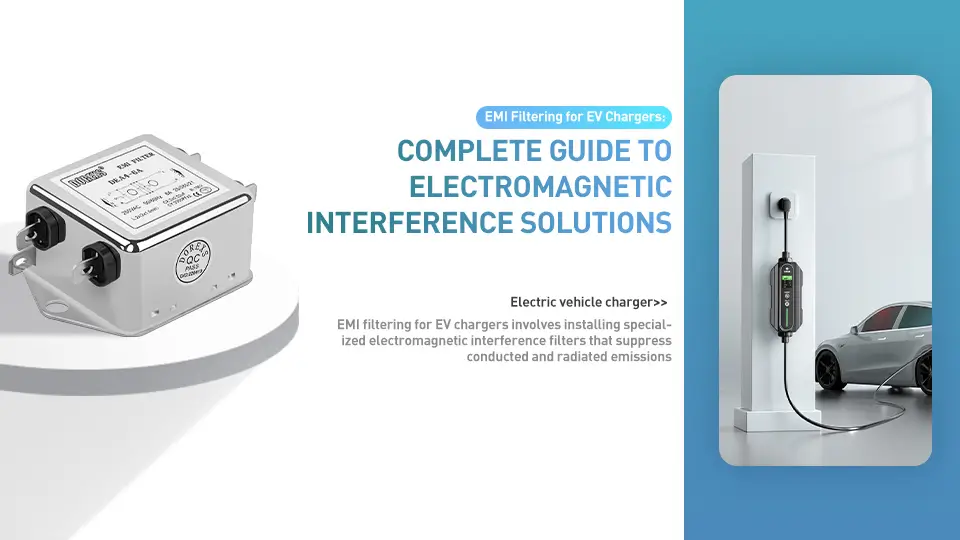
This guide covers DC and AC EMI filtering solutions, regulatory compliance requirements, and practical implementation strategies for charging station operators, OEMs, and facility managers.
EMI Filtering for EV Chargers: Complete Guide to Electromagnetic Interference Solutions
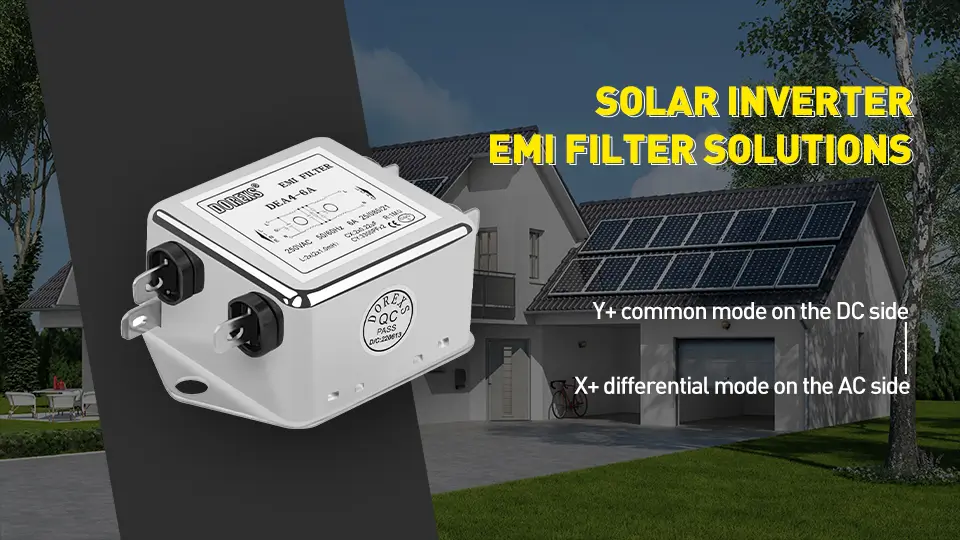
EMI from solar power systems can affect the performance of sensitive electronic devices, such as computers, medical devices, appliances, electrical devices, and other devices.
Solar Inverter EMI Filter Solutions: Professional EMC Solutions for Grid-Tied and PV Inverter Systems

In today’s fast-growing smart manufacturing era, CNC machines are expected to deliver not only machining capability but consistent precision, long-term stability, and zero-downtime reliability.However, as machine power increases and electronic components operate at higher speeds, EMI (Electromagnetic Interference) has become one of the most serious hidden threats in CNC systems.
EMI Interference in CNC Equipment & DOREXS Industrial Filter Solutions
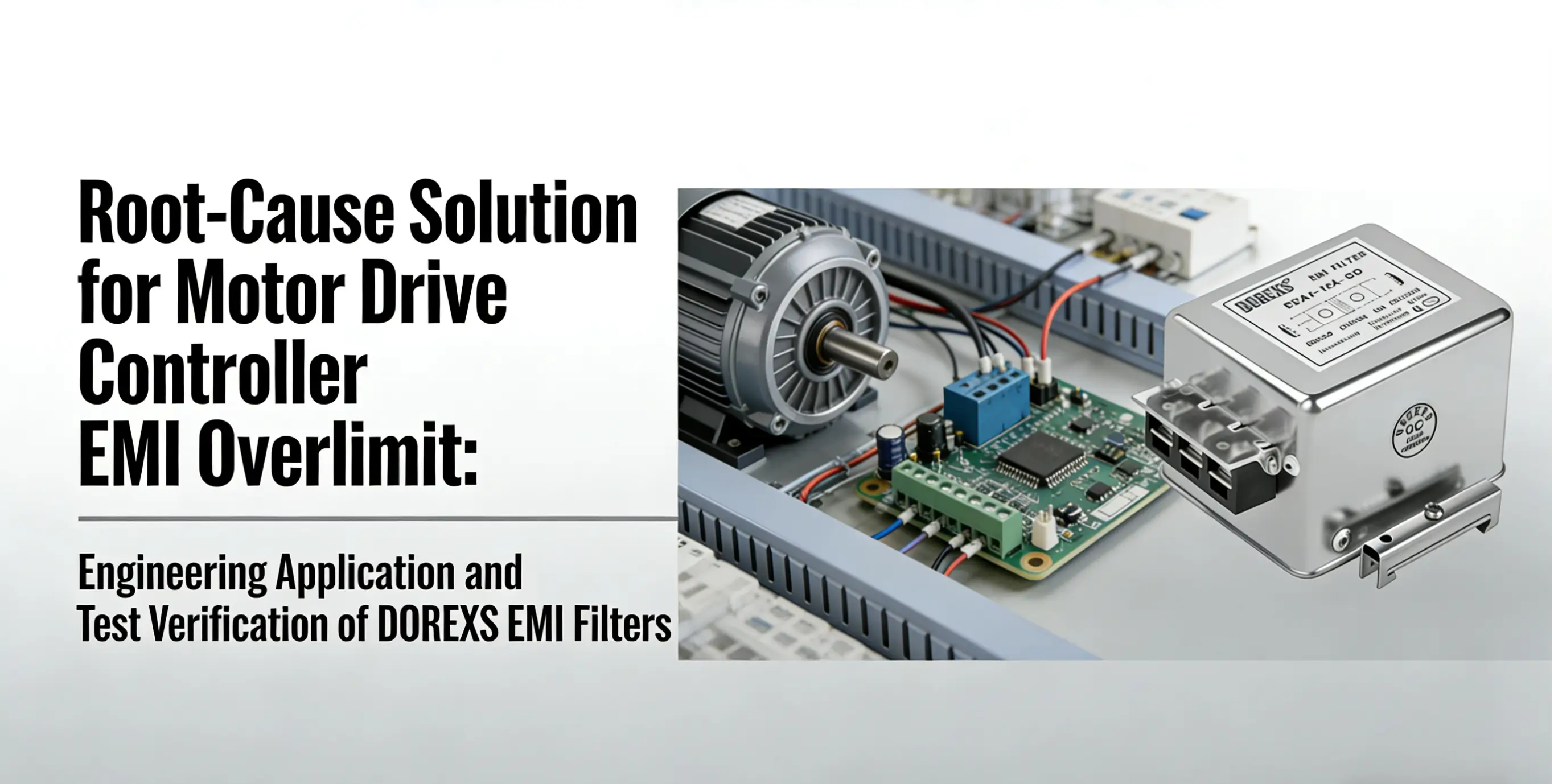
Based on an actual mitigation case, this article systematically explains the EMI generation mechanisms in motor drive controllers, the functional role of DOREXS EMI power filters, and an engineering-proven combination of filters + PCB design + grounding measures.
EMI Over-Limit Mitigation for Motor Drive Controllers: Engineering Application and Field Verification of DOREXS EMI Power Filters