EMI Power Filter in Industry-Application and Case Analysis in Industrial Equipment

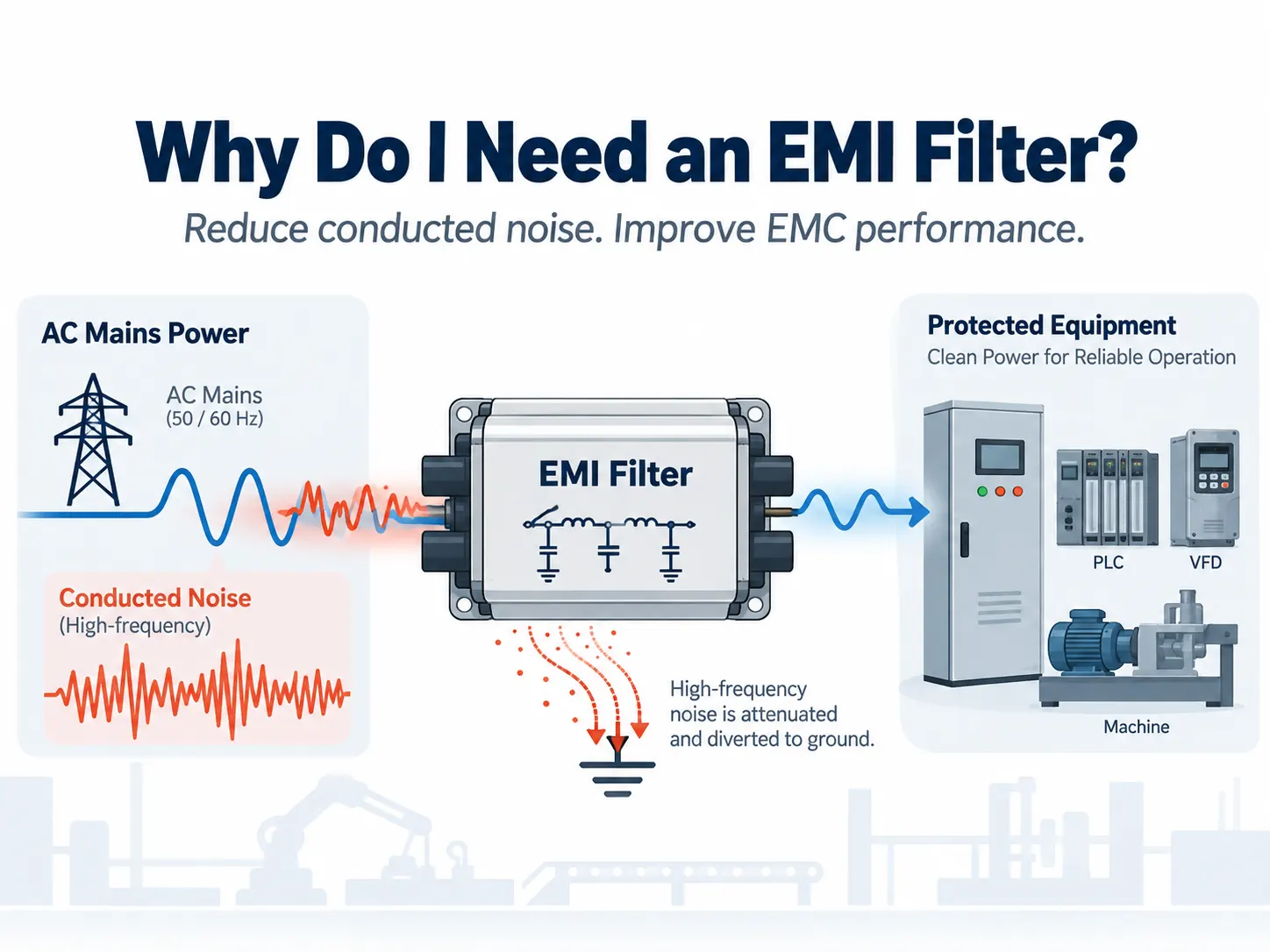
In modern industrial environment, electromagnetic interference () has become a key factor affecting the stability and performance of equipment. Industrial equipment usually involves high-power motors, frequency converters, PLC control systems, etc. In these environments, electrical devices, electronic devices, and industrial devices act as both sources and victims of EMI. Electromagnetic disturbances, electromagnetic noise, and electrical noise can impact industrial machinery and other devices in industrial settings, leading to performance degradation and malfunctions. Therefore, as an important part of electromagnetic compatibility (EMC) solutions, power filters play a vital role in ensuring stable operation of equipment, improving energy efficiency and reducing failure rates. EMI power filters are essential to prevent interference, suppress EMI, and protect nearby electronic equipment and power systems in various industrial applications. Whether it is AC power supply or DC power supply system, including considerations at the DC input stage, EMI power filter plays an important role. Variable frequency drives are also a common source of EMI in industrial environments, requiring effective filtering solutions. External interference and unwanted signals must be filtered to ensure reliable operation of sensitive equipment. This article will explore the application of power filter in industrial equipment in depth and analyze it in combination with typical cases.
Learn more about selecting the right power filter...
Introduction to Electromagnetic Interference
Understanding the causes and effects of EMI is critical for engineers and facility managers working to maintain electromagnetic compatibility (EMC) in their operations. Effective EMI filtering is essential to suppressing unwanted electromagnetic emissions, ensuring uninterrupted operation of sensitive equipment such as medical devices, industrial automation controllers, and power electronics. EMI filters play a vital role in maintaining the normal operation of electronic systems, protecting electronic components, and supporting the safe integration of advanced technologies in areas such as industrial automation, medical devices, and renewable energy systems. By prioritizing EMI filtering and EMC, organizations can achieve reliable operation and meet industry standards even as electronic systems become more complex and interconnected.
Main EMI sources in industry

1. Frequency converter
2. Motor and motor servo system
3. Welding equipment and switching power supply
4. Automation control system
5. High-voltage equipment and power transmission
How to reduce the impact of EMI in industrial environments?
- Use high-efficiency EMI power supply filters: Install EMI filters (such as single-phase filters, three-phase filters, DC filters) on the power input and key equipment to suppress power supply conducted interference.
- Optimize the grounding system: Use a combination of single-point grounding or multi-point grounding to avoid interference problems caused by ground loops, which can exacerbate EMI issues.
- Shielding and isolation: Use shielded cables and metal shielding covers to protect sensitive equipment and reduce the impact of radiation interference.
- Reasonable wiring: Signal lines and power lines are laid out separately to avoid high-frequency interference coupling; twisted pairs are used to reduce differential mode interference.
- Use ferrite rings: Adding ferrite rings to signal lines and power lines can effectively absorb high-frequency noise and reduce the impact of EMI.
The core role of power filters in industrial equipment
Differences between AC and DC power supplies
| Feature | AC Power Supply |
DC Power Supply
|
| Definition | Alternating current, changes direction periodically (50Hz/60Hz). | Direct current, flows in one direction. |
| Noise Source | Grid fluctuations, harmonics from inverters/switching power supplies. | Switching noise from DC-DC converters and power supplies. |
| Filter Design | Low-pass filters to suppress high-frequency noise. The electrical characteristics and unique magnetic properties of filter materials, such as permeability and core loss, are critical for effective attenuation at high frequencies and higher frequencies in AC systems. | Filters for common-mode & differential-mode noise in kHz-MHz range. The electrical characteristics and unique magnetic properties of advanced core materials enhance filter performance at high frequencies and higher frequencies in DC systems. |
| Application | Industrial motors, power distribution. | Electronic systems, robotics, photovoltaic inverters. |
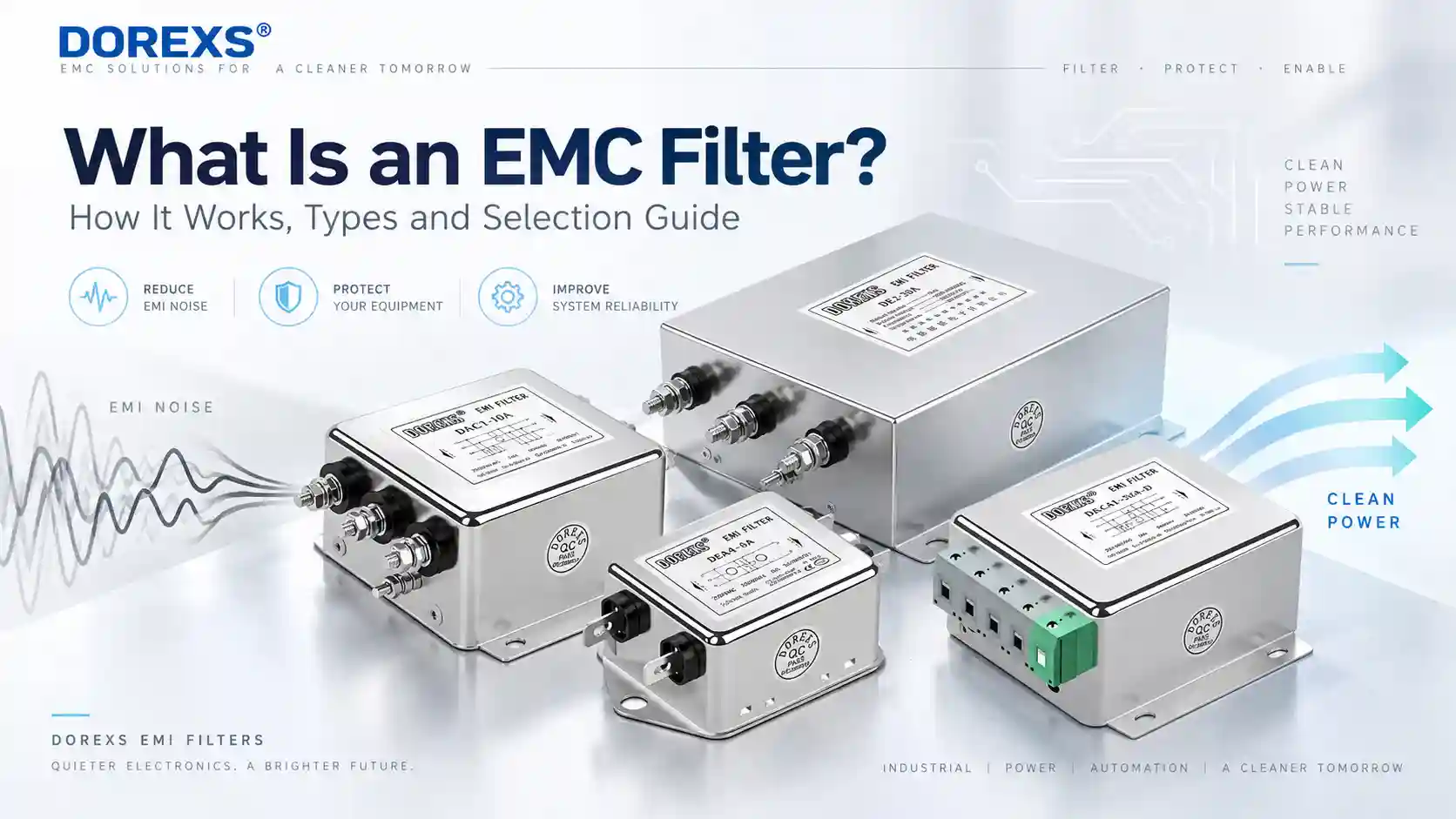
Product features of DOREXS EMI power filter
- Wide-band noise suppression: Covering the 10kHz~30MHz frequency band, effectively suppressing high-frequency noise.
- High insertion loss: The insertion loss can reach more than 40dB at a frequency of 1MHz, significantly reducing EMI interference.
- Compact design: Modular design, small size, suitable for space-constrained industrial equipment.
- High reliability: Passed strict temperature, humidity and vibration tests, suitable for harsh industrial environments.
- Multiple specifications available: Provide single-phase, three-phase, DC and other models to meet different application requirements.
Typical application scenarios and cases

Case 1: AC power scenario - DOREXS EMI filter in CNC machine tools
CNC machine tools in a factory frequently have control signal false triggering, which is detected as high-frequency noise in the power grid coupled to the control system through the power line.
Case 2: DC power scenario - robot power supply system in automated production lines
The DC power supply system of a robot in a certain automobile manufacturing plant causes abnormal operation of the communication module due to switching power supply noise.
Case 3: Hybrid power scenario - photovoltaic inverter system
There is high-frequency noise at the output end of a photovoltaic power station inverter, which affects the power quality of the power grid.
Selection points of AC and DC power filter
1. Selection of AC power filter
- Rated voltage and current: Select according to the power of the equipment, and reserve 20% margin.
- Noise frequency range: Determine the interference frequency band through spectrum analysis.
- Installation method: Consider environmental factors such as high temperature and high humidity.
- Certification requirements: Ensure that the product complies with international standards such as UL, CE, ROHS, ISO 9001, etc.
2. DC power filter selection
-
Voltage polarity: Make sure the filter supports DC voltage polarity.
-
High-frequency noise suppression: Select a filter with a suitable frequency band for switching power supply noise.
-
Size and heat dissipation: DC systems usually have limited space, so you need to select a small, efficient heat dissipation filter.
-
Certification requirements: Make sure the product complies with international standards such as UL, CE, ROHS, ISO 9001, etc.
Common problems and optimization suggestion
Problem: The filter causes voltage drop
- Reason: The filter internal resistance is too large or the rated current is insufficient.
- Optimization: Select a low-loss core inductor and optimize the capacitance.
Problem: The high-frequency suppression effect is not ideal
Problem: The filter itself heats up
Safety Precautions and Regulations
Proper installation, regular maintenance, and thorough testing of EMI filters are critical steps to prevent electrical hazards and ensure reliable operation. Following manufacturer guidelines and industry best practices can help minimize the risks associated with electromagnetic interference, such as equipment failure or safety incidents. By prioritizing compliance with safety regulations and using certified EMI filters, organizations can achieve efficient operations and have the peace of mind that comes with knowing that sensitive equipment is protected from the adverse effects of EMI.
Conclusion and Future Directions for Industrial Automation
By focusing on electromagnetic compatibility and implementing advanced EMI filtering strategies, companies can improve performance, reduce downtime, and ensure safe and efficient operation of sensitive equipment. The integration of renewable energy systems, advanced power electronics, and automated control systems further highlights the need for reliable EMI suppression. As the industrial automation landscape continues to evolve, EMI filters will continue to be an essential component for achieving efficient operation, reliable performance, and greater safety in a variety of applications.
DOREXS focuses on high-quality EMI power filters and EMI solutions, providing professional electromagnetic interference suppression products suitable for industrial, medical, home appliances and other fields, helping customers improve equipment reliability and electromagnetic compatibility. In the future, with the advancement of intelligent and green manufacturing, power filter technology will continue to iterate to provide more efficient solutions for the industrial field.
What is High Pass Filter: Working Principle and Main Classification
The Impact of EMI Power Filters on Power Output and Optimization Recommendations