Research on the Impact, Standards, and Mitigation Methods of Electromagnetic Interference (EMI)
1. Basic Concepts and Classification of Electromagnetic Interference (EMI)
1.1 Definition and Causes of EMI
1.2 Classification and Characteristics of EMI
1.3 Common Sources of EMI and Their Hazards
2. The Impact of EMI on Device and System Performance
2.1 Analysis of EMI Effects on Transmission Lines
EMI impacts transmission lines primarily through signal interference. When an electromagnetic interference source is present, signals on the transmission line are subjected to varying degrees of interference, causing signal waveform distortions that affect signal quality and stability. Specifically, EMI can lead to signal amplitude reduction, phase shifts, waveform distortion, and, in severe cases, signal loss. These issues not only affect system operation but also degrade system performance, such as reducing resolution and signal-to-noise ratio. Moreover, EMI may trigger other interferences within the system, such as self-oscillation and electromagnetic induction, further complicating the system.
The impact of EMI on transmission speed is also notable. As EMI distorts the waveform of signals, the speed of signal transmission is reduced, thereby lowering transmission rates. EMI also increases the error rate of signals, causing the system to require more time to transmit the same amount of data. This not only reduces system efficiency but also increases data transmission costs. Therefore, when designing systems, it is essential to consider the impact of EMI on transmission speed and take appropriate measures to improve transmission rates.
In addition to the aforementioned effects, EMI also limits the transmission distance. As transmission distance increases, signal attenuation and interference accumulation grow. When interference reaches a critical level, signals can no longer be correctly transmitted, restricting the transmission range. This presents challenges for system layout and installation, limiting the application scope. Therefore, system designers must determine optimal transmission distances to ensure stable signal transmission.
2.2 Analysis of Internal Circuit Interference
EMI can cause malfunctions in internal circuits. As signals in the circuit are interfered with by external electromagnetic fields, their waveforms may change, impairing normal circuit operation. For example, in an amplifier circuit, EMI on the input signal could cause distortion at the amplifier's output, affecting amplification. In an oscillator circuit, EMI may cause frequency instability or even cause the oscillator to stop, disrupting normal operation.
Strong EMI can lead to the damage of components. When the intensity of EMI exceeds a component's tolerance, it can cause overloads, resulting in component failure. For instance, integrated circuits may burn out due to internal circuit overload when exposed to strong electromagnetic pulses. Resistors, capacitors, and other components are also susceptible to damage from EMI, affecting normal circuit functionality.
EMI may cause increased power consumption in devices. This happens because EMI leads to fluctuations in current and voltage in circuits, which increases energy consumption. For example, in a switch-mode power supply, EMI may affect the switching frequency, causing higher switching losses in transistors and decreasing power efficiency. Increased power consumption not only leads to higher heat generation but also impacts device lifespan and reliability.
3. EMI Standards and Regulatory Requirements
3.1 Introduction to ISO Standards
3.2 Overview of National EMI Regulations
3.3 Industry Self-Regulation Guidelines
4. EMI Mitigation Methods and Technical Approaches
4.1 Filter Technology Principles and Applications
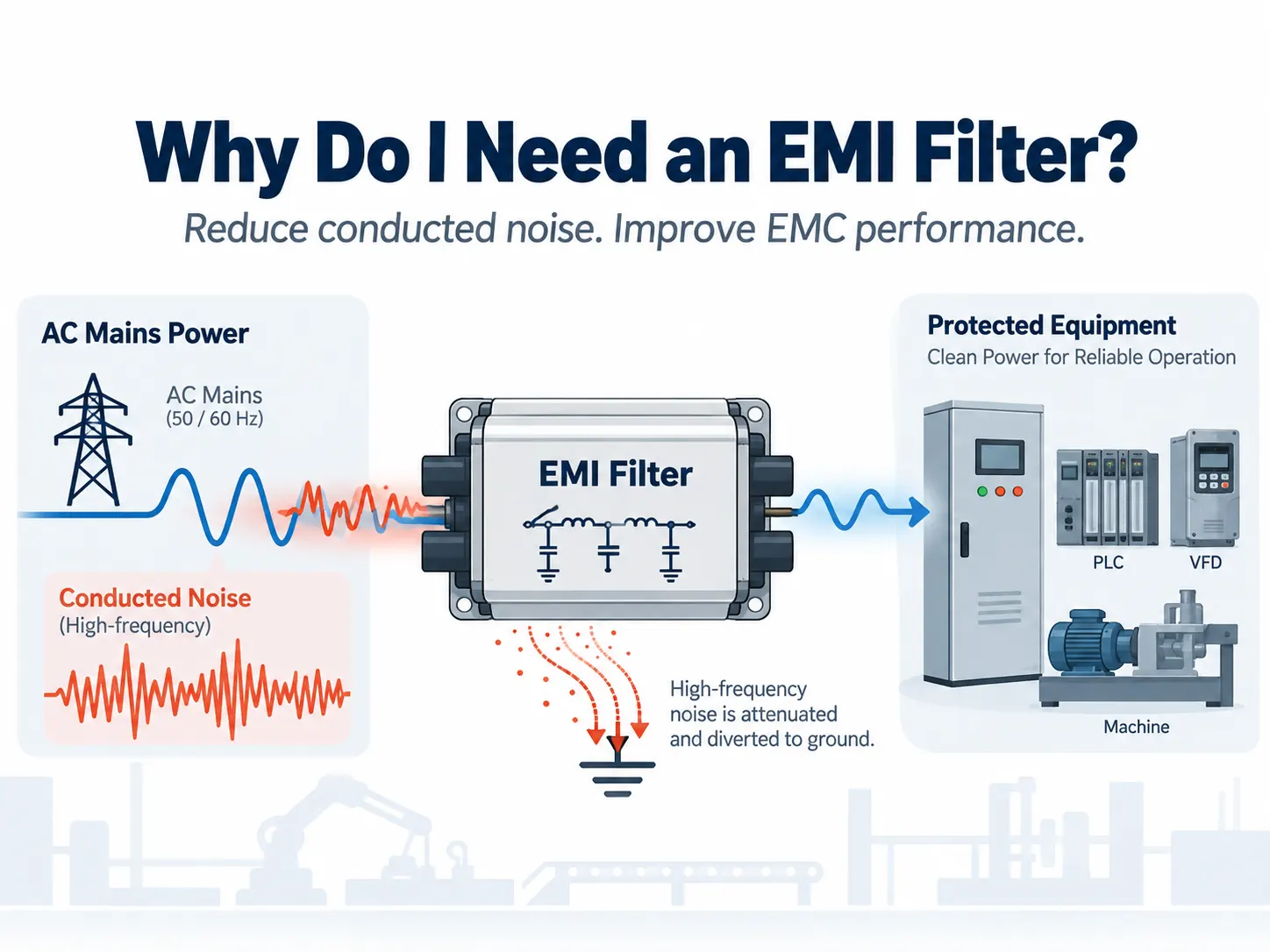
Filter technology selects signal frequencies and removes interference signals through specific circuit designs. Its principle relies on the frequency characteristics of capacitors and inductors—capacitors pass AC and block DC, while inductors pass DC and block AC. Filter technology is widely applied in power supply design and signal processing. In power supply systems, filter circuits eliminate high-frequency noise from the grid, ensuring stable device operation. In signal processing, EMI filters extract the desired frequency signals while removing unnecessary noise or interference, improving the quality of audio or images.
4.2 Shielding Design Methods
Shielding design isolates electromagnetic interference sources and reduces their impact on devices through appropriate structures and shielding materials. The design should block the electromagnetic coupling path between the interference source and the device, while guiding the interference signals along specific paths to minimize their effect on the device. For high-frequency interference, materials with strong conductivity should be used, while magnetic materials like ferrite are effective for low-frequency interference. Grounding is an essential part of the shielding design, and suitable grounding methods such as single-point or multi-point grounding should be selected. Common shielding methods include metal enclosures and shielding nets. Metal enclosures enclose the entire device, while shielding nets are used to shield internal circuits. The shielding effectiveness should be tested and evaluated, and regular inspection and maintenance are necessary.
4.3 Grounding Strategies and Considerations
Grounding treatment reduces electromagnetic interference through reasonable grounding design. Grounding methods include single-point grounding, multi-point grounding, and mixed grounding, which are suitable for different circuit requirements. The length and cross-sectional area of the grounding wire should be appropriate to avoid electromagnetic coupling, and the grounding wire should ideally remain straight. Grounding points should be selected near noise sources, and their layout should prevent imbalances in potential. Proper grounding design significantly improves the stability and reliability of the device.
EMI is an important factor that must be considered in modern electronic device design. If EMI issues are not effectively addressed during the product design and development phase, they can have a profound impact on product performance, safety, compliance, and user experience. To resolve these issues, the industry has developed various effective techniques and solutions, including EMI filters, shielding, and grounding optimization. The proper application of these methods ensures the reliability and stability of electronic devices in complex environments, thereby extending the product lifecycle and enhancing the company's market competitiveness.
Basic Knowledge of EMI and EMI Filters
Application of EMI Filter in Inverter