Why Do I Need an EMI Filter? A Practical Guide for Equipment Designers
Modern electrical and electronic equipment depends heavily on switching power supplies, digital controllers, motor drives, inverters, communication circuits, and high-speed power semiconductors.
These technologies improve efficiency and performance, but they also generate unwanted high-frequency electrical noise.
That raises an important question:
Why do I need an EMI filter?
The short answer is:
You may need an EMI filter when conducted electromagnetic interference generated by your equipment—or entering your equipment through the power line—affects EMC compliance, system stability, communication reliability, or nearby electronic devices.
An EMI filter helps reduce unwanted high-frequency noise traveling through AC or DC power lines while allowing the required electrical power to pass.
However, not every product automatically needs an external EMI filter. The decision depends on the equipment architecture, switching circuits, EMC requirements, power system, installation environment, and actual test results.
This guide explains when EMI filters are needed, what problems they solve, when an external filter may not be necessary, and how engineers can determine the right filtering solution.
Quick Answer: Why Do I Need an EMI Filter?
You typically need an EMI filter for one or more of the following reasons:
-
Reduce conducted electromagnetic emissions
-
Help equipment meet applicable EMC requirements
-
Prevent switching noise from returning to the power network
-
Suppress electromagnetic noise in electronic devices
-
Improve reliability of PLCs, controllers, sensors, and communication systems
-
Control EMI generated by VFDs, servo drives, inverters, and switching power supplies
-
Reduce interference between different devices connected to the same electrical system
An EMI filter is particularly useful when your equipment contains high-frequency switching circuits or when EMC testing shows excessive conducted emissions, since too much interference can lead to poor performance in electronic devices.
But an EMI filter should be considered one part of the complete EMC design, not a universal solution for every interference problem.
For a broader overview of filter structures, applications, and product types, see the DOREXS EMI / EMC Filter Guide.

What Is Electromagnetic Interference (EMI)?
EMI stands for Electromagnetic Interference.
In other words, electromagnetic interference EMI refers to unwanted electromagnetic disturbances from electronic devices or natural sources that can interfere with the operation of electrical or electronic equipment.
EMI can come from many sources, including:
-
Switching power supplies
-
Variable frequency drives
-
Servo drives
-
Inverters
-
DC/DC converters
-
Motor controllers
-
IGBTs and MOSFET switching circuits
-
LED drivers
-
Microprocessors
-
Relays and contactors
-
Long power and motor cables
-
Poor grounding or shielding
EMI refers to disturbances that may affect nearby systems either through conducted and radiated paths.
Some EMI travels through the air as radiated EMI.
Other interference travels along electrical conductors as conducted EMI.
Power-line EMI filters are primarily designed to control conducted interference.
A typical arrangement is:
AC Mains → EMI Filter → Equipment
The filter can reduce noise generated by the equipment from propagating back onto the mains while also reducing some external conducted noise entering the equipment.
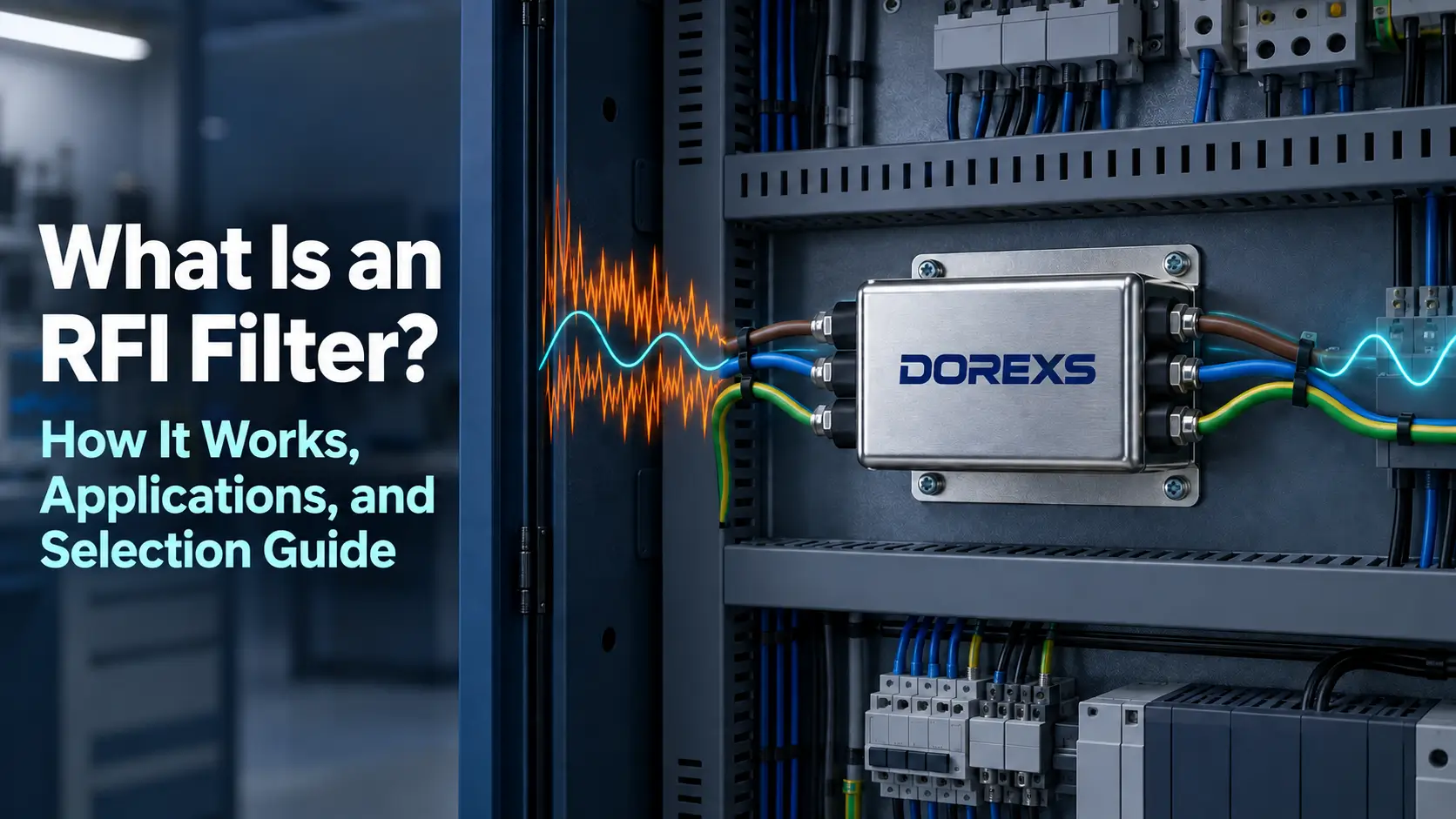
If you want a deeper explanation of EMI filter construction and operation, read What Is an EMI Filter?.

What Does an EMI Filter Actually Do?
An EMI filter is usually a passive filtering network that uses capacitors and inductors for noise suppression, with components such as:
-
Common-mode chokes
-
Differential inductors
-
X capacitors
-
Y capacitors
-
Discharge resistors
The exact topology depends on the filter design and application. A first-order filter uses one reactive component, while a second-order filter uses at least two for greater attenuation.
Most power-line EMI filters behave broadly as a low pass filter.
The required DC or low-frequency AC power passes through the filter, while unwanted higher-frequency energy is attenuated. The cut-off frequency is the point where attenuation reaches 3 dB.
For example, a 50/60 Hz industrial power supply needs the fundamental power frequency to pass with minimal impact.
At the same time, switching circuits inside the equipment may generate noise from the kilohertz region into much higher frequencies.
The EMI filter creates impedance and controlled noise-return paths that reduce this unwanted high-frequency energy.
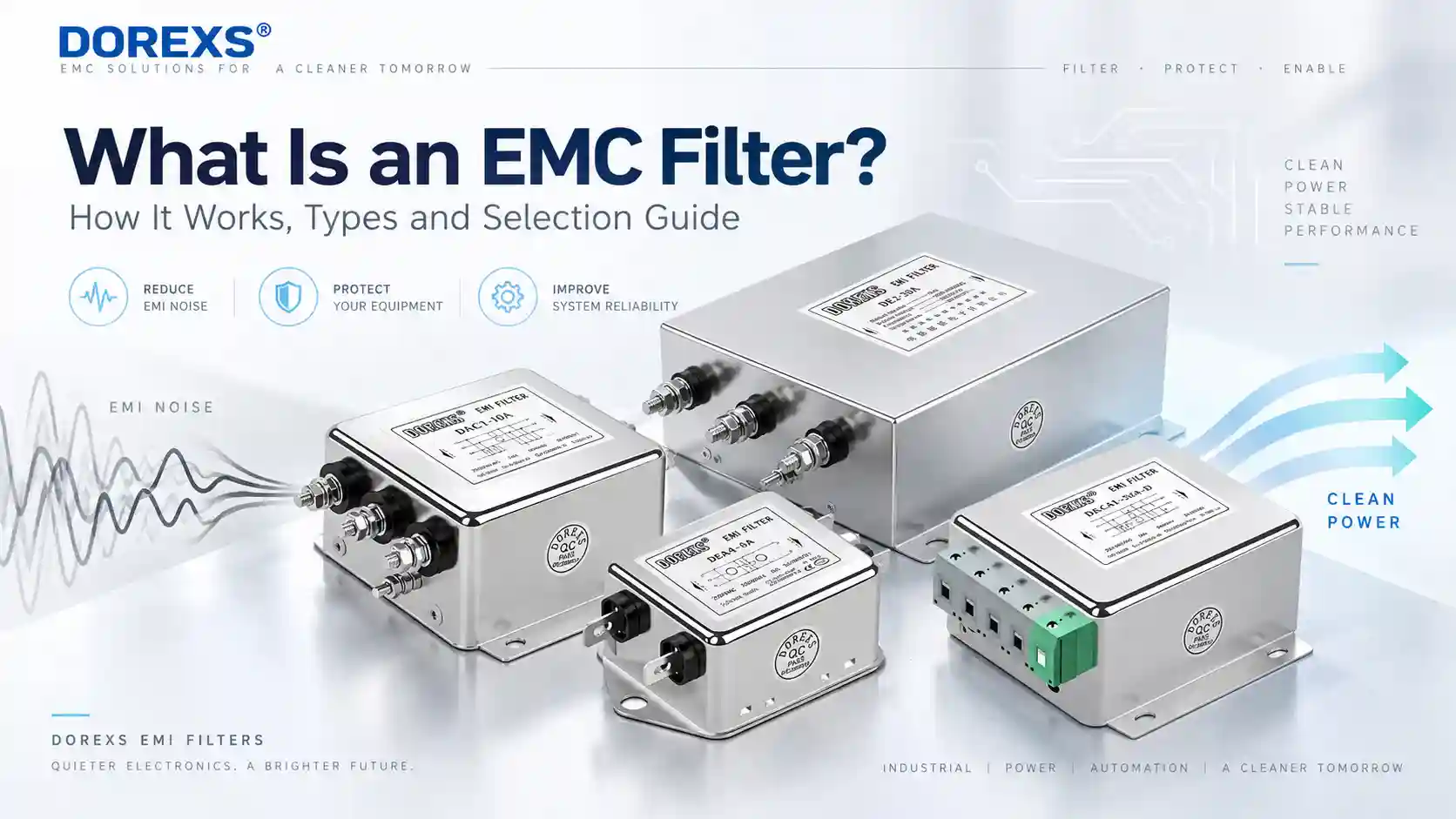
The terms EMI filter and EMC filter are often used interchangeably in power-line applications. For more detail on the terminology and system-level role, see What Is an EMC Filter?.

1. You May Need an EMI Filter to Meet EMC Requirements
One of the most common reasons for installing an EMI filter is EMC compliance. EMI filters play a critical role in helping products meet regulatory standards and electromagnetic compatibility requirements.
Electrical and electronic products may be subject to electromagnetic compatibility requirements depending on:
-
Product category
-
Intended environment
-
Market
-
Power system
-
Application
-
Regulatory framework
Examples of standards that may be relevant to different types of equipment include, and these EMC standards define the maximum electromagnetic emissions allowed for the product category and environment:
-
CISPR 11 for certain industrial, scientific, and medical equipment
-
CISPR 32 for multimedia equipment
-
IEC 61800-3 for adjustable-speed power drive systems
-
IEC 60601-1-2 for medical electrical equipment
Regulatory bodies enforce limits on electromagnetic noise, including the Federal Communications Commission in the U.S. under Title 47 Part 15.
The applicable standard must always be determined according to the final product and target market.
An EMI filter can help reduce conducted emissions measured at the equipment power input, and filtering also supports compliance with FCC and EMC regulations where applicable.
However:
Adding an EMI filter does not automatically guarantee that equipment will pass EMC testing.
EMC performance also depends on:
-
PCB layout
-
Grounding
-
Chassis bonding
-
Shielding
-
Cable routing
-
Cable length
-
Switching frequency
-
Enclosure construction
-
Filter installation
-
Source and load impedance
The complete system must therefore be evaluated.
2. You May Need an EMI Filter Because Switching Electronics Generate Noise
Modern power electronic systems operate by rapidly switching voltage and current.
Examples include:
-
SMPS power supplies
-
VFDs
-
Servo drives
-
Solar inverters
-
EV charging power converters
-
UPS systems
-
Motor drives
-
Battery chargers
Fast switching edges create high-frequency current components. Left unchecked, EMI noise from these circuits can undermine reliable operation.
These noise currents can couple into power lines, chassis structures, signal wiring, communication cables, and nearby equipment, so filtering can also improve signal integrity by limiting crosstalk and spurious signals.
For example, a VFD controlling a motor uses high-speed semiconductor switching to generate a variable-frequency output waveform.
The resulting system may generate substantial common-mode and differential-mode noise.
Installing a properly selected VFD EMI filter at the AC input can help reduce conducted interference propagating back toward the power distribution system. Suitable filtering can also protect sensitive microelectronics from voltage spikes and high-frequency noise while reducing electrical stress on connected electronics.
For VFD applications, filtering should be considered together with:
-
Motor cable shielding
-
Cable length
-
Grounding
-
PE bonding
-
Input wiring
-
Output-side filtering requirements
An input EMI filter and an output reactor, dv/dt filter, or sine-wave filter perform different functions and should not be treated as interchangeable components.
3. You May Need an EMI Filter to Protect Sensitive Electronics
EMI is not only a regulatory issue.
It can also become an equipment reliability problem.
Modern machines frequently contain sensitive electronic systems such as:
-
PLCs
-
Industrial computers
-
Encoders
-
Sensors
-
Ethernet communication
-
CAN communication
-
Fieldbus networks
-
Measurement circuits
-
Analog signal inputs
-
Microcontrollers
High-frequency noise entering these systems may contribute to symptoms such as:
-
Unexpected PLC resets
-
Communication errors
-
Sensor instability
-
Incorrect measurements
-
Controller faults
-
Encoder errors
-
Intermittent equipment shutdowns
-
Unexplained machine faults in sensitive electronic components, with conducted EMI sometimes causing temporary or permanent malfunction
These symptoms do not automatically prove that the power line is the interference path.
Engineers should identify the coupling mechanism before selecting a solution.
If the interference is being conducted through the equipment power input, an EMI filter may help with preventing interference as part of the corrective action.
For single-phase PLC cabinets, control systems, power supplies, and similar equipment, a single-phase EMI filter is commonly evaluated when the AC input is part of the conducted-noise path.
4. You May Need an EMI Filter to Prevent Your Equipment From Affecting Other Devices
EMC works in both directions.
Your equipment should operate reliably in its electromagnetic environment, but it should also avoid producing unacceptable interference for other equipment. EMI filters also help prevent a device from emitting interference that affects nearby electronics.
Consider an industrial control cabinet containing:
-
VFDs
-
Servo amplifiers
-
PLCs
-
24 VDC power supplies
-
Industrial Ethernet
-
Sensors
-
Control relays
The drives may generate substantial switching noise.
Without proper EMC design, this noise can propagate through shared power wiring or couple into nearby signal cables in cabinets where many devices share wiring or space.
The result may be that the motor drive itself works correctly while another part of the machine becomes unstable.
For high-power industrial equipment supplied from a three-phase network, appropriately selected three-phase EMI filters can help reduce conducted-noise propagation between noisy power electronics and the surrounding electrical system.
5. Do I Still Need an EMI Filter If My Power Supply Already Meets EMC Requirements?
Possibly.
This is an important issue for equipment designers.
A power supply can pass its own manufacturer's EMC testing under a defined laboratory configuration.
But when that power supply is installed inside your final equipment, the electromagnetic environment changes.
Your complete system may also contain:
-
Motors
-
Microprocessors
-
Long cables
-
Displays
-
Communication modules
-
Relays
-
Switching converters
-
Cooling fans
-
Other power supplies
The physical arrangement of the equipment can also create new coupling paths.
For example:
Input Cable → Power Supply → Output Cable
If the input and output cables are routed close together, high-frequency noise can couple around the original filtering network.
As a result:
A compliant component does not automatically make the complete equipment EMC compliant.
The final equipment should therefore be evaluated at system level.
6. Common-Mode and Differential-Mode Noise Matter
To understand whether you need an EMI filter, it helps to understand the two primary conducted-noise modes.
Common-Mode Noise
Common-mode noise generally appears on multiple conductors relative to chassis or earth, with unwanted current often returning through parasitic paths.
Typical sources include:
-
Parasitic capacitance
-
Fast switching edges
-
Motor cable coupling
-
Heatsink coupling
-
Transformer capacitance
A common-mode choke is commonly used to provide impedance against this noise.
Y capacitors may provide a low impedance path for high-frequency common-mode noise toward protective earth or chassis.
However, Y-capacitor values influence leakage current and therefore require particular attention in applications such as medical equipment.
Differential-Mode Noise
Differential-mode noise appears between conductors.
For a single-phase AC system, for example, the noise may exist between line and neutral, so the filter suppresses unwanted current while allowing the desirable currents to continue passing through the conductors.
Differential-mode filtering commonly involves:
-
X capacitors
-
Differential inductance
-
Multi-stage LC networks
Many commercial EMI filters are designed to attenuate both common-mode and differential-mode interference.
The required balance depends on the measured noise characteristics of the equipment.
7. What Happens If I Don't Use an EMI Filter?
The result depends entirely on the equipment.
A system without an external EMI filter may work perfectly if its internal EMC design already provides sufficient attenuation.
In other cases, insufficient filtering can contribute to several problems.
Failed Conducted-Emissions Testing
The equipment may exceed the applicable limits at particular frequencies, causing failure against EMC regulations or other applicable regulatory standards.
Interference With Other Equipment
Noise may propagate through shared AC or DC power systems, and in industrial environments this propagated noise can also contribute to data loss in connected systems.
Communication Instability
Industrial communication networks can experience errors when noise couples into cables, references, or power supplies.
Controller or PLC Problems
Sensitive electronics may experience resets or unstable operation under certain interference conditions.
Additional EMC Redesign
Discovering excessive emissions late in the certification process can require additional filtering, PCB redesign, wiring changes, shielding, or enclosure modifications.
For this reason, EMC considerations are usually more effective when addressed during the design phase, with design engineers evaluating filter options and test equipment earlier to shorten certification cycles rather than only after a failed final test.
8. Does Every Electronic Device Need an EMI Filter?
No.
An external EMI filter is not automatically required in every product.
You may not need an additional external filter if:
-
The existing power supply includes adequate filtering
-
Internal filtering already meets the system requirements
-
EMC testing confirms acceptable emissions
-
The equipment has low-noise circuitry
-
The product has no significant switching-noise source
-
The installation provides adequate EMC control
-
The applicable system requirements can already be met
The correct question is therefore not:
“Does every electronic device need an EMI filter?”
It is:
“Does this equipment require additional conducted-noise attenuation to meet its EMC and operational requirements?”
Testing is usually the most reliable way to answer that question.
9. How Do I Know If My Equipment Needs an EMI Filter?
Use a combination of design review and measurement.
A practical engineering process is:
Step 1: Identify Potential Noise Sources
Look for:
-
VFDs
-
Servo drives
-
Switching power supplies
-
Inverters
-
High-speed switching devices
-
Long motor cables
-
High-power converters
Step 2: Identify Sensitive Circuits
Determine whether the equipment contains:
-
PLCs
-
Encoders
-
Communication interfaces
-
Precision analog circuits
-
Sensors
-
Medical measurement circuits
Step 3: Determine Applicable EMC Requirements
Identify:
-
Product category
-
Target market
-
Installation environment
-
Required EMC standard
-
Emission limits
-
Immunity requirements
Do this early in product development.
Step 4: Perform EMC Pre-Compliance Testing
Testing can determine:
-
Whether conducted emissions exceed limits
-
At which frequencies the problem occurs
-
How much attenuation may be required
-
Whether common-mode or differential-mode noise dominates
A test result is far more useful for filter selection than simply saying:
“My machine has EMI.”
Step 5: Evaluate Filtering
Compare the problem frequencies with the filter's insertion-loss characteristics.
Then verify performance in the actual equipment.
Remember that datasheet insertion-loss curves are normally measured under defined laboratory impedances.
Actual system performance can differ because real source and load impedances are rarely identical to the test setup.
10. Which Equipment Commonly Uses EMI Filters?
EMI filters play a critical role across different industries and EMI filter applications where switching electronics and EMC demands are common.
Industrial Automation
Typical equipment includes:
-
PLC control cabinets
-
Servo systems
-
CNC machines
-
Robotics
-
Packaging machinery
-
Industrial power supplies
Filtering helps protect industrial equipment from electromagnetic interference in control cabinets and automated systems.
Single-phase or three-phase EMI filters may be used depending on the power system and equipment architecture.
For a broader overview of EMC problems in manufacturing plants and machine-control systems, see DOREXS Industrial EMI Filter Solutions.
Variable Frequency Drives
VFD systems in high power applications are significant noise sources because of high-speed semiconductor switching.
A three-phase or dedicated VFD EMI filter may be installed at the AC input.
Other EMC measures may include:
-
Proper grounding
-
Shielded motor cables
-
Short bonding connections
-
Correct cable separation
-
Appropriate output filtering
Servo Drive Systems
Servo amplifiers can generate switching noise while simultaneously operating near sensitive encoder and communication circuits.
Good cabinet layout and power-line filtering can therefore be important parts of the EMC design.
Medical Equipment
Medical devices in the medical field may combine sensitive measurement electronics with strict leakage-current and EMC requirements.
Filter selection must therefore consider both:
EMI attenuation
and
leakage current
Using a filter with excessive earth capacitance can be inappropriate even if its insertion-loss performance appears attractive. Suitable filtering helps ensure reliable operation of sensitive medical equipment and patient safety, and EMI filters are used in medical devices to ensure safety.
Severe EMI can contribute to failure of essential medical equipment, which is why medical grade EMI filters and compliance matter. For these systems, explore DOREXS medical EMI filter solutions, including low-leakage configurations for suitable applications.
EV Charging, Power Supplies, and Power Conversion
EV charging equipment contains high-power conversion stages, switching devices, communication electronics, and AC/DC interfaces that function as power electronic systems.
EMI control may be required at different locations depending on the converter architecture and noise path, and filtering mitigates noise in power electronics to support reliable operation of the converter system.
This can include:
-
AC input filtering
-
DC-side filtering
-
Cable management
-
Shielding
-
Grounding
Where interference is present on DC power lines, dedicated DC EMI filters may be evaluated according to voltage, current, converter architecture, and required attenuation.
Communication Equipment
Radio frequency power-line noise can affect sensitive communication and data equipment.
IEC inlet filters, printed circuit board filters, DC filters, or chassis-mounted power filters may be selected depending on the system.
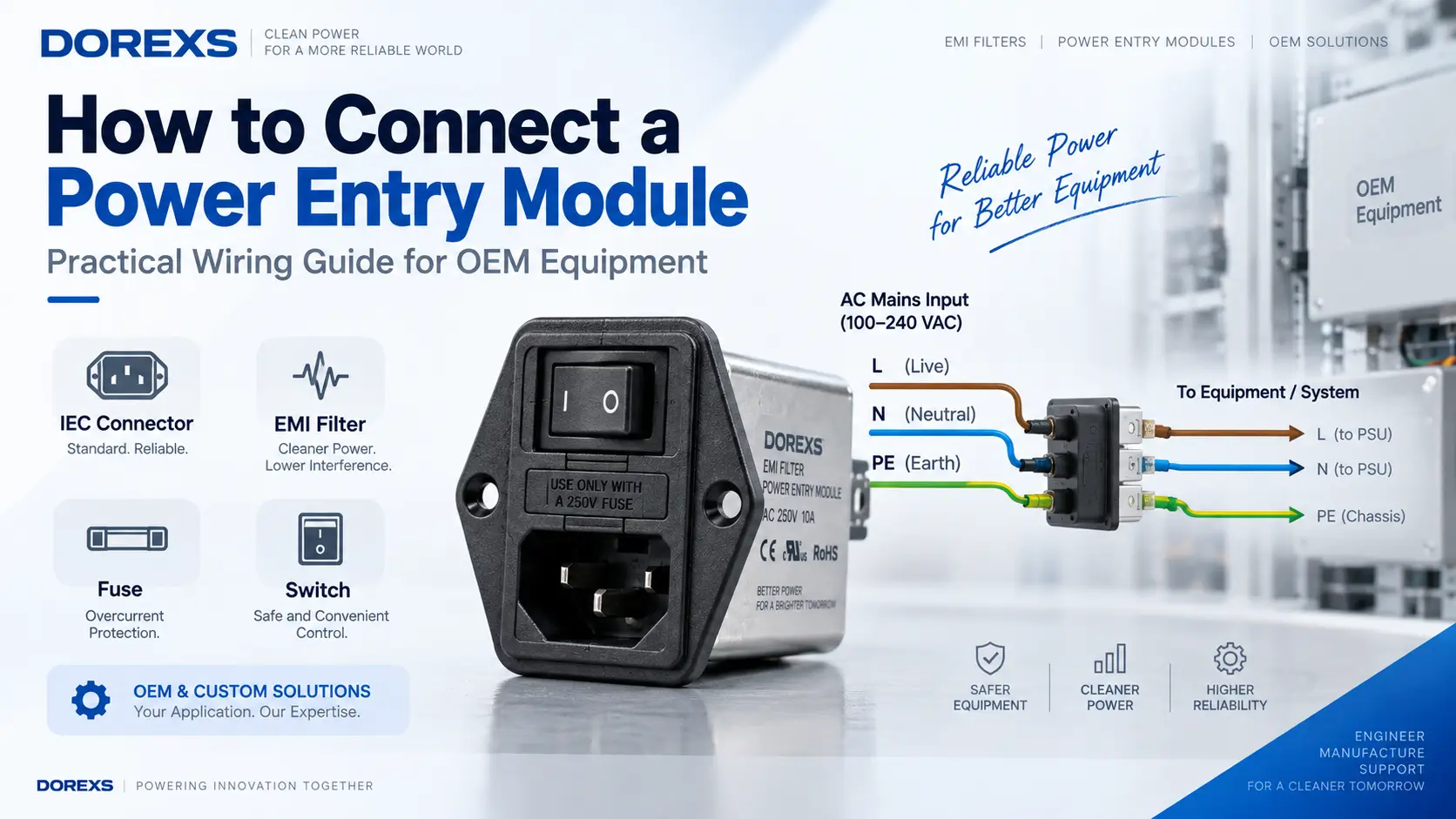
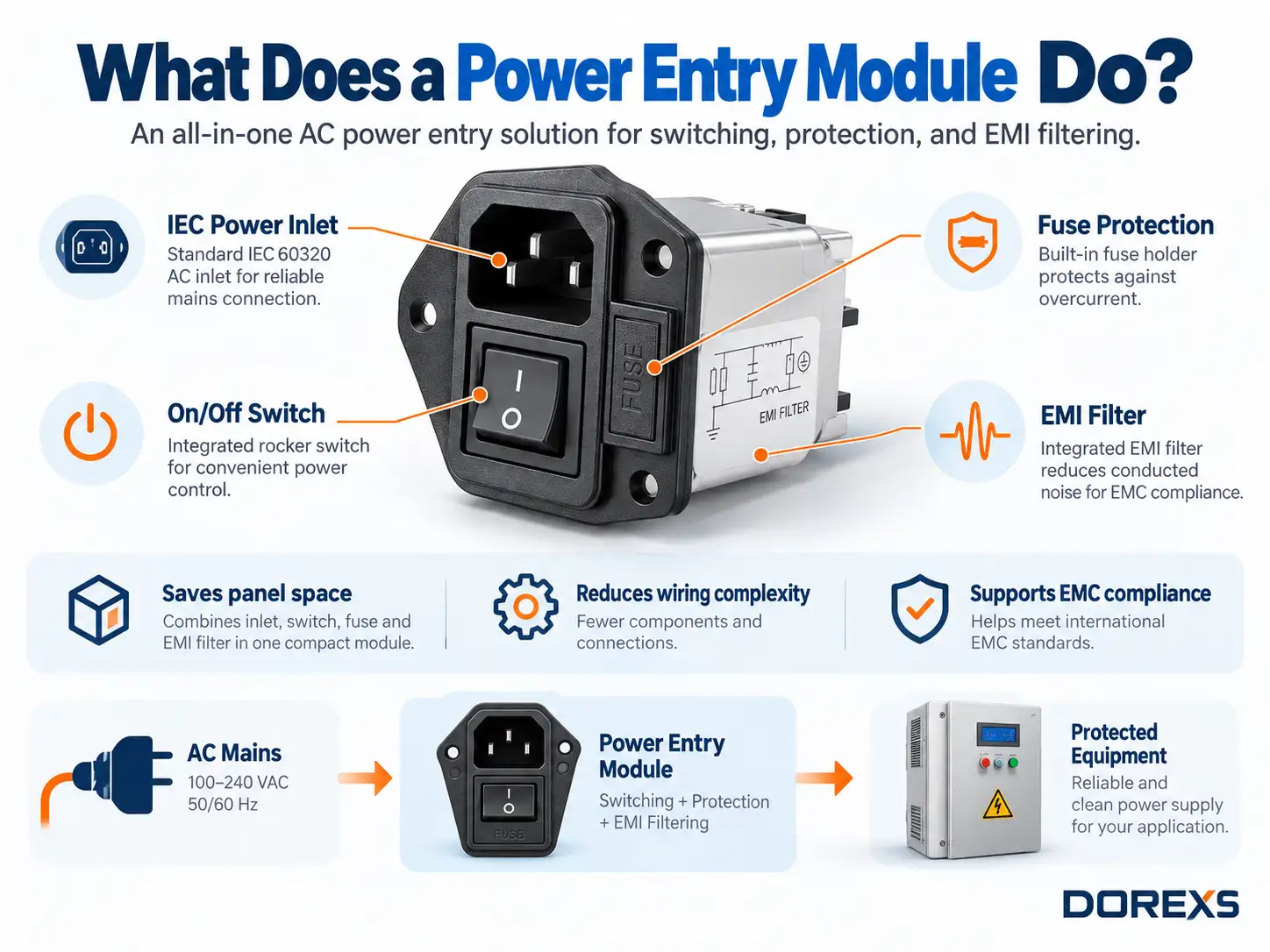
Compact AC-powered equipment may also use a power entry module that integrates the IEC inlet with EMI filtering and, depending on the configuration, functions such as fusing or switching, with some compact layouts using discrete components or integrated modules depending on packaging constraints.
11. Where Should an EMI Filter Be Installed?
For power-entry filtering, the filter should generally be installed close to the point where power enters the equipment enclosure.
A simplified layout is:
AC Input → EMI Filter → Equipment / Power Converter
rather than:
AC Input → Long Internal Cable → EMI Filter → Equipment
The objective is to prevent unfiltered wiring from becoming an internal noise-coupling path.
Important installation principles include:
-
Keep input wiring short
-
Keep output wiring short where practical
-
Separate filtered and unfiltered cables
-
Avoid routing input and output conductors together
-
Provide effective chassis bonding
-
Use a low impedance path to chassis or ground at high frequency
-
Avoid long grounding leads
-
Follow the filter manufacturer's mounting recommendations
A good filter installed incorrectly can perform far below its datasheet capability, especially on transmission lines formed by longer internal wiring and cable runs.
12. How Do I Choose the Right EMI Filter?
Do not select a filter based only on current rating.
At minimum, consider:
|
Selection Factor |
Why It Matters |
|---|---|
|
Operating Voltage |
Must match the electrical system |
|
Rated Current |
Must support continuous operating current |
|
Phase Configuration |
Single-phase, three-phase three-wire, three-phase four-wire, or DC |
|
Noise Frequency |
Determines where attenuation is required |
|
Common-Mode Noise |
Influences CM filtering requirements |
|
Differential-Mode Noise |
Influences DM filtering requirements |
|
Insertion Loss |
Indicates attenuation under specified test conditions |
|
Leakage Current |
Particularly important in medical and sensitive applications |
|
Installation Space |
Determines mechanical format, including panel mount filters when cabinet integration and bonding are important |
|
Terminal Type |
Affects cabinet and production integration |
|
EMC Standard |
Defines the system-level target |
|
Environment |
Industrial, medical, commercial, EV, communication, etc.; specialized applications may also narrow choices due to leakage, mounting, and compliance constraints |
For equipment that has already failed an EMC test, the most useful information is often:
Voltage + Current + Equipment Type + Test Result + Failure Frequency + Installation Space
This provides much more engineering information than current rating alone.
If you are still determining which topology is appropriate, compare the available EMI / EMC filter categories before selecting a specific model.
13. Can I Just Install a Bigger EMI Filter?
Not necessarily.
A larger or higher-current filter does not automatically provide better noise suppression.
Filter effectiveness depends on:
-
Circuit topology
-
Inductance
-
Capacitance
-
Number of stages
-
Common-mode characteristics
-
Differential-mode characteristics
-
Source impedance
-
Load impedance
-
Installation
-
Noise frequency
For example, replacing a 20 A filter with a physically larger 50 A filter does not guarantee better attenuation at the frequencies where your equipment is failing.
The filter should be selected according to the electrical and EMC problem rather than physical size alone.
14. Is an EMI Filter the Same as a Surge Protector?
No.
They perform different functions.
An EMI filter is primarily intended to attenuate unwanted high-frequency conducted interference.
A surge protection device is intended to manage high-energy transient overvoltage events. For example, disturbances caused by lightning strikes are separate from the normal high-frequency noise an EMI filter is designed to attenuate.
Depending on the equipment, an electrical input system may require both.
Similarly, an EMI filter should not be confused with:
-
Circuit breakers
-
Fuses
-
Harmonic filters
-
Line reactors
-
Isolation transformers
-
dv/dt filters
-
Sine-wave filters
Each solves a different electrical problem.
15. EMI Filter vs Line Reactor: Which Do I Need?
This question is particularly common in motor-drive applications.
A line reactor primarily adds inductance to the power system and can help address certain line-side current and power-quality conditions.
An EMI filter is specifically designed to attenuate higher-frequency electromagnetic interference.
A system may use:
Line Reactor + EMI Filter + VFD
depending on the design requirements.
One should not automatically be substituted for the other.
When Should You Consider Adding an EMI Filter?

You should investigate EMI filtering when:
-
Your equipment fails conducted-emissions testing
-
A VFD or inverter generates excessive power-line noise
-
PLC or controller problems occur when power equipment operates
-
Communication becomes unstable when motors or converters switch
-
Multiple devices share the same noisy power system
-
Your equipment contains high-speed switching power stages
-
EMC performance changes after integrating a compliant power supply
-
You are preparing a new product for EMC testing
The filter should preferably be considered during system design rather than treated only as an emergency fix after certification failure.
Why EMI Filters Matter for OEM Equipment Manufacturers
For OEMs, high quality EMI filters can reduce EMC risk, maintenance burden, and certification delays for OEM programs.
Late-stage EMC failures can lead to:
-
Additional engineering work
-
Repeat laboratory testing
-
Mechanical redesign
-
PCB modifications
-
Wiring changes
-
Delayed product certification
-
Delayed production
-
Field-service problems
Considering power-line filtering early gives engineers more freedom to reserve installation space, grounding points, suitable terminals, cable separation, and appropriate filter topology, and it helps design engineers plan bonding and test access before certification.
This can make later EMC optimization considerably easier.
DOREXS EMI Filter Solutions
DOREXS provides EMI and EMC filtering solutions for equipment manufacturers, system integrators, and industrial, medical, communication, and consumer electronics applications.
Available product categories include:
-
IEC Inlet EMI Filters
-
PCB EMI Filters
-
Feedthrough EMI Filters
-
Custom EMI Filters
Different applications require different filtering strategies.
For example:
Single-phase industrial equipment→ Single Phase EMI Filter
Three-phase motor drive or industrial machine→ Three Phase or VFD EMI Filter
Compact equipment with IEC power inlet→ IEC Inlet EMI Filter or Power Entry Module
DC converter, telecom or battery system→ DC EMI Filter; passive EMI filters are also available for suitable AC and DC line-filtering needs.
Medical electrical equipment→ Low-leakage EMI Filter
DOREXS can evaluate a filtering requirement based on:
Operating Voltage + Maximum Current + Power System + Equipment Type + EMC Problem + Problem Frequency + Leakage Current Requirement + Installation Space + Target EMC Requirement
If EMC testing has already been performed, providing the test report can make filter evaluation significantly more effective.
Frequently Asked Questions
Why do I need an EMI filter?
You may need an EMI filter to reduce conducted electromagnetic noise generated by or entering electrical equipment and help prevent devices from affecting nearby electronics. It can also improve EMC performance and limit noise propagation through power lines.
For a deeper introduction to the technology, see What Is an EMI Filter?.
Does every device need an EMI filter?
No. Some equipment already contains sufficient internal filtering. Whether an additional EMI filter is required depends on the equipment design, noise sources, EMC requirements, installation, and test results.
Do I need an EMI filter if my power supply already has one?
Possibly. A power supply may meet EMC requirements under its manufacturer's test configuration, while the complete equipment can generate additional noise after motors, processors, cables, converters, and other components are added.
How do I know if my equipment needs an EMI filter?
Review your noise sources and EMC requirements and perform pre-compliance testing. If conducted emissions exceed applicable limits or power-line interference is affecting system operation, additional filtering may be required.
Do VFDs need EMI filters?
Many VFD installations use dedicated input EMI filters because high-speed switching can generate significant conducted interference. The final requirement depends on the drive, installation, cable configuration, environment, and applicable EMC requirements.
For suitable input-side solutions, see the DOREXS DF2 EMI Filter for VFD.
Where should an EMI filter be installed?
For equipment power-entry filtering, install the filter close to the power-entry point, keep connections short, provide effective chassis bonding, and physically separate filtered and unfiltered wiring.
Can an EMI filter stop all electrical noise?
No. EMI filters mainly address conducted interference on the lines for which they are designed, while radiated emissions are typically handled with shielding and layout changes. Radiated interference, poor grounding, PCB layout problems, cable coupling, and shielding issues may require additional EMC measures.
How do I select the correct EMI filter?
Start with operating voltage, maximum current, phase configuration, noise frequency, insertion-loss requirements, leakage-current limit, mechanical installation, and applicable EMC requirements.
Actual EMC test data is especially valuable for filter selection.
Conclusion: Do You Really Need an EMI Filter?
So, why do you need an EMI filter?
The most important reason is not simply because an electrical product “should have a filter.”
You need one when your system requires additional attenuation of conducted electromagnetic interference.
That requirement may come from:
-
EMC emissions limits
-
Noise generated by switching electronics
-
Sensitive control circuits
-
Communication problems
-
Interaction between multiple devices
-
System-level EMC testing
And in some systems, an additional external filter may not be necessary at all.
The best approach is therefore:
Identify the noise → Measure the problem → Determine the required attenuation → Select the filter → Install it correctly → Test the complete system again.
That engineering process is much more reliable than selecting an EMI filter based only on voltage and current.
If you are ready to evaluate a suitable configuration, start with the DOREXS EMI / EMC Filter Product Categories and select the filter type according to your power system, current, equipment architecture, and EMC problem.
Need Help Determining Whether Your Equipment Needs an EMI Filter?
If you are developing industrial equipment, a motor-drive system, medical electronics, EV charging equipment, communication hardware, or another power-electronic product, DOREXS can help evaluate your power-line EMI filtering requirements.
Provide:
Operating Voltage
Maximum Current
Power System
Equipment Type
EMC Problem or Test Result
Problem Frequency
Installation Space
Target EMC Requirement
DOREXS engineers can recommend a standard or customized EMI filtering solution for further evaluation and system-level testing.
Explore DOREXS EMI / EMC Filters →
What Is an EMC Filter? How It Works, Types and Selection Guide