
Model No: DSR
Series Reactor (reactive power compensation reactor)
For capacitor reactive power compensation
5-60KVar
5-60KVar
Quantity :
Subscribe to our Newsletter
Series reactors are usually composed of coils and cores. Depending on their design parameters (such as inductance, current capacity, etc.), they can be used in different voltage levels and systems. They are generally installed at certain key nodes of transformers, capacitor banks or transmission lines to achieve the best power system control effect.
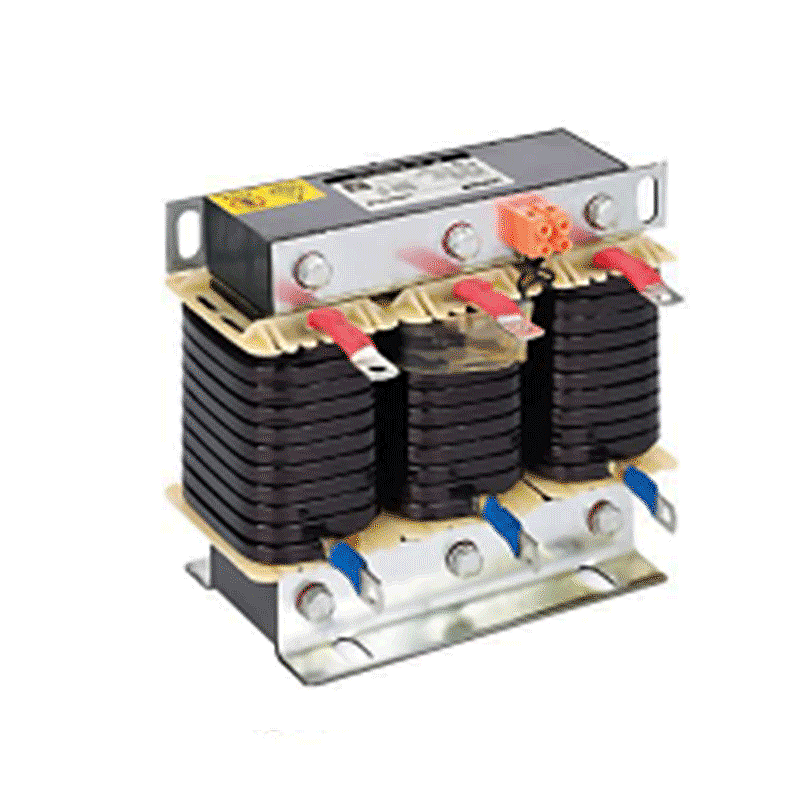 | Series Reactor (reactive power compensation reactor) |
| Three phases complement each other | |
| Effectively suppress harmonics | |
| Protection capacitor life |
Technical specifications
- Maximum continuous working voltage: 3x450VAC; 3x525VAC
- Rated capacity: 5-60KVar
- Reactance rate: 6%; 7%; 12%; 14%
- Overload capacity: 1.6 times rated current for 1min, once per hour
- Cooling method: natural cooling
- Protection level: IP00
- Insulation level: T40/F (155°C)
- Temperature range:
-40℃-45℃ full load operation
45C-100°C reduced capacity operation
-40℃-100℃ transportation and storage
Features and Benefits
- After the capacitor is connected in series with the reactor, the resonant frequency is lower than the lowest in the system (generally 5th to 7th), making it capacitive at the power frequency to improve the power factor, and there is no filter to amplify harmonics at resonance. After good impedance matching, the capacitor group can absorb 30%-60% of the harmonic current (such as the 5th).
- The harmonic order of the system is mainly above 5th, and the reactance rate is selected from 6% to 7%.
- The harmonic order of the system is mainly 3rd, and the reactance rate is selected from 12% to 14%.
Application
- Secondary side of power transformers
- High voltage transmission lines
- Front end of capacitor banks
- Access points for distributed power generation
DOREXS offers more series reactor options, please contact us for a quote.
What is series reactor
Series reactor is also called detuning reactor, which is used for powerless compensation, adding impedance at appropriate places to limit short-circuit current and/or control load balance between parallel lines. It is a common power device in power system.
Functions of series reactors
- Suppress high-order harmonics
- Limit inrush current when switching on
- Improve system power factor
- Prevent harmonic capacitors from causing damage
- Avoid excessive amplification of grid harmonics and resonance caused by capacitor device connection
- Regulating the output of distributed power sources
What is the difference between series reactor and shunt reactor?
1. Different functions
Series reactors are connected in series in the circuit to adjust the voltage and current phase of the circuit. Shunt reactors are connected in parallel in the circuit to consume useless work in the circuit, thereby improving the power supply quality of the power system.
Series reactors are connected in series in the circuit to adjust the voltage and current phase of the circuit. Shunt reactors are connected in parallel in the circuit to consume useless work in the circuit, thereby improving the power supply quality of the power system.
2. Different principles
Series reactors adjust the power factor of the circuit by changing the inductance value of the circuit. Shunt reactors adjust the reactive power of the circuit by changing the inductance value in the circuit.
Series reactors adjust the power factor of the circuit by changing the inductance value of the circuit. Shunt reactors adjust the reactive power of the circuit by changing the inductance value in the circuit.
3. Different application scenarios
Series reactors are often used in high-voltage transmission lines and large substations, while shunt reactors are more suitable for low-voltage power systems.
Series reactors are often used in high-voltage transmission lines and large substations, while shunt reactors are more suitable for low-voltage power systems.
How to choose a suitable series reactor?
The following factors should be considered when choosing a suitable series reactor:
- System voltage level
- Short-circuit current level
- Inductance value and current capacity
- Working environment (temperature, humidity, etc.)
- Equipment size and installation location
What problems can series reactors cause?
- Noise and vibration may occur
- Overheating or damage to the reactor may cause power system failure
- If not designed properly, it may not effectively limit short-circuit current or improve voltage quality
DOREXS offers a high quality selection of reactors. Contact our team for the latest quote.
Comprehensive score