What is EMI Filter
With the popularization of electronic and electrical equipment, various environments, ranging from home environments to industrial manufacturing, are full of electromagnetic interference. In these settings, EMI can disrupt electrical systems and electrical devices, leading to noise, signal degradation, and operational issues.
However, as the number of electronic devices increases, the electromagnetic interference they generate may cause device performance degradation or even malfunction. Both natural EMI, such as that caused by lightning or solar flares, and man-made sources like Bluetooth devices, contribute to electromagnetic disturbances in these environments.
In industrial manufacturing environments, industrial EMI is a significant concern due to large-scale equipment and processes generating strong electromagnetic disturbances and transient voltages.
In order to ensure the reliability and performance stability of the equipment, the control of EMI becomes crucial. In this case, EMI filters become an important tool that can effectively reduce or eliminate unnecessary interference.
However, as the number of electronic devices increases, the electromagnetic interference they generate may cause device performance degradation or even malfunction. Both natural EMI, such as that caused by lightning or solar flares, and man-made sources like Bluetooth devices, contribute to electromagnetic disturbances in these environments.
In industrial manufacturing environments, industrial EMI is a significant concern due to large-scale equipment and processes generating strong electromagnetic disturbances and transient voltages.
In order to ensure the reliability and performance stability of the equipment, the control of EMI becomes crucial. In this case, EMI filters become an important tool that can effectively reduce or eliminate unnecessary interference.

In order to better understand what an EMI filter is, we must first know what EMI is
EMI (Electromagnetic Interference) refers to the interference phenomenon caused by the radiation or conduction of electromagnetic fields in electronic equipment or systems. This interference may come from components of the device itself, or from other devices or electromagnetic sources in the external environment. When the interference is in the radio frequency spectrum, it is also called radio frequency interference (RFI). EMI can occur across the entire electromagnetic spectrum, and broadband EMI can impact devices by spanning multiple frequency ranges. When EMI is generated in the environment, it will disrupt the normal operation of electronic equipment, resulting in reduced equipment performance and reduced lifespan. In severe cases, it will directly lead to equipment failure and permanent damage. Therefore, EMI filter has become one of the important tools to effectively reduce or eliminate unnecessary interference.
What causes EMI?
Noise on power lines and ground lines is one of the main sources of EMI. Electrical circuits and power and signal lines are common pathways for EMI to travel. This noise may come from parasitic capacitance and inductance between the power line and ground, as well as voltage fluctuations on the power line. To reduce this noise, methods such as filters, voltage regulators, and shielding can be used. In reality, a common cause of excessive radiation is that the loop that should be kept minimal becomes a large loop, or extra wires are attached to the line, resulting in additional radiation. The antenna effect formed by these large loops or wires will play a major role in the total radiation. EMI can be classified as conducted and radiated, depending on whether the unwanted energy travels through wires or through the air. In short, there are many sources of EMI. Understanding these EMI sources and taking corresponding measures can effectively reduce the EMI level of electronic equipment and communication systems and ensure their normal operation. Unwanted energy from both internal and external sources can disrupt signal and power lines, leading to interference.
Types of EMI
Electromagnetic interference (EMI) can be classified into several types based on how it originates, its frequency, and the way it travels through electronic systems. The main types of EMI include radiated EMI, conducted EMI, common mode EMI, and differential mode EMI.
Radiated EMI refers to electromagnetic energy that is emitted through the air, often from sources like radio transmitters, mobile phones, or microwave ovens. This type of interference can disrupt the operation of nearby electronic devices without any direct electrical connection. Conducted EMI, on the other hand, travels along power lines, cables, or other conductive paths, entering electronic equipment through its power or signal lines.
Common mode EMI occurs when unwanted electric currents flow between the power line and ground, while differential mode EMI happens between two power conductors. Each type of EMI poses unique challenges for electronic devices and systems, making effective EMI filtering essential for maintaining electromagnetic compatibility. By understanding the different types of EMI, engineers can select the right EMI filters and design strategies to protect sensitive equipment and ensure reliable operation.
Radiated EMI refers to electromagnetic energy that is emitted through the air, often from sources like radio transmitters, mobile phones, or microwave ovens. This type of interference can disrupt the operation of nearby electronic devices without any direct electrical connection. Conducted EMI, on the other hand, travels along power lines, cables, or other conductive paths, entering electronic equipment through its power or signal lines.
Common mode EMI occurs when unwanted electric currents flow between the power line and ground, while differential mode EMI happens between two power conductors. Each type of EMI poses unique challenges for electronic devices and systems, making effective EMI filtering essential for maintaining electromagnetic compatibility. By understanding the different types of EMI, engineers can select the right EMI filters and design strategies to protect sensitive equipment and ensure reliable operation.
What is an EMI filter?
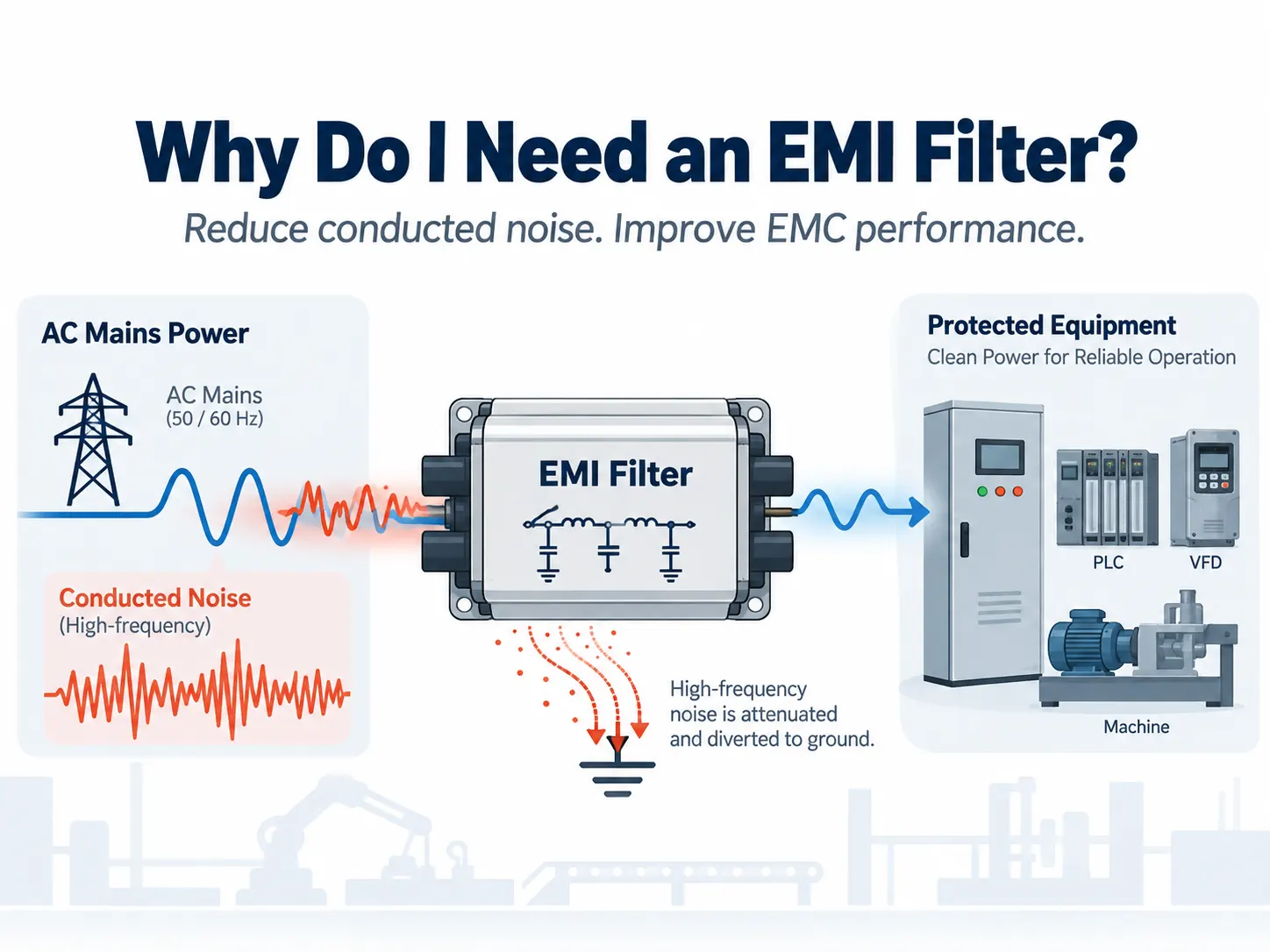
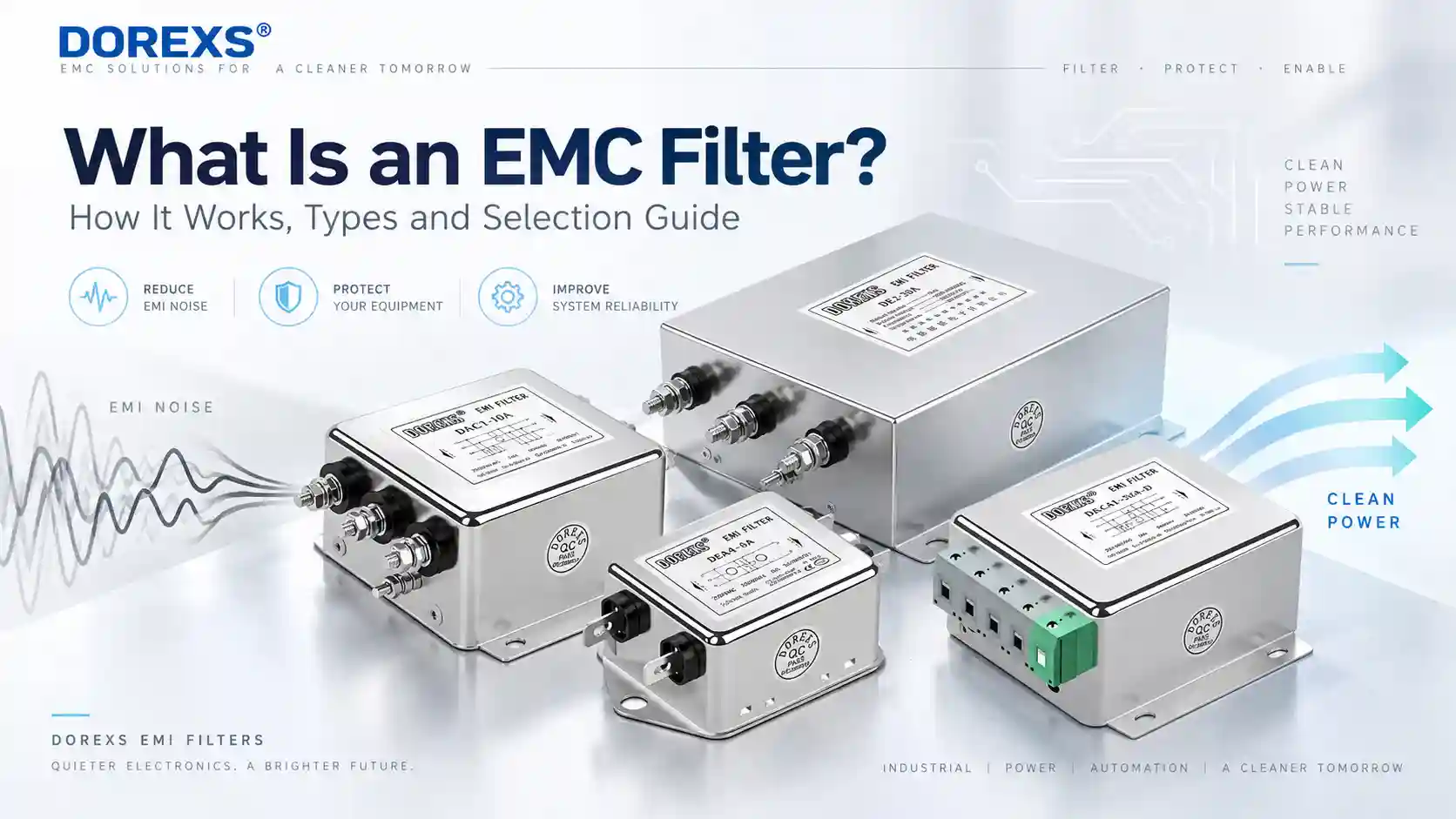
EMI filter, also called EMI suppression filter, is an electronic device that can effectively block or weaken interference signals within a specific frequency range, thereby protecting equipment from electromagnetic interference and ensuring the normal operation of equipment. Electromagnetic interference filters are used in a wide range of EMI filter applications to protect sensitive equipment in residential, industrial, medical, military, and power electronics sectors.
EMI filters play a key role in EMI mitigation by reducing voltage distortion and improving power quality in electronic systems.
EMI filters play a key role in EMI mitigation by reducing voltage distortion and improving power quality in electronic systems.

The composition of EMI filter
EMI filters usually consist of capacitors, inductors, resistors, chokes and fuses. These components can be implemented as discrete components or combined to form integrated passive filters. Passive filters are designed to absorb and dissipate electromagnetic interference, and they use electrical resonance to target and attenuate specific frequencies of unwanted signals.These components are rationally connected together to form a filter circuit that is used to reduce or block electromagnetic interference signals in a specific frequency range.
How EMI filters work
EMI filters use the impedance characteristics of inductors and capacitors at specific frequencies to absorb or reflect interference signals, thereby reducing the impact of electromagnetic interference. Many EMI filters function as low pass filters, allowing desired signals to pass while blocking high frequencies.
Set appropriate impedance on the power line so that interference signals cannot pass smoothly. Line filters and power line filters are commonly installed on power supply lines to suppress conducted EMI. At the same time, the filter can also reflect interference signals back to the source to reduce interference to other equipment. Proper connection and shielding of the filter input is essential for effective EMI suppression. Moreover, EMI filters can also effectively suppress common-mode interference and differential-mode interference, improving the electromagnetic compatibility of equipment. EMI filters are designed to handle specific signal power levels and are particularly effective at filtering high frequencies.
Set appropriate impedance on the power line so that interference signals cannot pass smoothly. Line filters and power line filters are commonly installed on power supply lines to suppress conducted EMI. At the same time, the filter can also reflect interference signals back to the source to reduce interference to other equipment. Proper connection and shielding of the filter input is essential for effective EMI suppression. Moreover, EMI filters can also effectively suppress common-mode interference and differential-mode interference, improving the electromagnetic compatibility of equipment. EMI filters are designed to handle specific signal power levels and are particularly effective at filtering high frequencies.
Common Mode EMI
Common mode EMI is a specific form of electromagnetic interference that arises when unwanted electric currents flow between the power line and ground. This type of interference is commonly generated by switching power supplies, electric motors, and various electronic devices found in industrial equipment and medical devices.
Common mode EMI can cause significant disruptions in power supplies and sensitive electronics, leading to malfunctions or degraded performance. To combat this, common mode EMI filters are used to attenuate the noise traveling between the power line and ground, while still allowing the desired differential mode signals to pass through. These EMI filters are crucial in environments where electromagnetic compatibility is a priority, such as in medical devices, industrial automation, and power supply systems. By effectively reducing common mode EMI, these filters help maintain the reliability and safety of electronic equipment.
Common mode EMI can cause significant disruptions in power supplies and sensitive electronics, leading to malfunctions or degraded performance. To combat this, common mode EMI filters are used to attenuate the noise traveling between the power line and ground, while still allowing the desired differential mode signals to pass through. These EMI filters are crucial in environments where electromagnetic compatibility is a priority, such as in medical devices, industrial automation, and power supply systems. By effectively reducing common mode EMI, these filters help maintain the reliability and safety of electronic equipment.
Active EMI Filters
Active EMI filters represent an advanced solution for managing electromagnetic interference in modern electronic systems. Unlike passive EMI filters, which rely solely on passive components like capacitors and inductors, active EMI filters use an internal power supply to generate a counteracting current that cancels out unwanted high frequency noise.
These filters are particularly effective at suppressing both common mode and differential mode EMI, especially in applications where high-frequency noise is a concern. Active EMI filters are commonly found in power supplies, industrial equipment, and medical devices, where they provide superior attenuation compared to passive EMI filters. Their compact size and lightweight design make them ideal for applications with space or weight constraints. However, because they require a power supply and more complex circuitry, active EMI filters can be more expensive than their passive counterparts. Despite this, their ability to deliver high performance EMI filtering makes them a popular choice in demanding environments.
These filters are particularly effective at suppressing both common mode and differential mode EMI, especially in applications where high-frequency noise is a concern. Active EMI filters are commonly found in power supplies, industrial equipment, and medical devices, where they provide superior attenuation compared to passive EMI filters. Their compact size and lightweight design make them ideal for applications with space or weight constraints. However, because they require a power supply and more complex circuitry, active EMI filters can be more expensive than their passive counterparts. Despite this, their ability to deliver high performance EMI filtering makes them a popular choice in demanding environments.
Filter classification
EMI filters can be classified according to their structural characteristics, operating frequency and application fields.
1. Classification according to structural characteristics
LC filter: A filter circuit composed of a combination of inductor (L) and capacitor (C), which can filter out harmonics of a specific order.
RC filter: uses a combination of resistor (R) and capacitor (C) and is usually used for simple signal conditioning.
Pi-type filter: It is composed of inductors and capacitors according to a specific Pi-type structure and is suitable for specific applications.
T-type filter: The structure is similar to the Pi-type filter, but a different component configuration is used.

2. Classification according to filter characteristics
Low-pass filter: allows signals below a specific frequency to pass and filters out interference signals above that frequency.
High-pass filter: The opposite of a low-pass filter, which allows signals above a specific frequency to pass and filters out interfering signals below that frequency.
Bandpass filter: only allows signals in a specific frequency range to pass and blocks signals in other frequency ranges.
Bandstop filter (also called notch filter): blocks signals in a specific frequency range while allowing signals in other frequency ranges to pass.
3. Classification according to application, such as power supplies
Power filter: used in the power supply system of circuits to suppress electromagnetic interference conducted by power lines. EMI filters are widely used in power electronics to suppress noise generated by switching operations.
Signal filter: used on signal lines to reduce electromagnetic interference on signal lines.
Filter on the printed circuit board: Has the ability to reduce electromagnetic interference on the circuit board.
4. Classification according to application current
Single Phase EMI Filters: Used in applications such as single-phase motor drives, power supplies, office equipment, and test and measurement equipment. Single phase filters are designed for use in a variety of electrical systems to filter electromagnetic interference for electrical and electronic equipment.
Three phase EMI filter: can be used as the main input filter for industrial equipment, machine tools, machinery and automation systems. Three phase EMI filters are essential for stabilizing voltages and supporting high-current three phase power applications, especially in equipment powered by three-phase power systems.
DC EMI Filters: Used to protect solar panels, photovoltaic charging/conversion systems, battery charging and conditioning systems, DC motor drives and inverters/converters. DC filters are critical for protecting DC power and control lines in renewable energy and battery systems.
Performance Advantages of EMI Filters
- Efficient filtering: EMI filters can effectively filter out various electromagnetic interference signals, prevent or weaken the impact of external interference signals on equipment, ensure the stability and reliability of equipment, and improve the quality of electronic equipment products.
- Low loss: High-quality EMI filters have low power and energy consumption and will not have a negative impact on the overall performance of the system. The efficiency of EMI filters reduces maintenance and repair costs.
- High reliability: EMI filters that have been rigorously tested and verified have high reliability and stability and can operate stably for a long time.
- Comply with electromagnetic compatibility requirements: EMI filters produced in accordance with standards and regulations ensure that equipment meets electromagnetic compatibility (EMC) requirements. Understanding EMI filter requirements is essential for selecting filters that meet specific application needs and regulatory standards.
- Comply with regulations: Ensure the safety of electronic equipment and meet complex EMC specifications, regulations and standards.
- Wide applicability: EMI filters are suitable for application fields in many different environments, including household consumer appliances, communication systems, industrial automation, medical equipment, military aviation, etc.
Tips for installing EMI filters
Choosing the correct EMI filter installation method can ensure efficient operation and minimize electromagnetic interference. The following EMI filter installation recommendations will help achieve proper EMI filter performance:
Choose an appropriate location: The filter should be installed at the shortest point in the cable, as close to the EMI source as possible.
Choose an appropriate location: The filter should be installed at the shortest point in the cable, as close to the EMI source as possible.
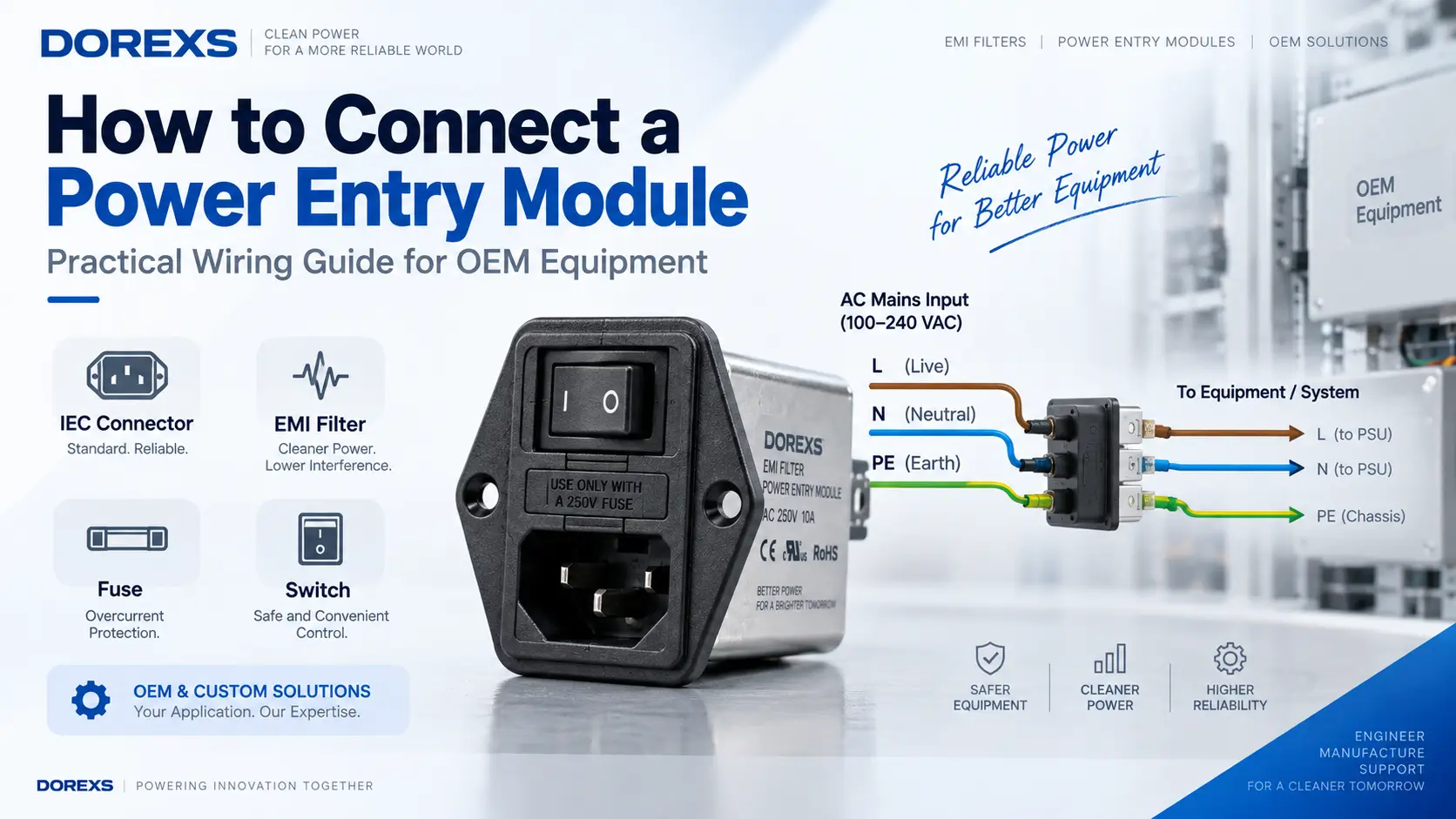
Correct wiring: Make sure to connect the input and output ends of the filter correctly, and pay attention to the polarity of the wiring and good contact.
Ground connection: Make sure the filter's ground wire is connected to a good grounding point on the equipment to effectively direct interfering signals to ground.
Proper fixation: Make sure the fixings are firm and secure and will not loosen or fall off.
Prevent cross interference: Keep the filter at a certain distance from other lines.
Test and adjust: After successful installation, debug to ensure normal operation.
Ground connection: Make sure the filter's ground wire is connected to a good grounding point on the equipment to effectively direct interfering signals to ground.
Proper fixation: Make sure the fixings are firm and secure and will not loosen or fall off.
Prevent cross interference: Keep the filter at a certain distance from other lines.
Test and adjust: After successful installation, debug to ensure normal operation.
How to select an EMI filter
Before selecting an EMI filter, it is important to examine and evaluate the requirements of the electrical system. The specific needs of the electronic system and the level of conducted emissions should also be considered, as these factors influence the choice of EMI filter to ensure compliance and reliable operation. Each type of EMI filter has limitations, frequency ranges, and suppression methods. Determine the frequency range: Different EMI filters are suitable for different frequency ranges, including low frequency, radio frequency and microwave bands. Select the appropriate filter type: Select the appropriate filter type according to specific needs. Consider system parameters:
- Input voltage
- Rated current
- Ambient temperature and operating temperature
- leakage current
- Insertion loss
- Power system type
- high potential
- Installation dimensions and installation methods
- Equipment type
EMI Filter Maintenance
Regular maintenance of EMI filters is essential to ensure the ongoing reliability and performance of electronic devices and systems. Over time, EMI filters can become less effective due to component aging, environmental factors, or physical damage, which can allow electromagnetic interference to compromise system operation.
To maintain optimal performance, it is important to conduct routine visual inspections for signs of wear or damage, perform electrical testing to verify filter effectiveness, and replace any degraded or faulty components as needed. Following the manufacturer’s guidelines for maintenance and replacement intervals is also crucial. Proper EMI filter maintenance not only helps prevent electromagnetic interference but also supports electromagnetic compatibility, reduces the risk of unexpected system failures, and extends the lifespan of sensitive electronic equipment. By proactively maintaining EMI filters, organizations can minimize downtime and ensure their electronic systems continue to operate reliably in environments with high levels of electromagnetic noise.
To maintain optimal performance, it is important to conduct routine visual inspections for signs of wear or damage, perform electrical testing to verify filter effectiveness, and replace any degraded or faulty components as needed. Following the manufacturer’s guidelines for maintenance and replacement intervals is also crucial. Proper EMI filter maintenance not only helps prevent electromagnetic interference but also supports electromagnetic compatibility, reduces the risk of unexpected system failures, and extends the lifespan of sensitive electronic equipment. By proactively maintaining EMI filters, organizations can minimize downtime and ensure their electronic systems continue to operate reliably in environments with high levels of electromagnetic noise.
DOREXS is an expert in EMI solutions
If you need effective EMI protection or EMC testing, DOREXS can provide you with reliable and durable EMI filters. We offer high-quality EMI filters for military, aerospace, and medical applications, as well as cost-effective EMI filters for small home appliances and industrial uses. If you need an EMI filter with special custom requirements, our team of experts can design an EMI suppression filter that meets your specific requirements.
With 15 years of EMI experience, DOREXS is a trusted manufacturer of high-quality EMI filters for medical, military, commercial and residential applications. All our EMI filters are designed to comply with industry standards and comply with EMC regulations. Explore our selection of EMI filters or submit a custom quote request to get the perfect EMI filter for your needs.
For more information about DOREXS custom and standard EMI filters, please contact us.
Learn more about DOREXS EMI solutions.
How to Test EMI Filter
EMI Impact in Gaming Equipment