EMC Filter VFD: Complete Guide to Electromagnetic Compatibility Filters for Variable Frequency Drives
When a water treatment plant installed VFDs to control their pump motors, they faced an unexpected challenge. The 150-meter motor cables experienced 120% voltage overshoot, leading to frequent motor failures and costly downtime. The solution? Installing specialized EMC filters that eliminated the overshoot and reduced failures by 65%. This example illustrates why EMC filters have become essential components in modern VFD installations.
Variable frequency drives generate high-frequency electromagnetic interference that can disrupt nearby equipment, violate compliance standards, and damage connected motors. EMC filters provide the critical electromagnetic compatibility needed for reliable industrial operations while meeting strict international standards.

Key Takeaways
- EMC filters for VFDs are essential low-pass filters that suppress high-frequency interference and ensure electromagnetic compatibility compliance
- Available in both input and output configurations with current ratings from 6A to 1000A for 3-phase systems at 250/440V AC
- Input EMC filters prevent noise feedback into the power grid, while output filters protect connected motors and equipment
- Required for EU compliance under IEC 61800-3 standards and widely used in industrial automation applications
- Three-stage filter design using inductors and capacitors provides superior interference suppression compared to basic filters
What is an EMC Filter for VFD

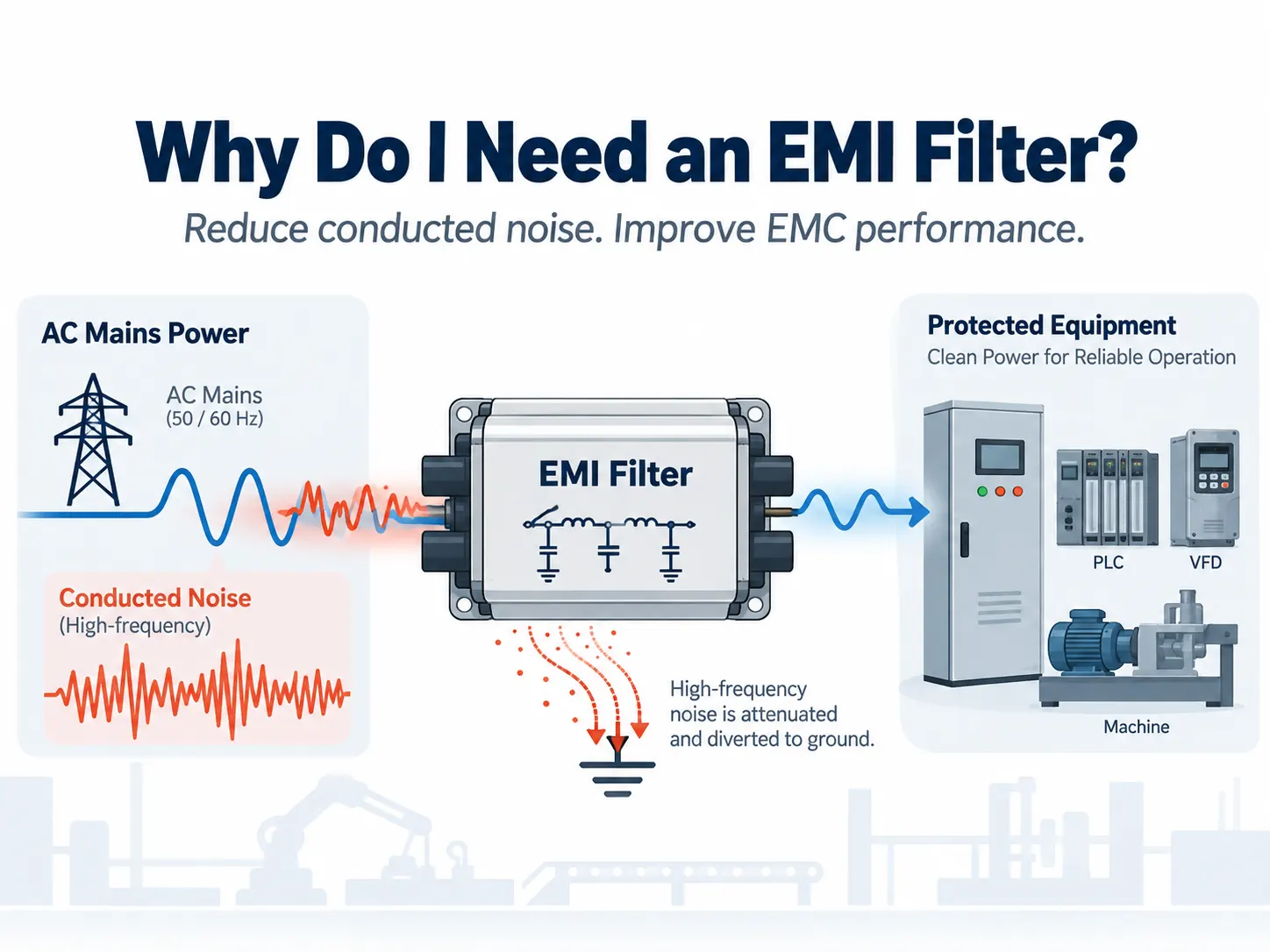
An EMC filter for VFD applications is a specialized low-pass filter composed of inductors and capacitors designed specifically for variable frequency drives. These filters eliminate high-frequency interference signals generated by pulse width modulation switching in VFDs while allowing useful fundamental frequency signals to pass through.
The primary function involves suppressing electromagnetic interference that occurs when Insulated Gate Bipolar Transistors (IGBTs) rapidly switch during frequency conversion. This switching action creates harmonic distortion and electrical noise that can interfere with other industrial electronic equipment and communication systems.
Core Components and Design
EMC filters utilize specific components to achieve excellent interference suppression capability:
- X and Y capacitors (such as TDK B32922C or Kemet R41Y) handle differential and common-mode noise suppression
- Common-mode chokes (like Würth WE-CMB) provide line-to-ground noise attenuation
- Series inductors create the low-pass filtering characteristic
These components work together to address both conducted emissions that could pollute the electrical system and radiated emissions that disturb nearby sensors and other digital equipment.
A documented case study demonstrates the effectiveness: a VFD installation measured 58dBμV of electromagnetic noise between 150kHz and 30MHz. After installing a quality filter specially designed for VFD applications, emissions dropped to a compliant 42dBμV level.
VFD Input EMC Filters
VFD input filters install between the main power supply and the VFD input end to prevent electromagnetic interference from propagating back into the power grid. These emc input line filters serve as the first line of defense against conducted emissions.
Technical Specifications
Input EMC filters feature robust specifications to meet strict environmental requirements:
- Current ratings spanning 6A to 1000A for comprehensive coverage
- Voltage compatibility with 250V and 440V AC systems at 50/60Hz frequency
- Three-stage filter topology providing larger attenuation than basic designs
- Small leakage current levels typically below 7.5mA for safety compliance
- Test voltage capabilities reaching 2700V DC for high reliability
The filters utilize a series of inductors and shunt capacitors arranged to create maximum interference suppression. This configuration effectively blocks high frequency noise while maintaining system efficiency for fundamental frequency operation.
Installation and Mounting
Input side filters offer flexible mounting solutions:
| Mounting Type | Application | Frame Compatibility |
| DIN rail | Control panels | A-D frames |
| Back panel | Space-efficient | A-D frames |
| Side mount | Larger current ratings | E frames |
Professional installation requires minimizing cable lengths between the filter and VFD input terminals to maintain filtering effectiveness.
VFD Output EMC Filters
Output EMC filters connect between the VFD output and connected motors to reduce common-mode electromagnetic noise and protect downstream equipment. These special filters address the unique challenges of motor cable installations.
Protection Benefits
VFD output filters provide multiple protection mechanisms:
- Voltage rise time reduction that protects motor insulation from fast switching transients
- Common-mode noise suppression that prevents interference with nearby control systems
- Extended motor and cable service life through reduced electrical stress
- Harmonic distortion reduction improving overall system efficiency
The filters particularly benefit applications with long cable runs exceeding 100 meters, where cable reflections can cause voltage doubling effects.
Current Ratings and Applications
Output filters accommodate diverse industrial applications:
- 6A to 50A: HVAC systems and small machinery
- 75A to 200A: Industrial automation and manufacturing equipment
- 250A to 1000A: Large motor drives in water treatment and critical infrastructure
Each current range meets specific application requirements while maintaining compliance with electromagnetic compatibility standards.
Technical Specifications and Standards
EMC filters must meet rigorous international standards to ensure reliable operation across global markets. The primary standard, IEC 61800-3, establishes electromagnetic compatibility requirements for adjustable speed electrical power drive systems throughout the EU and many other regions.
Performance Characteristics
Key technical specifications define filter performance:
|
Parameter
|
Specification
|
Purpose
|
| Attenuation frequency | >150kHz | Match regulatory limits |
| Insertion loss | 40-60dB at 1MHz | Effective interference suppression |
| Operating temperature | -25°C to +85°C | Industrial environment compatibility |
| Protection rating | IP20 | Standard enclosure integration |
These specifications ensure filters provide sufficient interference suppression while maintaining compatibility with existing electrical systems.
Compliance Requirements
Different regions require specific compliance certifications:
- IEC 61800-3: Primary EU standard for electromagnetic compatibility
- CISPR 11/EN 55011: EMI limits for industrial equipment
- UL recognition: North American safety and performance standards
Meeting these requirements enables global deployment while avoiding costly compliance issues during installation.
Installation and Mounting Options
Proper installation maximizes EMC filter effectiveness and ensures long-term reliability. Installation practices vary based on VFD frame sizes and application requirements.
Frame-Specific Mounting
Different VFD frame sizes require tailored mounting approaches:
Frames A-D (Smaller drives):
- Filter mounts on enclosure back panel for space efficiency
- DIN rail mounting simplifies control panel integration
- Shorter cable runs maintain filtering effectiveness
Frame E (Larger drives):
- Side mounting accommodates higher current ratings
- Enhanced heat dissipation prevents thermal issues
- Dedicated EMC mounting plates streamline installation
Best Practice Guidelines
Successful installations follow established best practices:
- Include EMC filtering in original VFD design to avoid costly retrofits
- Select current ratings with 20% safety margin above VFD nominal current
- Minimize cable lengths between filter and drive terminals
- Implement proper shield grounding for maximum effectiveness
- Avoid shared neutrals in EMC-critical installations
Some manufacturers provide ferrite cores and specialized mounting hardware to enhance high-frequency suppression and simplify cable management.
Applications and Industries

EMC filters find widespread application across industries where variable frequency drives operate near sensitive electronic equipment or must meet electromagnetic compatibility requirements.
Primary Industries
HVAC Systems: Industrial HVAC installations utilize EMC filters to meet energy efficiency regulations while preventing interference with building automation systems. The filters enable compliance with strict environmental requirements common in commercial buildings.
Water and Wastewater Treatment: Long cable runs between control rooms and remote pump stations create ideal conditions for electromagnetic interference. EMC filters prevent disruption of SCADA systems and other critical monitoring equipment.
Manufacturing and Automation: Precision manufacturing requires EMC filters to prevent frequency converters from interfering with sensitive measurement equipment, PLCs, and communication networks on the work site.
Specialized Applications
Servo motor systems in precision machinery demand exceptional noise immunity, making EMC filters essential for maintaining positioning accuracy. Renewable energy installations, including wind turbines and solar inverters, use these filters to meet grid connection requirements.
Critical infrastructure applications in hospitals and data centers cannot tolerate electromagnetic interference that might disrupt life-safety systems or data processing equipment.
Selection Guidelines and Best Practices

Selecting the appropriate EMC filter requires careful consideration of electrical specifications, application requirements, and compliance needs. Following systematic selection guidelines ensures optimal performance and regulatory compliance.
Electrical Requirements
Start with fundamental electrical compatibility:
- Current Rating: Select filters rated at least equal to VFD nominal output current, with a recommended 20% safety margin
- Voltage Compatibility: Verify 250V or 440V AC rating matches local power supply standards
- Frequency Range: Confirm 50/60Hz compatibility for regional power systems
Application Considerations
Different applications require specific filter characteristics:
- Input filters: Essential for preventing power grid contamination and meeting utility interconnection requirements
- Output filters: Critical for long cable runs, sensitive downstream equipment, or motor protection
- Combined approach: Many installations benefit from both input and output filtering for comprehensive EMC management
Standards Compliance
EMC filters ensure compliance with electromagnetic compatibility standards but address different issues than harmonic distortion. For applications requiring IEEE-519 harmonic compliance, dedicated harmonic correction devices may be necessary alongside EMC filtering.
Popular EMC Filter Models and Manufacturers
The market offers diverse EMC filter options from established manufacturers, each providing specialized solutions for different VFD applications and current requirements.
Leading Manufacturers
- DOREXS DF2 Series: Features three-stage design for superior performance across 10A to 1000A current range. These filters provide excellent interference suppression capability for demanding industrial applications.Rockwell Automation: PowerFlex 750 drives include EMC filters as standard equipment, while PowerFlex 520, 525, and 523 series offer filtering as optional add-ons. This integration simplifies system design and reduces installation complexity.
- Delta EMC Filters: Specifically designed for IEC 61800-3 compliance in industrial applications. These filters meet strict environmental requirements while providing reliable interference suppression.
- KEB Filter Portfolio: Comprehensive range covering input and output applications from 10A to 1000A ratings. Known for flexibility in custom configurations and specialized mounting options.
Performance Examples
Real-world testing demonstrates filter effectiveness. The DOREXS DF2 model reduced emissions from 58dBμV to 42dBμV in a documented 100HP VFD installation. The TDK B84312A sine wave output filter effectively managed extreme cabling distances while maintaining signal integrity.
Common Questions
What is the difference between input and output EMC filters for VFDs?
Input EMC filters protect the power grid and upstream equipment from VFD-generated interference, while output filters protect motors and cables from high-frequency noise and voltage stresses. Input filters prevent conducted emissions from propagating back through the electrical system, while output filters reduce motor insulation stress and extend equipment life.
Do all VFDs require EMC filters for proper operation?
Not all VFDs require EMC filters for basic functionality, but their use becomes mandatory for installations subject to EMC regulations such as IEC 61800-3 in the EU. Even where not legally required, EMC filters provide significant benefits in protecting sensitive equipment and reducing maintenance costs.
How do I determine the correct current rating for my EMC filter?
Base filter selection on the VFD’s nominal current rating with a recommended 20% safety margin. For example, a 100A VFD would require a filter rated for at least 120A. This margin accounts for operational variations and ensures reliable long-term performance.
Can EMC filters be retrofitted to existing VFD installations?
Yes, EMC filters can be retrofitted to existing installations, though this approach is more complex and costly than incorporating filters during initial system design. Retrofitting requires careful consideration of available space, cable routing, and potential system downtime during installation.
What are the typical leakage current levels for VFD EMC filters?
Most quality EMC filters maintain leakage current below 7.5mA to ensure safety and prevent nuisance tripping of ground fault protection devices. This low leakage current enables compliance with electrical safety standards while maintaining effective interference suppression.
Are EMC filters required for compliance with international standards?
EMC filters are essential for meeting IEC 61800-3 requirements in the EU and similar electromagnetic compatibility standards in other regions. These regulations mandate specific emission limits that most VFDs cannot meet without proper filtering.
How do EMC filters affect VFD efficiency and performance?
Properly selected and installed EMC filters have minimal impact on VFD efficiency, typically less than 1% reduction. The filters primarily affect high-frequency components while allowing fundamental frequency signals to pass with minimal loss. Quality filters may actually enhance system performance by reducing electrical noise and improving power quality.
What maintenance is required for VFD EMC filters?
EMC filters require minimal routine maintenance, primarily consisting of visual inspections for overheating, physical damage, and loose connections. Periodic insulation resistance testing can verify continued filter integrity, though most quality filters operate reliably for many years without intervention.
Conclusion
EMC filters represent essential components for modern VFD installations, providing the electromagnetic compatibility required for reliable industrial operations. These specialized filters address the high-frequency interference generated by variable frequency drives while ensuring compliance with strict international standards.
The choice between input and output EMC filters depends on specific application requirements, with many installations benefiting from both types for comprehensive interference
management. Proper selection based on current ratings, voltage compatibility, and compliance requirements ensures optimal performance and long-term reliability.
As industrial automation continues expanding and electromagnetic compatibility regulations become more stringent, EMC filters will remain critical for successful VFD deployments. By incorporating these filters into system designs from the outset and following established best practices, engineers can eliminate costly interference issues while protecting valuable equipment investments.
For specific applications requiring detailed filter specifications or custom solutions, consulting with reputable manufacturers can help identify the most effective EMC filtering approach for your particular requirements.
Best Plug in EMI Filter Solutions for Reliable Performance
Optimizing Your Switch Mode Power Supply Filter for Minimal Noise