Switching Power Supply EMI Filter: Role, Type and Selection Guide

Switching power supplies are widely used in industry, communication, medical and consumer electronics due to their high efficiency, miniaturization and high power density. However, the high-frequency switching action, parasitic parameters and electromagnetic radiation of switching power supplies will cause serious electromagnetic interference (EMI), affecting the quality of input power, interfering with peripheral equipment, and even causing compatibility issues with the power grid and surrounding systems.
As a key component for suppressing conducted and radiated interference, the correct selection and reasonable layout of EMI power supply filter can effectively reduce the noise level of switching power supply and ensure that the equipment complies with international EMC standards (such as CISPR, FCC, EN 55032, etc.). EMI mitigation is a critical aspect of electronic system design, requiring careful filter design and selection of high-quality filter components.
This article will introduce the role, type and selection method of switching power supply EMI filter in detail to help engineers optimize power supply design. Understanding filter design principles and the selection of appropriate filter components is essential for effective EMI mitigation in switching power supply applications.
Learn more about selecting the right EMI power supply filter...
EMI problems in switching power supply
Sources of EMI in switching power supplies
Impact of EMI
EMI standards and regulations
- CISPR 32 (Radiation Standard for Information Technology Equipment)
- FCC Part 15 (US Electromagnetic Compatibility Requirements)
- EN 55032/55035 (EU EMC Standard)
- GB/T 9254 (Chinese National Standard)
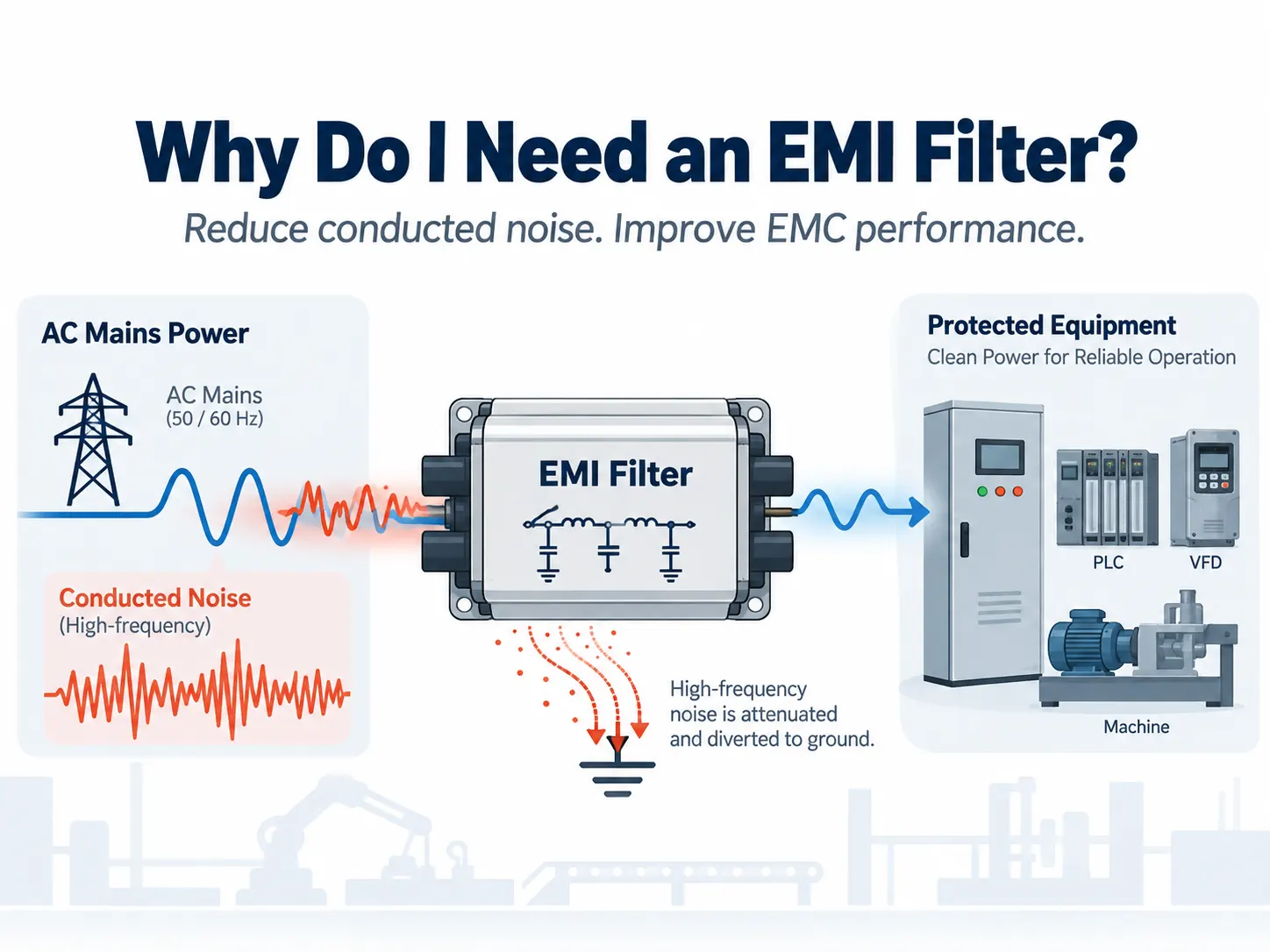
Basic Principles of EMI Power line Filters
- Common mode inductor: suppresses common mode noise (current flows in the same direction).
- X capacitor (across L-N): serves as a filter capacitor to filter out differential mode noise, and its value helps determine the cutoff frequency and overall filtering performance.
- Y capacitor (L/N-PE): serves as a filter capacitor to filter out common mode noise, with attention to leakage current limitation; also influences the cutoff frequency and filtering performance.
- Resistors/ferrite beads: damp high frequency oscillation.

Classification of EMI filters for DC and AC switching power supplies
DC EMI filter
The schematic diagram below illustrates the typical structure of a DC EMI filter.
Features:
- Mainly suppress high frequency switching noise (such as Buck/Boost circuit).
- Typical structure: LC filter, π filter.
- The influence of DC bias on inductance needs to be considered.
-
Inductive loads, such as motors and relays, are key factors that must be considered when designing DC EMI filters, as their presence affects the current waveform and EMI.
Example circuit:

AC EMI filter
Features:
- Suppresses power grid conducted interference (150kHz~30MHz).
-
Must meet safety regulations (such as Y capacitor withstand voltage, leakage current < 0.25mA), and ensure proper connection to earth ground for effective common mode noise suppression and safety compliance.
- Three-phase system requires a three-phase EMI filter.
Example circuit:

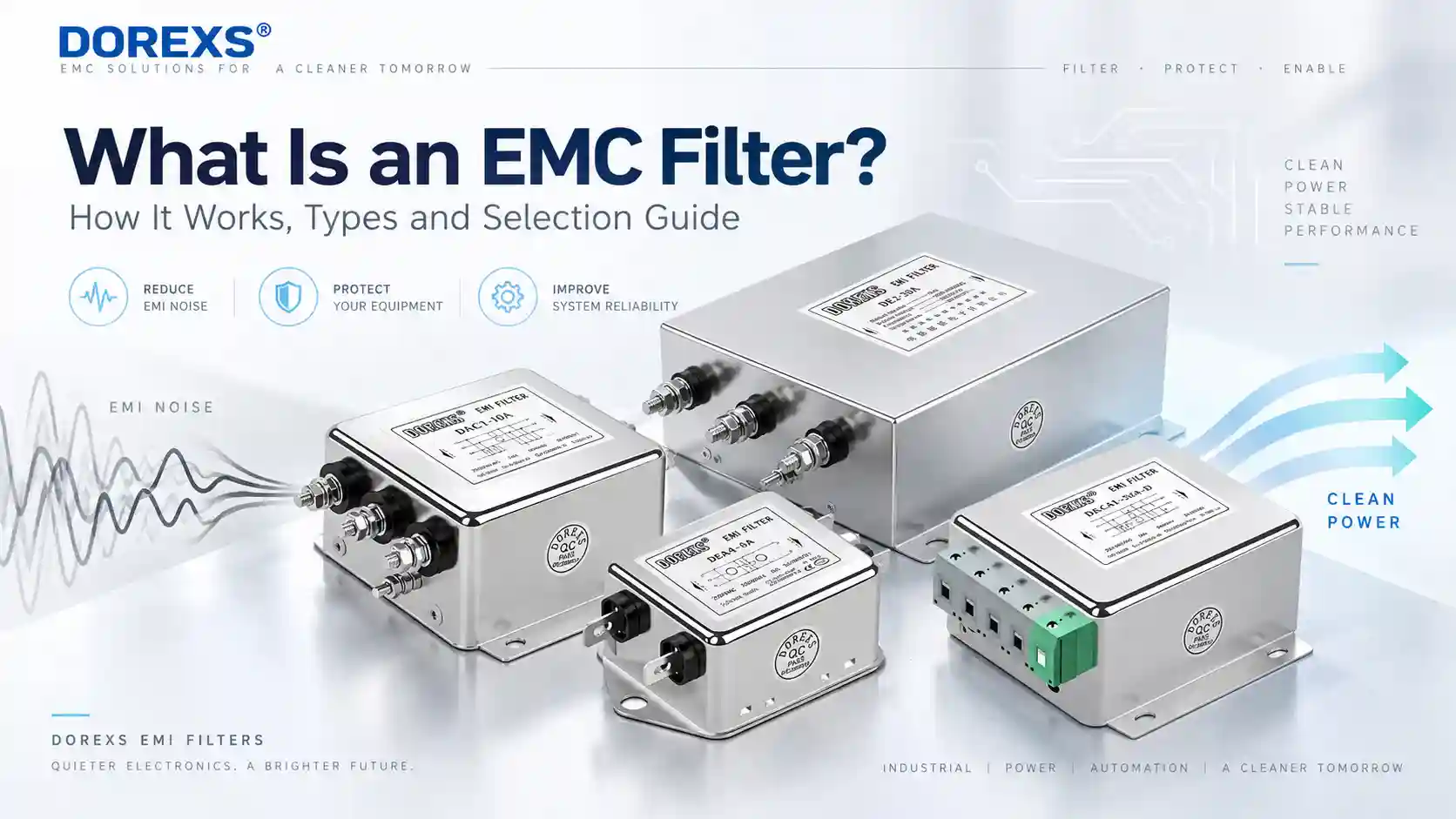
Types of switching power supply EMI filters
Type |
Features |
Applicable scenarios |
| Single-stage filter | Simple structure, low cost | Low power supply (<100W) |
| Two-stage filter | High attenuation performance, suitable for harsh environments | Industrial power supply, medical equipment |
| PCB installation type | Space saving, high integration | Compact DC-DC module |
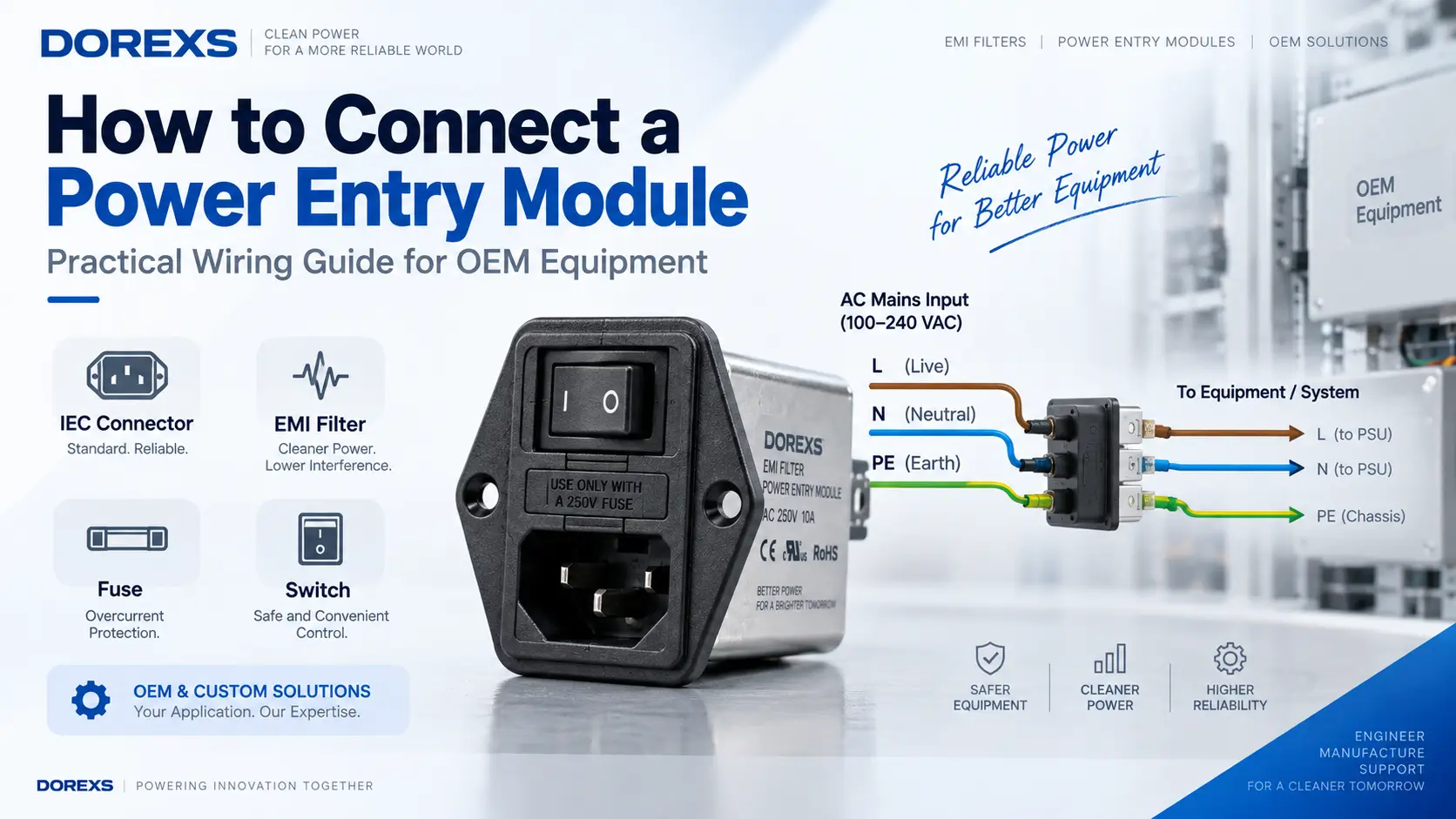
| IEC socket type | Plug and play, in line with standard power interface | Household appliances, IT equipment |
How to choose a suitable switching power supply EMI filter
(1) Select according to operating frequency
Switching frequency >100kHz: need to strengthen common mode suppression (common mode inductor + Y capacitor). The fundamental frequency or fundamental switching frequency in this case also sets the frequency band where EMI emissions are most significant, guiding the design of the filter for optimal attenuation.
(2) Select according to power level
(3) Comply with EMC standards
Adjust filter parameters according to test results (such as increasing inductance or capacitance value).
(4) Other considerations
- Leakage current: The total capacitance of Y capacitors needs to be limited (generally < 4700pF).
- Withstand voltage level: X capacitors (≥275VAC), Y capacitors (≥1500VDC). Proper capacitor selection helps prevent short circuit failures in safety-critical applications.
- Temperature characteristics: Ceramic capacitors or film capacitors are used in high temperature environments. The choice of dielectric material in capacitors affects their reliability and performance.
Installation and optimization of EMI power supply filters
When considering correct layout, it is crucial to focus on pcb layout and printed circuit board design. Using a ground plane beneath switching components helps minimize EMI by providing a low-impedance return path. Careful routing of power lines and controlling the emi current path are essential to reduce radiated noise and radiated EMI.
For optimization, reducing emi and radiated noise can be achieved through proper pcb layout and shielding techniques.
(1) Correct layout
(2) Grounding treatment
(3) Optimization tips
Use magnetic rings to suppress high-frequency radiation noise.
Action suggestions:
-
Reserve EMI filter space at the beginning of power supply design.
-
Verify filter performance through simulation and testing.
-
Select filters that meet safety certifications (such as UL, CE).
As a leading manufacturer of EMI filtering solutions, DOREXS has extensive R&D experience and advanced production equipment. We are committed to providing customers with high-quality EMI filtering products and services to meet the needs of multiple fields from industrial to consumer electronics.
Frequently Asked Questions
1. How do I choose an EMI filter that fits my power system?
2. What are the installation methods for switching power supply EMI filters?
3. For which standards of electromagnetic compatibility (EMC) does the EMI filter help?
4. What certification standards do EMI filters support?
5. Are EMI filters suitable for switching power supplies of various brands?
6. Can the switching power supply EMI filter be customized?
7. What is the delivery cycle and after-sales service of the product?
Top Uses for a Low Pass Filter in Modern Electronics
Top Ten EMI Filter Manufacturers 2025