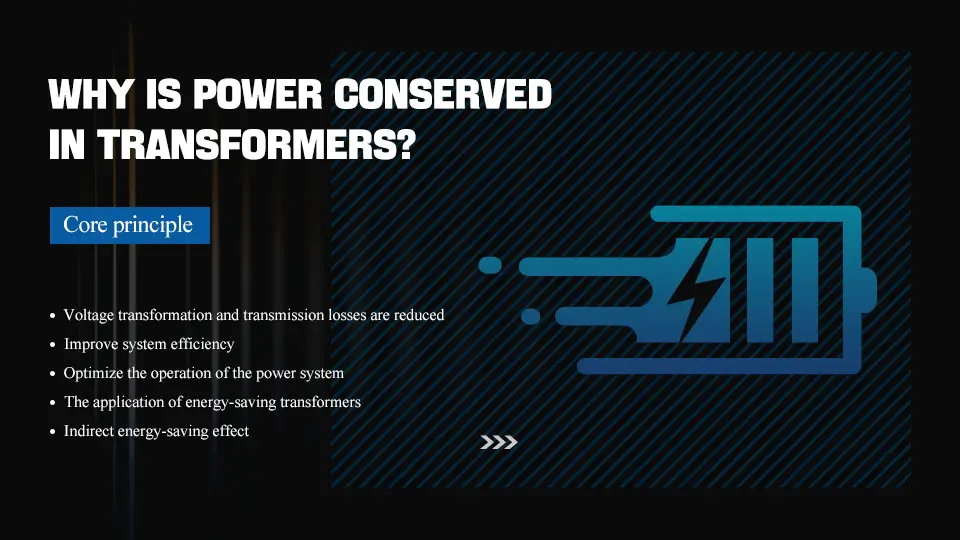
Why is Power Conserved in Transformers? Understanding the Core Principle
Power is conserved in transformers due to the law of energy conservation, which states energy cannot be created or destroyed. An ideal transformer ensures that the power input to the primary coil equals the power output from the secondary coil, which raises the question: why is power conserved in transformers? This article explains how transformers conserve power and the efficiency factors involved.
Key Takeaways
- Transformers maintain power conservation through electromagnetic induction, ensuring input power equals output power with minimal losses.
- Real transformers experience efficiency losses due to factors like resistive heat, eddy currents, and design imperfections, while ideal transformers are 100% efficient.
- The turns ratio and magnetic coupling efficiency are crucial for determining voltage transformation and ensuring effective energy transfer in transformers.
Fundamentals of Transformer Power Conservation

At the core of every transformer is the principle of power, defined as the product of voltage and current. This concept is essential for understanding transformer operation. Power represents the rate at which energy is transferred within an electrical system, making it a key factor in the efficiency of energy transformation.
Transformers use electromagnetic induction to change voltage levels efficiently. This process is governed by the principle of energy conservation, ensuring that the input power equals the output power in an ideal transformer. In practice, the power input to the primary winding (connected to the power source) is nearly fully transferred to the power output from the secondary winding (connected to the load). This efficient transfer makes transformers indispensable for distributing electrical energy over long distances.
By transforming voltage according to the law of energy conservation, transformers maintain the balance of power in electrical systems. Whether increasing voltage for long-distance power lines or reducing it for safe household use, transformers transfer electrical energy with minimal losses, adhering to energy conservation principles.
The Role of Energy Conservation
The principle of energy conservation states that energy cannot be created or destroyed, only converted from one form to another. In transformers, this ensures that the energy input to the primary coil equals the energy output from the secondary coil, accounting for minor losses. Adhering to this principle guarantees efficient energy transfer between circuits.
Transformers efficiently convert power input to the primary winding into power output from the secondary winding, minus inevitable losses. This power constancy ensures efficient energy transfer, upholding the law of conservation of energy, including both primary and secondary windings. Understanding how transformers work is essential for grasping these concepts.
Transformers often exceed 95% efficiency, meaning minimal energy losses and effective conversion of input power to output power. This high efficiency is crucial for applications requiring reliable and economical energy transfer.
Transformers efficiently convert power input to the primary winding into power output from the secondary winding, minus inevitable losses. This power constancy ensures efficient energy transfer, upholding the law of conservation of energy, including both primary and secondary windings. Understanding how transformers work is essential for grasping these concepts.
Transformers often exceed 95% efficiency, meaning minimal energy losses and effective conversion of input power to output power. This high efficiency is crucial for applications requiring reliable and economical energy transfer.
Ideal vs. Real Transformers

An ideal transformer operates at 100% efficiency with no losses, meaning the power input to the primary winding equals the power output from the secondary winding. However, real-world transformers experience efficiency losses due to factors like resistance in the windings and heat generation.
Real transformers experience losses that ideal transformers do not, including resistive loss (copper loss) due to the resistance of the windings, which creates responsible heat generation and makes sense.
Harmonic currents from modern equipment can further decrease transformer efficiency by generating additional heat in the windings under varying operating conditions. These factors underscore the challenges of achieving ideal transformer performance in practical applications.
Voltage and Current Dynamics
In transformers, voltage and current have an inversely proportional relationship to ensure power conservation. As voltage changes, current adjusts inversely to maintain the same power level. For instance, in a step-down transformer, reducing the voltage current increases the current in the secondary winding.
The transformer equation, which states that the ratio of secondary to primary voltage equal matches the ratio of their respective loop counts, illustrates this current relationship. This equation helps maintain power balance by adjusting voltage levels for efficient energy transfer and minimal losses, in accordance with Faraday’s law, while also determining the output voltage and the secondary current.
Practically, increasing the voltage in a step-up transformer decreases the current, and vice versa for a step-down transformer. This dynamic adjustment is vital for efficient transformer operation, allowing them to handle varying electrical loads while maintaining power constancy.
The transformer equation, which states that the ratio of secondary to primary voltage equal matches the ratio of their respective loop counts, illustrates this current relationship. This equation helps maintain power balance by adjusting voltage levels for efficient energy transfer and minimal losses, in accordance with Faraday’s law, while also determining the output voltage and the secondary current.
Practically, increasing the voltage in a step-up transformer decreases the current, and vice versa for a step-down transformer. This dynamic adjustment is vital for efficient transformer operation, allowing them to handle varying electrical loads while maintaining power constancy.
The Importance of the Turns Ratio
The turns ratio in a transformer is crucial, determining the relationship between primary and secondary voltages. Defined as the ratio of the number of turns in the primary winding to the secondary winding, this ratio directly influences voltage transformation.
In an ideal transformer, the voltage ratio between coils directly corresponds with the turns ratio. For example, a transformer with a 25:1 turns ratio will reduce 12,000 volts to 480 volts.
Selecting the appropriate turns ratio is crucial for achieving the desired power output in transformers, making it a key point of consideration in their design.
In an ideal transformer, the voltage ratio between coils directly corresponds with the turns ratio. For example, a transformer with a 25:1 turns ratio will reduce 12,000 volts to 480 volts.
Selecting the appropriate turns ratio is crucial for achieving the desired power output in transformers, making it a key point of consideration in their design.
Magnetic Flux and Coupling
Magnetic flux measures the magnetic field passing through a given area and plays a crucial role in transformer operation. Transformers transfer electrical energy between circuits without direct electrical connections, relying on electromagnetic induction.
Magnetic coupling in transformers occurs when the magnetic field generated by the primary coil induces an electromotive force in the secondary coil, influenced by a changing magnetic field. Governed by Faraday’s law, this process allows power transfer without a direct electrical connection, crucial for maintaining power balance.
The efficiency of magnetic coupling depends on the alignment and quality of the primary and secondary coils. Misalignment can lead to energy losses, emphasizing the importance of precise design and construction in transformers.
Magnetic coupling in transformers occurs when the magnetic field generated by the primary coil induces an electromotive force in the secondary coil, influenced by a changing magnetic field. Governed by Faraday’s law, this process allows power transfer without a direct electrical connection, crucial for maintaining power balance.
The efficiency of magnetic coupling depends on the alignment and quality of the primary and secondary coils. Misalignment can lead to energy losses, emphasizing the importance of precise design and construction in transformers.
Power Balance in Transformers

Power balance is essential for efficient transformer operation. The strength and quality of magnetic coupling between coils largely determine energy transfer efficiency. Correct alignment of primary and secondary coils is crucial for maximizing coupling and minimizing energy losses.
In real-world transformers, power differences often dissipate as heat due to inefficiencies. Factors like resistance, hysteresis, and eddy currents contribute to these energy losses, impacting the overall power balance.
For engineers, understanding power constant in transformers is crucial for efficient design and operation of electrical power systems. Mitigating inefficiencies helps maintain a stable power balance, ensuring reliable energy transfer.
Efficiency Considerations and Energy Losses

Transformers experience several types of losses, including:
-
Resistive loss (or copper loss), which occurs due to the resistance of the windings, leading to heat generation
-
Eddy currents
-
Hysteresis loss
-
Flux loss
Eddy current loss results from currents induced in the transformer’s metal parts by changing magnetic fields, causing additional heating. Hysteresis loss occurs when the magnetic domains within the core material realign in response to changing magnetic fields, consuming energy and generating heat.
Flux loss occurs when some magnetic flux does not pass through the iron core, often due to saturation or the high reluctance of surrounding air. Core material selection significantly impacts efficiency, with premium materials like grain-oriented steel reducing losses from eddy currents and hysteresis.
A well-designed transformer can achieve efficiencies ranging from 97% to 99%, despite these losses.
Flux loss occurs when some magnetic flux does not pass through the iron core, often due to saturation or the high reluctance of surrounding air. Core material selection significantly impacts efficiency, with premium materials like grain-oriented steel reducing losses from eddy currents and hysteresis.
A well-designed transformer can achieve efficiencies ranging from 97% to 99%, despite these losses.
Practical Applications and Examples
Transformers are vital for efficient electricity transmission and distribution, enabling high voltage transmission over long distances with minimal energy losses. Electrical transformers, like current and potential transformers, are critical for safely measuring high voltage and current.
High-frequency transformers are used in specialized applications such as induction heating and medical equipment like X-ray machines. Auto-transformers can dynamically adjust voltage levels, making them useful in various applications.
In homes, businesses, and industrial settings, transformers ensure efficient power distribution, with commercial and industrial operations typically using three-phase voltages like 480 or 208 volts for optimal performance.
High-frequency transformers are used in specialized applications such as induction heating and medical equipment like X-ray machines. Auto-transformers can dynamically adjust voltage levels, making them useful in various applications.
In homes, businesses, and industrial settings, transformers ensure efficient power distribution, with commercial and industrial operations typically using three-phase voltages like 480 or 208 volts for optimal performance.
Summary
Transformers are essential components in our electrical systems, ensuring efficient energy transfer and power conservation. From understanding the fundamentals of power conservation and energy transfer to exploring the importance of the turns ratio and magnetic coupling, this blog post has delved into the core principles that make transformers work. By maintaining power balance and mitigating energy losses, transformers play a crucial role in the reliable distribution of electricity.
In conclusion, the efficiency and effectiveness of transformers are a testament to the principles of physics and engineering that govern their operation. Whether in homes, businesses, or industrial settings, transformers are indispensable in ensuring that electrical energy is delivered safely and efficiently. Understanding these principles empowers us to appreciate the technology that powers our world.
In conclusion, the efficiency and effectiveness of transformers are a testament to the principles of physics and engineering that govern their operation. Whether in homes, businesses, or industrial settings, transformers are indispensable in ensuring that electrical energy is delivered safely and efficiently. Understanding these principles empowers us to appreciate the technology that powers our world.
Frequently Asked Questions
What is the principle of energy conservation in transformers?
The principle of energy conservation in transformers dictates that the input power must equal the output power, accounting for any losses. This reflects the fundamental concept that energy is neither created nor destroyed, but merely transformed.
How do ideal transformers differ from real transformers?
Ideal transformers operate at 100% efficiency without any losses, while real transformers experience inefficiencies due to factors such as winding resistance and heat generation. This fundamental difference impacts their performance in practical applications.
What is the significance of the turns ratio in transformers?
The turns ratio in transformers is significant because it establishes the relationship between primary and secondary voltages, thereby determining whether the transformer steps up or steps down voltage. This ratio is crucial for efficient voltage transformation in electrical systems.
What types of energy losses occur in transformers?
Transformers experience various energy losses, including resistive loss (copper loss), eddy current loss, hysteresis loss, and flux loss, all of which diminish their efficiency. Understanding these losses is crucial for optimizing transformer performance.
What are some practical applications of transformers?
Transformers play a crucial role in power transmission and distribution, as well as in measuring high voltage and current. They are also essential for induction heating and are utilized in medical equipment such as X-ray machines, along with various electrical applications in residential, commercial, and industrial environments.
Optimizing Your Switch Mode Power Supply Filter for Minimal Noise
Understanding What is the Difference Between EMI and RFI Filter