Why EMI Requirements Are Becoming Tighter: Key Drivers & Business Impacts
In today’s hyper-connected world, electromagnetic interference (EMI) has gone from being a minor technical issue to a major business worry. Industries across the board are feeling the squeeze of tighter EMI requirements, but what’s driving this trend? For manufacturers, engineers and business leaders dealing with the global market place, getting a handle on the drivers, implications and future direction of EMI regulations is crucial to avoid compliance headaches and stay ahead of the competition.
This blog will provide a detailed analysis of the key drivers, business impacts, and the competitive landscape surrounding tighter EMI requirements.
This blog will provide a detailed analysis of the key drivers, business impacts, and the competitive landscape surrounding tighter EMI requirements.

Technology Evolution: Smaller, Faster, More Powerful Devices
The pace of technological progress and ongoing technological advancements are the main reasons why EMI requirements are getting tighter. As devices get more sophisticated, their electromagnetic emissions and susceptibility to interference go up exponentially. There are four key factors driving this trend:
-
Miniaturization: In recent years, electronics have gotten a lot more compact - we’ve crammed more components into smaller spaces. This reduces the physical isolation between circuits, making it easier for electromagnetic signals to leak and interfere with nearby components. Advanced shielding solutions and innovative shielding technologies are increasingly necessary to address EMI challenges in these smaller devices.
-
Higher Operating Frequencies: The roll out of 5G, Wi-Fi 6E and new wireless technologies has taken our device operating frequencies to new heights. Higher frequencies mean signals radiate more easily, and the potential for interference gets bigger and more intense, especially in mobile devices. This drives the need for specialized shielding technologies to ensure reliable performance and compliance.
-
Increased Power Density: Electrical vehicles, renewable energy systems and industrial equipment now pack a lot more punch - they’ve got significantly higher power densities. These systems both emit more electromagnetic energy and are more sensitive to external interference.
-
New Semiconductors: The adoption of wide-bandgap materials like silicon carbide (SiC) and gallium nitride (GaN) is bringing big improvements in energy efficiency. However, these materials also introduce high frequency noise challenges that older EMI standards didn’t account for.
Global Regulatory Pressures: Stricter Standards to Access Global Markets

Regulatory bodies worldwide are cracking down on EMI requirements to safeguard public health, prevent market cheating and enable technology coexistence. Compliance with these standards has become a non-negotiable step for entering key markets. Compliance testing for electromagnetic compatibility (EMC) is now a critical step for all end user industries seeking market access, as it verifies that products meet regulatory and industry-specific standards.
Key updates include:
- Health & Safety Mandates: New standards now tackle long-term exposure risks in densely electromagnetic environments. Regulators are erring on the side of caution, building safety margins to protect vulnerable people and delicate equipment.
- Market Access Barriers: EMC certification is no longer optional - it’s a must to sell products in regions like the EU, North America and China. Different market segments and end user industries may face unique compliance testing requirements. Non-compliant products face import bans and financial penalties.
Recent Regulatory Updates (Compliance is Critical):
- EU EMC Directive 2014/30/EU - Conducted emissions limits tightened by 10dB, which led to a 30% failure rate among EU exports.
- China’s GB 4824-2025 (Effective 2026) - Expands testing bands to 1-6GHz, covering more modern wireless devices.
- FCC Part 15 - Strengthens radiation limits for wireless devices in the 68-108MHz band, setting an 18dBμV average threshold.
These regulatory changes are expected to significantly influence the EMI shielding market during the upcoming forecast period (2024–2032), impacting projected revenues, market growth rates, and industry developments across key regions and segments.
Industry Transformation: New Applications, New Electromagnetic Interference Challenges
Emerging industries and innovative applications are creating unique EMI challenges, forcing standards to adapt. Key market trends and market growth are being shaped by the emergence of new market segments and developing markets, as technological advancements and regulatory changes drive expansion. Emerging markets, particularly in regions like South & Central America, the Middle East, and Africa, are playing an increasingly important role in driving innovation and adoption of EMI shielding solutions. Three sectors are leading this transformation:
The Automotive Sector: EVs & ADAS Raise EMI Stakes
Electric vehicles rely on high-power electronics (motors, inverters) and advanced driver-assistance systems (ADAS), which are highly sensitive to interference. Multiple voltage systems (12V, 48V and high-voltage) create complex ground loops that amplify EMI risks. So, CISPR 25 now demands shielding for high-voltage cables in vehicles, adding new compliance burdens for automakers. These shielding measures are essential to minimize electromagnetic interference in modern vehicles and ensure reliable operation of sensitive electronics. Additionally, automakers are increasingly focused on the cost effectiveness of their EMI shielding strategies to remain competitive in the market.
Healthcare Technology: Patients Safety Above All Else
Life-critical medical devices (e.g., pacemakers, MRI machines) must operate uninterrupted in noisy hospital environments. EU MDR regulations now demand stricter EMC performance for medical wireless devices, ensuring they’re immune to interference from mobile phones, hospital equipment and other electronics. Healthcare organizations rely on specialized EMI shielding providers to supply advanced shielding solutions that help meet these stringent requirements. Patient safety is top priority, making EMI compliance a must in healthcare. Fluctuations in raw material prices can also impact the cost and supply of shielding materials for medical devices, affecting both manufacturers and end-users.
Communications & Consumer Electronics: IoT Taking Over
The explosion of IoT devices (billions worldwide) has intensified spectrum competition. The proliferation of smart devices in consumer electronics is increasing the complexity of electromagnetic compatibility (EMC) challenges, as more connected products operate in close proximity. 5G infrastructure deployment, along with expanding telecommunications infrastructure, requires coexistence with legacy systems and drives the adoption of advanced shielding solutions in the consumer electronics sector, especially to support reliable operation in increasingly connected environments. Wearable devices, in particular, have a tough time - their small size leaves little room for shielding, making EMI control even more crucial.
EMI Shielding Materials: The Foundation of Compliance
As the demand for high-performance electronic devices continues to surge, the role of advanced EMI shielding solutions has never been more critical. Effective EMI shielding materials are the backbone of electromagnetic compatibility, ensuring that sensitive electronic components operate reliably in increasingly complex environments. From smartphones and laptops to industrial automation systems and advanced driver assistance systems in vehicles, robust EMI shielding solutions are essential to prevent electromagnetic interference and maintain the integrity of electronic equipment.
The global EMI shielding market is experiencing rapid growth, fueled by the proliferation of consumer electronics, the adoption of advanced technologies like 5G and IoT, and the rising complexity of electronic systems. In the consumer electronics sector, the trend toward miniaturization and higher functionality means that devices are more susceptible to interference, making the need for effective EMI shielding materials even more pressing. As a result, manufacturers are turning to innovative shielding solutions—such as conductive coatings, conductive polymers, and customized EMI shielding solutions—to ensure reliable operation and compliance with stringent regulatory standards.
Market dynamics are also being shaped by the automotive and aerospace industries, where the integration of electric vehicles, battery management systems, and advanced driver assistance systems demands highly effective and customized EMI shielding. These sectors require shielding materials that can withstand harsh environments and prevent electromagnetic interference in mission-critical applications. The push for electric and autonomous vehicles is a key factor driving the adoption of advanced EMI shielding solutions, as these vehicles rely on complex electronic systems that must function flawlessly.
Regionally, the Asia Pacific market is leading the charge, thanks to the rapid growth of consumer electronics production and the widespread adoption of advanced technologies. North America and Europe are also significant contributors, with strong demand for EMI shielding solutions in the automotive, aerospace, and industrial automation sectors. Meanwhile, the Middle East and Africa are emerging as developing markets, supported by government initiatives to promote renewable energy systems and advanced technological adoption, further expanding the need for effective shielding solutions.
The EMI shielding market is segmented into materials, filtering solutions, and EMC testing environments. Among these, EMI shielding materials hold the largest market share, driven by their critical role in preventing electromagnetic interference across diverse end user industries. EMI filtering solutions are also gaining traction, particularly as manufacturers seek to enhance electromagnetic compatibility in increasingly dense and complex electronic systems.
With a forecasted compound annual growth rate exceeding 7% over the coming years, the EMI shielding market is set for significant expansion. Key factors fueling this growth include the increasing demand for electromagnetic compatibility, the rapid adoption of advanced technologies, and the ongoing evolution of regulatory compliance standards. Leading companies in the sector are investing heavily in research and development to deliver innovative, cost-effective, and customized EMI shielding solutions that address the unique challenges of today’s electronic landscape.
In summary, the foundation of compliance in the modern electronics industry lies in the selection and application of effective EMI shielding materials. As market dynamics evolve and regulatory frameworks become more stringent, businesses that prioritize robust EMI shielding and continuous innovation will be best positioned to ensure reliable operation, achieve market expansion, and maintain a competitive edge in the global market.
EMI Compliance Costs: What Businesses Need to Know
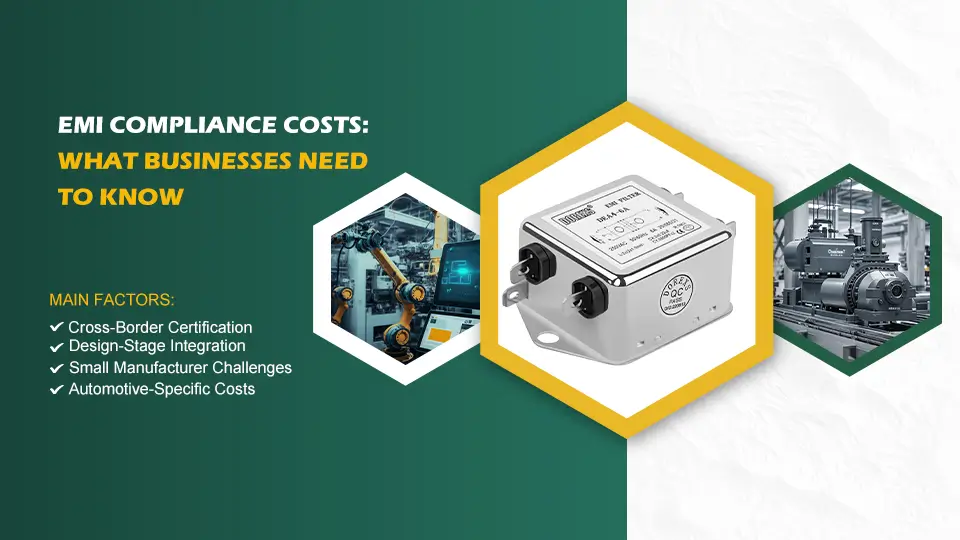
Tighter EMI requirements come with significant costs, but planning ahead can mitigate risks. Achieving cost effectiveness in EMI compliance is a major concern for businesses operating in a competitive landscape, where managing expenses is crucial to maintaining market position. Key cost factors include:
-
Integration at Design Stage: Fixing EMI issues once the design is final can increase costs by 40-60%. Integrating EMI control measures early in the design process is way more cost-effective.
-
Busting Cross-Border Barriers to Certification: Meeting all the various global testing regimes can really break the bank - up to 40% more. Compliance testing is a significant contributor to overall expenses. Working with an accredited testing lab can make the whole certification process a lot more manageable.
-
The Added Cost of Going Electric: EV manufacturers are facing an extra 15-20% in costs due to EMI compliance - and it’s down to the special shielding requirements and testing needed.
-
How Certification Costs Can Crush Small Businesses: Loads of small businesses are basically giving up on international markets because of the sheer expense of certification, which puts them right at a competitive disadvantage in the current competitive landscape.
The Future of EMI Requirements: What to Expect in the Coming Years (2025-2030)
EMI standards are only going to keep getting tougher in the years ahead as tech gets more advanced and the world gets more connected. What’s on the horizon includes:
-
Higher Frequency Testing: Testing is going to need to cover frequencies right up to 100GHz to keep pace with all these new wireless technologies coming down the track.
-
Testing for Real World Interference: Forget about just passing lab tests, EMI standards are going to start focusing on how things perform in the real world, rather than just ticking boxes in a lab.
-
When IoT and 5G Collide: The crazy thing about the combo of all these IoT devices and 5G networks is the new interference scenarios they’re creating - and this is all going to need to be sorted out in the standards.
-
EMC Gets Sustainable: EMI standards will be changing to prioritise energy efficiency and low emissions. Compliance is no longer just about not causing interference, but also about being eco-friendly.
What You Need to Know to Stay Ahead of EMI Requirements
The thing is, tighter EMI requirements aren’t just some short-term trend - they’re the only way forward in a world where everything’s getting more connected and tech-driven. Key market trends and projected market growth during the forecast period (2024–2032) will significantly impact different market segments and end user industries, such as medical devices, industrial automation, and consumer electronics. For businesses, the key to success is to stay ahead of the game on compliance. This means integrating EMI control early on in your design, keeping on top of changing global regulations, and finding an expert to help you navigate all the testing and certification hoops.
While compliance can be a real headache, it also presents a great opportunity to build products that are safer, more reliable and more marketable. So don’t let EMI requirements hold you back - embrace them and you’ll be the one driving innovation.
Need some help figuring out how EMI requirements affect your industry? Leave a comment below and our team of EMC experts will be happy to answer any questions you might have.
While compliance can be a real headache, it also presents a great opportunity to build products that are safer, more reliable and more marketable. So don’t let EMI requirements hold you back - embrace them and you’ll be the one driving innovation.
Need some help figuring out how EMI requirements affect your industry? Leave a comment below and our team of EMC experts will be happy to answer any questions you might have.
What Is Leakage Current and Why It Matters : A Complete Guide to Electrical Safety
Three Phase EMI Filters vs Single Phase: Key Differences