
EMI Issues in Industrial Robots and How DOREXS EMI Filters Deliver Reliable Solutions
author: DOREXS
2025-11-19
Industrial robots rely on high-speed motion control, precision sensors, servo drives, and real-time communication networks. These components make robotic systems extremely sensitive to electromagnetic interference (EMI). Ensuring electromagnetic compatibility is critical for reliable robot operation. EMI prevention is crucial for robotic design and manufacturing environments, as strong EMC measures and effective shielding are essential to ensure device reliability and safety. EMI issues and solutions are relevant across various industries, including automation, automotive, manufacturing, and aerospace, where strict certification standards and high EMI sensitivity demand robust solutions. Without proper filtering, EMI can cause positioning errors, system downtime, and long-term device damage.
DOREXS offers a complete range of EMI filters—including DAA1 series, DEA4 single-phase filters, DAC44 multi-stage filters, and three-phase high-current filters—designed specifically to enhance EMC performance in industrial robots. DOREXS EMI filters are engineered to comply with major industry standards (such as CE, FCC, ISO 7637-2) for electromagnetic compatibility.
Below are detailed real-world style application cases showing how DOREXS filters effectively solve EMI problems in robotic systems.

Sources of Disturbance in Industrial Robot Environments
Industrial robot environments are filled with a wide range of electromagnetic interference (EMI) sources that can disrupt the reliable operation of electronic devices and robotic systems. As robots become more advanced and interconnected, the risk of EMI issues increases, making it essential for robotics engineers to understand and address these challenges. A thorough understanding of electromagnetic noise sources, mechanisms, and mitigation strategies is crucial for developing effective EMC measures and ensuring system reliability amidst electromagnetic interference. Robotics have become integral to daily life and business operations, making EMI mitigation even more important.
1. Common EMI Challenges in Industrial Robots
Industrial production lines contain numerous interference sources, increasing the likelihood of EMI issues occurring in robotic systems. These sources include:
- Servo drives and servo motors
- VFDs for conveyors and auxiliary axes
- Switching power supplies
- Robotic welding equipment
- High-frequency communication systems (CANopen, EtherCAT, Profinet)
The effects of EMI on robotic systems can include reduced precision, communication errors, unexpected malfunctions, and even safety hazards, all of which can disrupt operations and increase costs. EMI issues can also compromise the mission of a robotic system, potentially leading to failure in achieving its intended tasks.
To minimize these risks, it is essential to follow best practices and recommended strategies to prevent EMI-related issues during robotic development and operation.
1.1 Typical Failures in Industrial Robots

Common failures in industrial robots due to EMI include:
-
Unintended stops or resets
-
Communication loss between controllers and sensors
-
Erratic movement or loss of positioning accuracy
-
Sensor malfunctions or false triggering
The use of ferrite beads and proper component placement are essential strategies to ensure the robot's operation remains unaffected by EMI.
Malfunctions caused by EMI can disrupt sensors, power supplies, and control systems, leading to operational instability. Proper component placement is crucial in reducing EMI and achieving compliance. If not properly addressed, EMI can lead to critical system failure, resulting in downtime and potential safety risks.
Typical EMI-related robot failures
-
Robot arm vibrations or uncontrolled micro-jitter
-
Encoder signal distortion → positioning inaccuracy
-
Servo overcurrent alarms
-
Controller crash or program freeze
-
Unstable PLC or fieldbus communication
-
False triggering of proximity/vision sensors
Using shields to cover sensitive components can help prevent external EMI from causing these failures.
Following established guidelines for EMI mitigation is essential for maintaining reliable robotic operation.
Following established guidelines for EMI mitigation is essential for maintaining reliable robotic operation.
External Factors Affecting Robot Operation
Industrial robots operate in environments filled with a variety of external factors that can significantly impact their performance, particularly when it comes to electromagnetic interference (EMI). In today’s manufacturing industry, the electromagnetic environment is more complex than ever, with numerous electronic devices, machinery, and wireless systems operating side by side. This creates a landscape where external noise and electromagnetic noise can easily interfere with a robot’s operation, leading to unexpected malfunctions, reduced precision, or even complete system failure.
Electromagnetic compatibility (EMC) is essential for ensuring that industrial robots and other electronic devices can function reliably without being affected by, or causing, unwanted interference. Robotics engineers must take into account not only the internal design of robotic systems but also the external sources of EMI present in the deployment environment. Common external EMI sources include nearby motors, variable frequency drives, switching power supplies, Wi-Fi networks, and even improperly shielded cables or antennas. These can introduce noise that disrupts sensitive components, signals, and communication systems within the robot.
Problem Background:A welding production cell with 4 six-axis robots suffered severe servo jitter whenever the welding torch activated. The welding inverter generated high-frequency conducted noise (1–10 MHz) feeding back into the robot controller power input. Testing was performed to identify the EMI source and determine which components were affected, revealing that the robot servo system was particularly vulnerable to external electromagnetic interference. During experimental testing in the factory environment, EMI was detected as it impacted the ability to accurately detect LTE signals and affected the robot's performance.
Symptoms:
Electromagnetic compatibility (EMC) is essential for ensuring that industrial robots and other electronic devices can function reliably without being affected by, or causing, unwanted interference. Robotics engineers must take into account not only the internal design of robotic systems but also the external sources of EMI present in the deployment environment. Common external EMI sources include nearby motors, variable frequency drives, switching power supplies, Wi-Fi networks, and even improperly shielded cables or antennas. These can introduce noise that disrupts sensitive components, signals, and communication systems within the robot.
Real Application Cases Using DOREXS EMI Filters
? Case 1: Six-Axis Robotic Welding Station — Servo Jitter & Unstable Motion
This case is an example of how EMI issues are identified and mitigated in real-world robotic automation scenarios.
Problem Background:A welding production cell with 4 six-axis robots suffered severe servo jitter whenever the welding torch activated. The welding inverter generated high-frequency conducted noise (1–10 MHz) feeding back into the robot controller power input. Testing was performed to identify the EMI source and determine which components were affected, revealing that the robot servo system was particularly vulnerable to external electromagnetic interference. During experimental testing in the factory environment, EMI was detected as it impacted the ability to accurately detect LTE signals and affected the robot's performance.
Symptoms:
-
Robot axis 4 & 5 showed micro-vibration during the arc-start phase
-
Occasional servo overcurrent alarms
-
Welding path deviation up to 0.8 mm
-
Production line downtime 3–5 times per week
DOREXS Solution:Installed DOREXS Three-phase high-performance EMI filter between the welding inverter and the robot servo drive cabinet to mitigate EMI on IGBT inverter welding machine and reduce EMI in the robotic system. As an additional measure, ferrite beads were placed on the power and signal cables to suppress high-frequency noise. Shielding and proper cable management were also implemented to prevent EMI from cables acting as unintended antennas.
Why This Model:
- 3-stage filtering structure
- Specially optimized for welding inverter noise
- High attenuation in 150 kHz–10 MHz conducted noise band
Installation Position:
Main AC input of robot servo drive controller cabinet, with attention to shielding and cable routing to minimize EMI pickup.
Measured Results:
- Conducted noise reduced by 72%
- Servo jitter completely eliminated
- Zero servo error alarms for 60 days continuous operation
- Welding accuracy improved from ±0.8 mm → ±0.15 mm
- Production downtime decreased from 3–5 times per week to 0 times.
- The robot’s operation was stabilized, with no further EMI-related disruptions after mitigation steps were implemented.
To ensure ongoing EMC compliance and optimal device operation, it is essential to engage all stakeholders in the testing process throughout the robotics development lifecycle.
? Case 2: Precision Assembly Robot — Encoder Positioning Errors
Background: A precision assembly line used SCARA and Delta robots for ±0.02 mm tasks. Robots occasionally produced small but critical positional deviation. Strategies for addressing EMI in the packaging line were needed to maintain system stability and product quality.
Symptoms:
- Encoder feedback showed random spikes
- Robot would drift 0.02–0.06 mm
- Product defect rate reached 3.1%
- The noise was traced to switching power supplies sharing the same AC line
DOREXS Solution:Installed DOREXS DAC41-10A Three-stage high-attenuation EMI filter on the robot controller’s AC input. These filters support EMI control by providing robust noise suppression and addressing communication dropout issues that can arise from electromagnetic interference.
Why DAC41-10A:
- Multi-stage filtering → extremely high common-mode noise suppression
- Very low leakage → safe for precision positioning robots
- Designed for sensitive electronics and motion control systems
Installation Position:
- Robot controller AC inlet
- Extra small DAA1-6A filter installed on the switching power supply feeding the vision system
Results:
- Encoder signal noise reduced by 83%
- Robot positioning repeatability restored to ±0.01 mm
- The defect rate decreased to 0.4%.
- Vision system recognition accuracy improved by 19%
Adopting a forward-looking approach to EMI prevention is the most effective way forward to further optimize manufacturing processes and ensure long-term reliability.
? Case 3: Robotic Packaging Line — EtherCAT Communication Dropouts
Background:A food packaging plant used 12 robots communicating over EtherCAT. Nearby conveyor VFDs caused periodic EMI injection into the shared power network, creating risks for robotic inspection stations by potentially disrupting machinery and communication systems.
Symptoms:
-
EtherCAT disconnection alarm between PLC and robot
-
Occasional robot freeze or stop
-
Communication retries increased by 500%
-
Overall line efficiency decreased by 12%.
-
EMI-induced malfunctions could lead to safety risks or even injury for operators and maintenance staff
DOREXS Solution: Apply the DOREXS DF2 1-30A inverter-specific filter to each conveyor VFD to protect sensitive sensors and controllers from EMI, thereby ensuring the reliable operation of the robot system. Additionally, using a shield as an isolation barrier can further prevent EMI from affecting sensitive components by blocking or reducing noise signals.
Why DF2:
- Cost-effective for VFD noise suppression
- Strong differential-mode filtering for 150 kHz–500 kHz
- Easy DIN-rail mounting for retrofit
Installation Position:
-
AC input of each VFD feeding conveyors
Results:
- EtherCAT packet loss reduced by 98.5%
- Robot-PLC communication became 100% stable
- Line efficiency restored + additional 7% boost
- System troubleshooting time reduced by 90%
? Case 4: Industrial Robot Workcell — Multiple Sensors Triggering Erratically
Background:A robot-equipped inspection station used 6 types of vision, distance, and IR sensors. EMI from a high-frequency plasma cutter interfered with sensor performance, making it difficult for the robot to operate reliably.
Symptoms:
-
Sensor false triggers
-
Vision noise affecting detection
-
Robot often stopped due to safety false alarms
DOREXS Solution:
- For robot controller: DEA4-10A High-performance single-phase filter
- For plasma cutter power unit: DAC1-20A Three-phase EMI filter
Why These Models:
- DEA4: optimised for sensitive control electronics
- DAC1: handles high-power load + strong suppression
Results:
-
Sensor false trigger rate decreased from 20–30 times per day to 0–1 times per day.
-
Vision image noise reduced by 60%
-
Robot stopped unexpectedly: from 2–3 times per day to 0 times.
-
Overall inspection accuracy improved by 14%.
-
The robot’s ability to perform its tasks accurately was restored after EMI mitigation, ensuring it could operate as intended.
-
Considering EMI mitigation throughout the development process of robotic systems is essential for maintaining reliable operation and long-term performance.
Advantages of Using DOREXS EMI Filters in Robotic Systems

✔ High Attenuation for Industrial Noise
Heavy machinery, servo systems, and inverters produce strong EMI—DOREXS filters provide multi-stage suppression.
✔ Protects High-Value Components
Servo drives、Encoders and robot controllers are expensive components; installing filters can significantly extend their lifespan.
✔ Improves Precision & Repeatability
For assembly, welding, cutting, and dispensing robots, EMI directly affects accuracy.
✔ Significantly Reduces Downtime
Real-world examples show that downtime can be reduced by 80–100%.
✔ Ensures EMC Compliance
It complies with industry standards such as EN 61800-3 and IEC 61000-6-4.
Recommended DOREXS EMI Filters for Robots
Scenarios |
Recommended Models |
Features |
|
Robot Main Controllers
|
DAC41 Series
|
Three-stage ultra-high attenuation, low leakage current
|
|
Servo Drive/Motor Systems
|
DEA4 Series
|
Excellent high-frequency suppression
|
|
PLC/Sensor Power Supply
|
DBA7 Series
|
Economical and stable, suitable for light-load filtering
|
|
Welding/Cutting Equipment
|
DAC1 Three-Phase Series
|
High current, high attenuation, multi-stage filtering
|
|
VFD/Conveyors
|
DF2 Series
|
Suppresses common VFD harmonic interference
|
In complex and ever-changing industrial environments, EMI has become a critical challenge affecting the accuracy, stability, and lifespan of robots. Whether in welding, assembly, packaging, or high-speed communication networks, reliable EMC construction determines the efficiency and safety of the entire production line. DOREXS provides proven, high-efficiency solutions for robot systems worldwide with its professional multi-series of industrial-grade EMI filters—offering superior attenuation, more stable interference immunity, and broader industry compatibility, truly enabling robots to perform at their full potential.
If you are looking for ways to improve robot system stability, reduce downtime, increase accuracy, or resolve existing EMI vulnerabilities, now is the perfect time to act.
EMI Over-Limit Mitigation for Motor Drive Controllers: Engineering Application and Field Verification of DOREXS EMI Power Filters
Typical Application Cases and Solutions of EMI Filters in Servo Drives and Servo Motors
Related Article
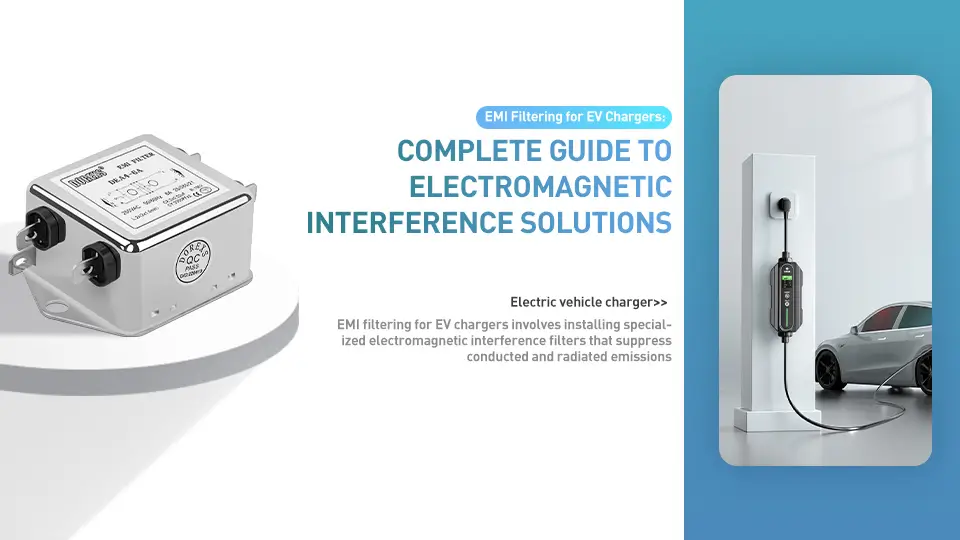
This guide covers DC and AC EMI filtering solutions, regulatory compliance requirements, and practical implementation strategies for charging station operators, OEMs, and facility managers.
EMI Filtering for EV Chargers: Complete Guide to Electromagnetic Interference Solutions
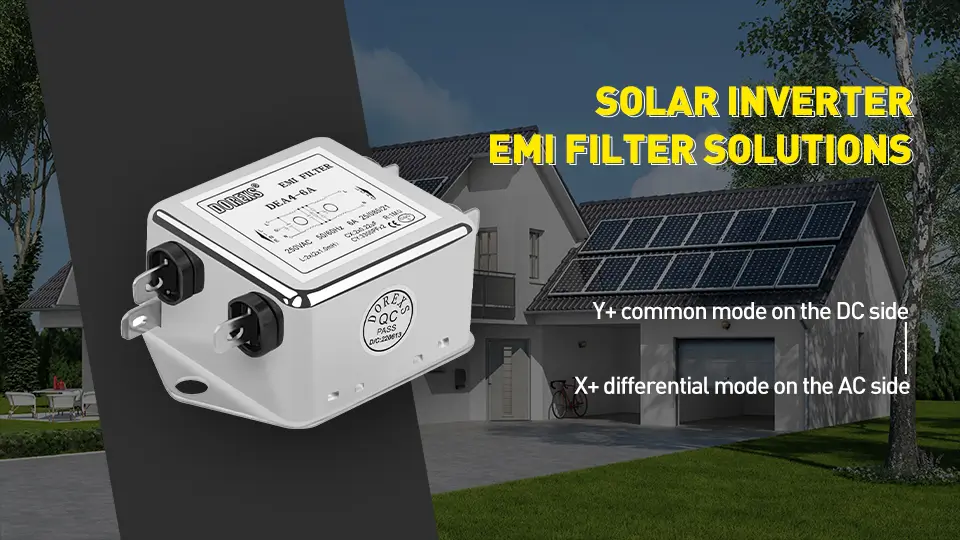
EMI from solar power systems can affect the performance of sensitive electronic devices, such as computers, medical devices, appliances, electrical devices, and other devices.
Solar Inverter EMI Filter Solutions: Professional EMC Solutions for Grid-Tied and PV Inverter Systems

In today’s fast-growing smart manufacturing era, CNC machines are expected to deliver not only machining capability but consistent precision, long-term stability, and zero-downtime reliability.However, as machine power increases and electronic components operate at higher speeds, EMI (Electromagnetic Interference) has become one of the most serious hidden threats in CNC systems.
EMI Interference in CNC Equipment & DOREXS Industrial Filter Solutions
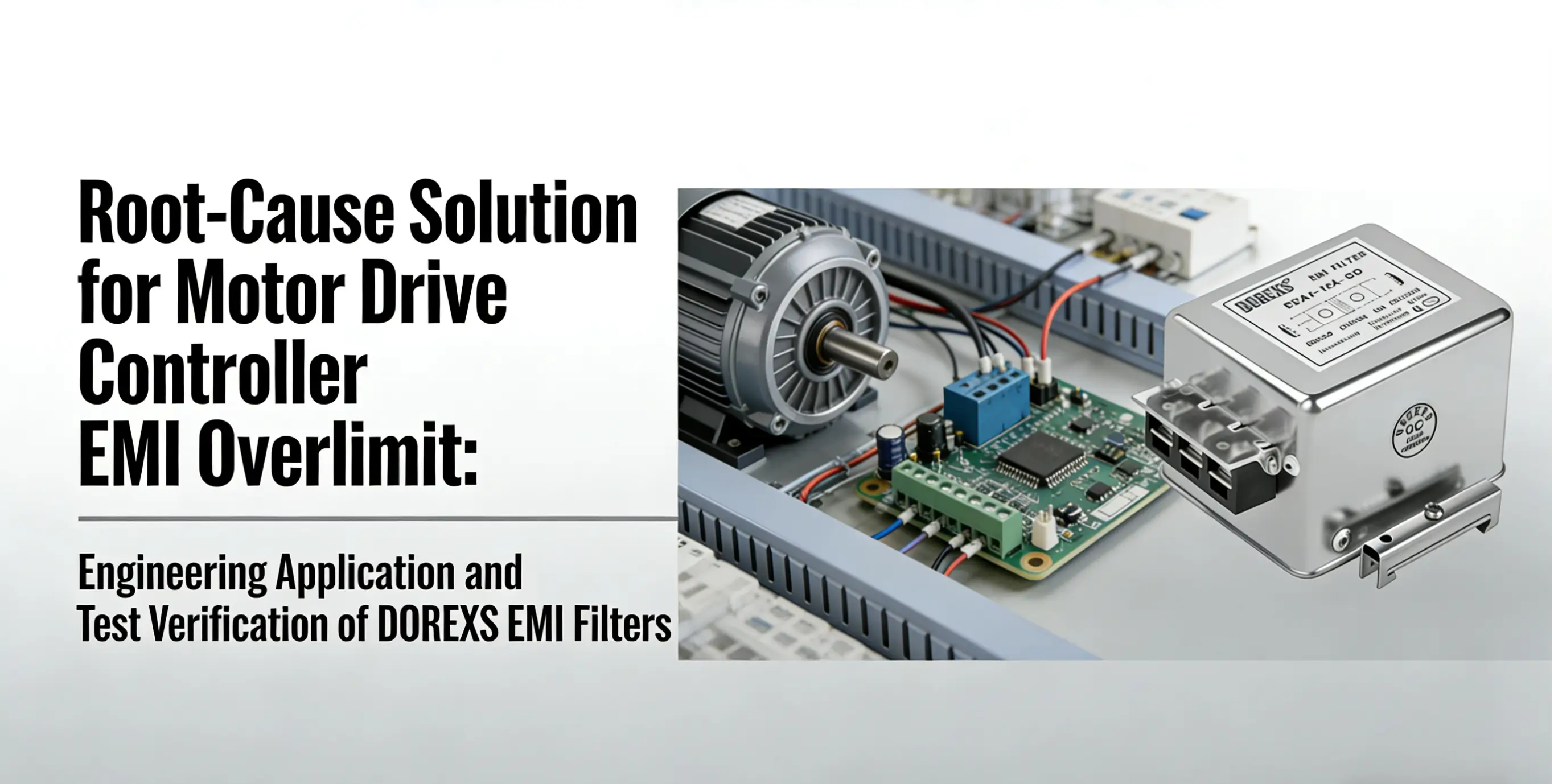
Based on an actual mitigation case, this article systematically explains the EMI generation mechanisms in motor drive controllers, the functional role of DOREXS EMI power filters, and an engineering-proven combination of filters + PCB design + grounding measures.
EMI Over-Limit Mitigation for Motor Drive Controllers: Engineering Application and Field Verification of DOREXS EMI Power Filters