Common Mode Chokes vs EMI Filters: Which EMI Solution is Right for Your Application?
Optimize Your EMI Suppression Strategy

Selecting the right electromagnetic interference suppression component can make or break your product’s system performance and regulatory compliance. Learn how to reduce electromagnetic interference: get it wrong, and you’re looking at failed EMC tests, costly redesigns, and delayed product launches. Get it right, and your electronic devices operate reliably even in harsh environments with high levels of electrical noise.
Both common mode chokes and EMI filters address electromagnetic interference, but they serve fundamentally different purposes. Common mode chokes offer targeted suppression of specific noise types, while complete EMI filter solutions provide comprehensive protection across broader frequency ranges.
This guide breaks down the key differences between these two approaches and helps you determine which solution fits your specific application—whether you’re designing power supply circuits for industrial control systems, medical equipment, or consumer electronic devices.
What Makes These EMI Solutions Unique?
Common Mode Chokes – Targeted Interference Control
Common mode chokes are specialized inductive components specifically designed to suppress common mode noise while allowing differential signals to pass through unaffected. Their construction involves winding inductor coils on a magnetic core in a parallel configuration, creating two identical coils that work together to block high frequency noise traveling in the same direction on both power lines.
Key benefits of incorporating common mode chokes:
-
High current handling capability due to lower resistance losses
-
Effective low-frequency noise suppression
-
Simple installation on power lines and data lines
-
Cost-effective solution for basic EMI control
-
Ability to use high permeability cores without saturation
Common mode chokes work particularly well in switch mode power supplies and motor drives where common mode currents need attenuation without affecting the desired power or data signals. They’re commonly found in applications where the differential signals operate in the same frequency range as the common mode noise that must be suppressed.

EMI Filters – Comprehensive Noise Suppression
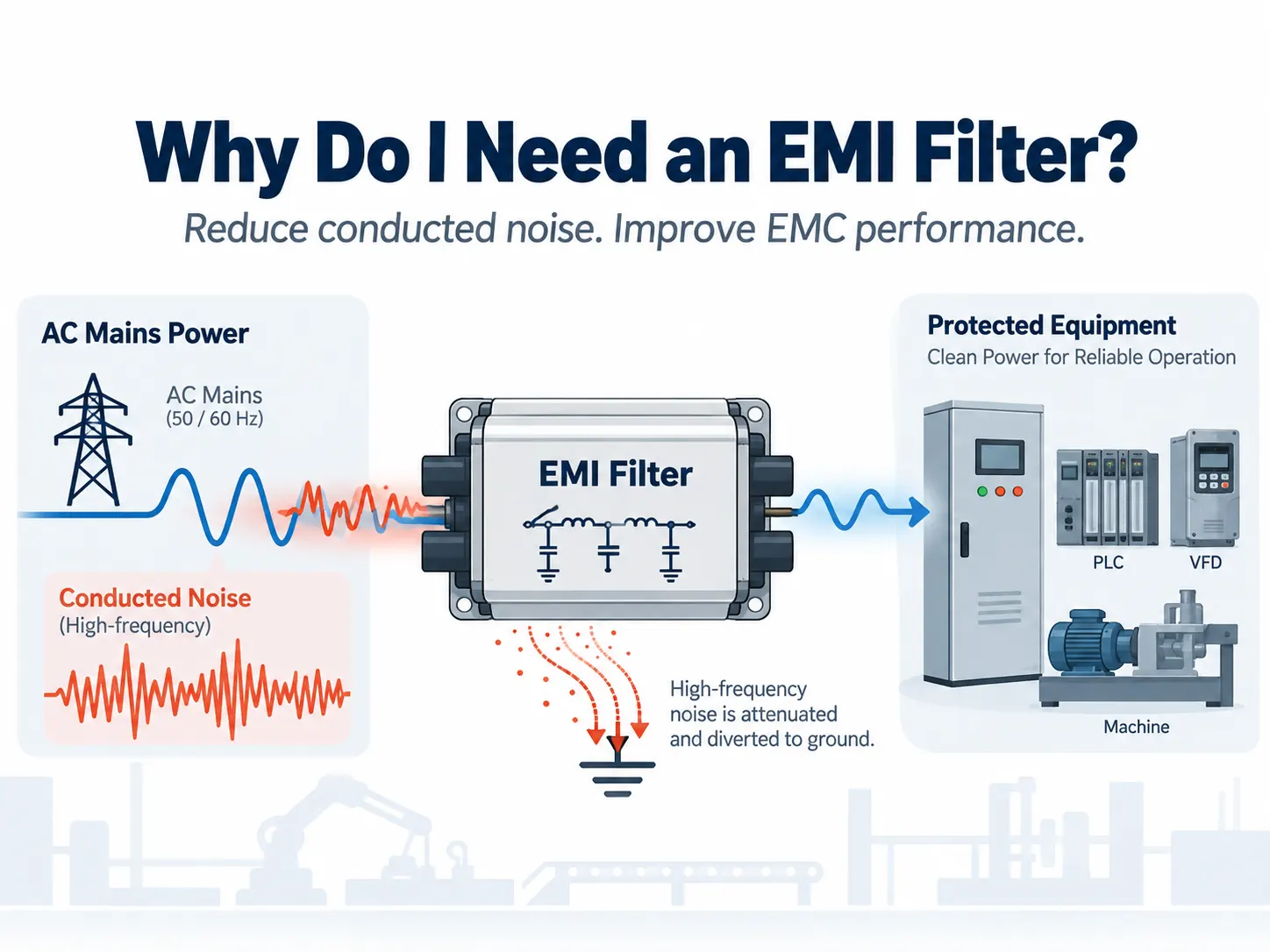
EMI filters represent complete filtering systems incorporating multiple components—inductors, capacitors, and sometimes additional protective elements—to provide broad-spectrum noise suppression. Unlike single-component solutions, these filters address both common mode and differential mode noise simultaneously.
Key benefits of EMI filter solutions:
-
Broad frequency spectrum coverage from DC to several hundred MHz
-
Multi-mode noise suppression handling both common and differential mode noise
-
Integrated safety features for enhanced system’s reliability
-
Designed for compliance with EMC standards
-
Available in configurations for different applications
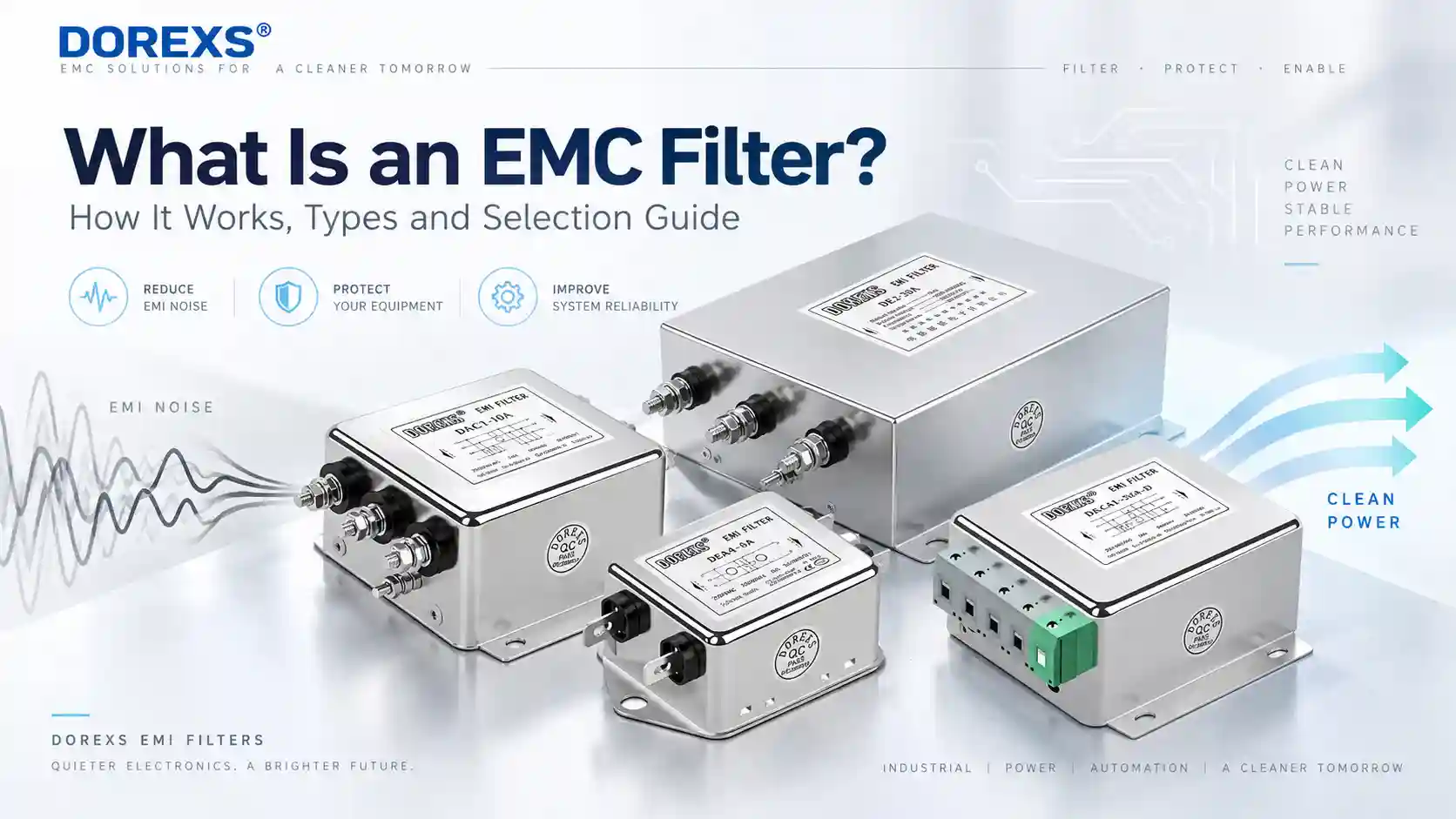
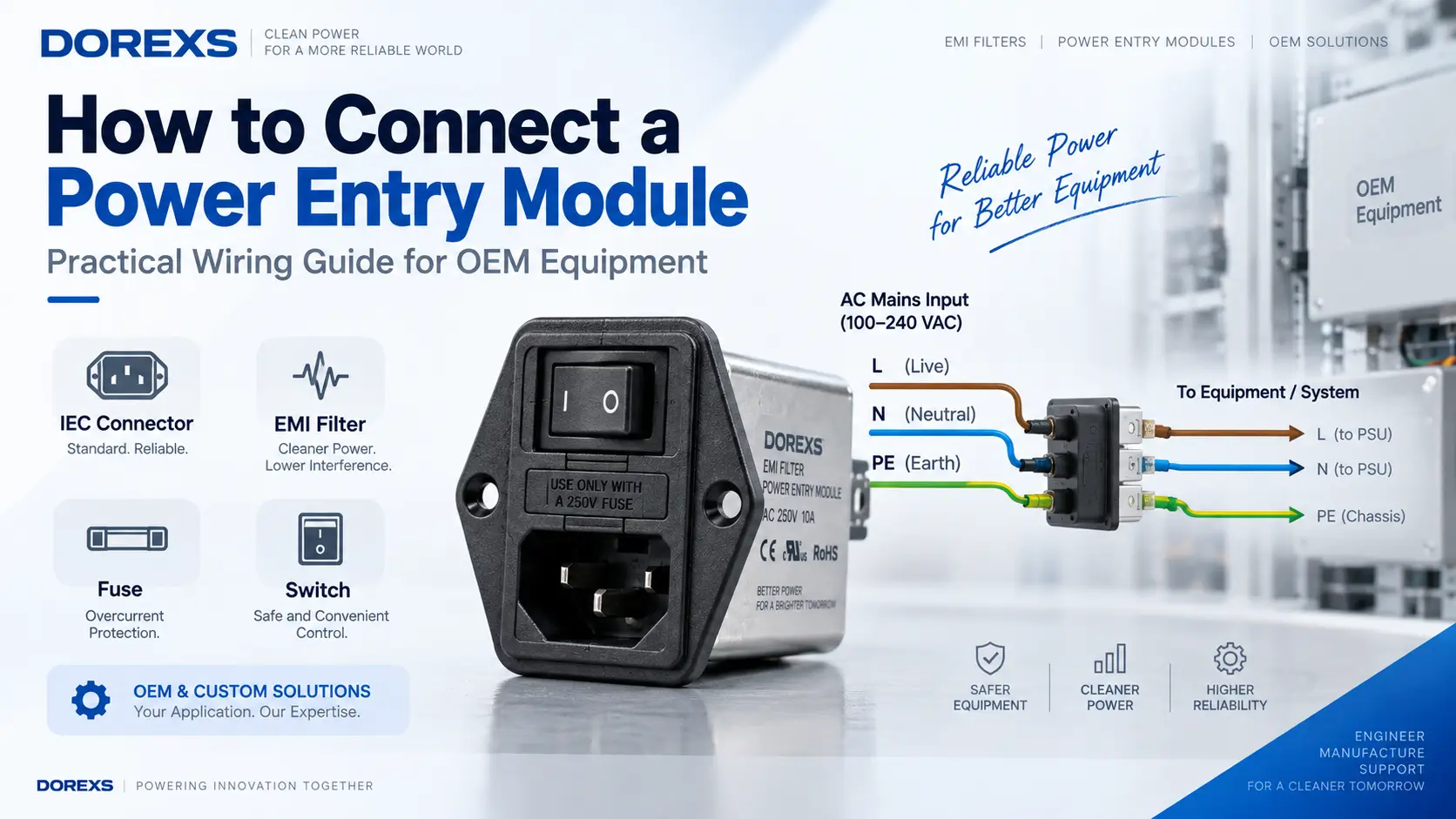
At DOREXS, we manufacture a comprehensive range of EMI filter solutions including single-phase, three-phase, IEC inlet, PCB, feed-through, and DC filters. Our products serve clients in industrial automation, medical devices, consumer electronics, and home appliances—each requiring reliable, standards-certified solutions to ensure compliance and stable power supply operation.

Common Mode Chokes vs. EMI Filters: What’s the Difference?
Application Areas
The choice between these solutions often comes down to your specific application requirements.
Application Type |
Common Mode Chokes |
EMI Filters |
|---|---|---|
|
Power line conditioning |
✓ Primary use |
✓ Comprehensive solution |
|
Motor drives |
✓ Effective |
✓ Full protection |
|
AC/DC power input |
Limited |
✓ Essential |
|
Industrial equipment |
Basic protection |
✓ Full compliance |
|
Medical devices |
Component-level |
✓ Required for standards |
|
Communication systems |
Signal line filtering |
✓ System-wide protection |
Common mode chokes play a crucial role in power conversion applications where you need to reduce noise on specific conductors. They excel in industrial systems with long cable runs—for instance, attenuating common-mode RF noise from variable speed drives and phase-control devices in the low megahertz spectrum.
EMI filters become essential when your application demands regulatory compliance or when you’re dealing with conducted EMI across multiple frequency ranges. Medical equipment, for example, typically requires the comprehensive approach that only complete filter solutions can provide.
Frequency Response
Understanding the frequency characteristics of each solution helps you match the right component to your noise problem.
Common Mode Chokes:
-
Most effective at lower frequencies (typically under 30 MHz)
-
Present high impedance to common mode noise signals
-
Parasitic capacitance limits high-frequency performance
-
Higher inductance requires more turns, creating greater parasitic effects
-
Wide frequency range coverage extending into hundreds of MHz
-
Multiple filter stages address various sources of noise
-
Optimized component selection for specific frequency bands
-
Better high-frequency performance through integrated design
A significant technical limitation of mode chokes involves the trade-off between low-frequency effectiveness and high-frequency performance. For a given core material, achieving lower-frequency filtering requires higher inductance, which necessitates more turns—and those additional turns create parasitic capacitance that defeats high-frequency filtering capabilities.
Component Complexity
The complexity of your EMI suppression solution directly affects board space, integration effort, and overall circuit design.
Common Mode Chokes:
-
Single inductive component with minimal additional circuitry required
-
Straightforward installation and replacement
-
Larger physical size and heavier weight compared to integrated solutions
-
Subject to vibration-induced failure in mechanical stress environments
-
Winding mismatch from manufacturing tolerances can cause mode conversion
EMI Filters:
-
Complete circuits with inductors, capacitors, and protective elements
-
Smaller package size for equivalent or better performance
-
More complex internal design but simpler system integration
-
Pre-tested for specific performance characteristics
-
Reduced design burden on engineering teams
Modern EMI filter devices provide significantly more RFI suppression in substantially smaller packages compared to discrete common mode choke solutions. This space efficiency becomes critical in contemporary electronics design where miniaturization drives competitive advantage.
Regulatory Compliance
Meeting EMC standards is non-negotiable for commercial products, and your choice of EMI suppression strategy affects your path to compliance.
Common Mode Chokes:
-
Provide component-level specifications for EMI reduction
-
Require additional design work to achieve system compliance
-
Performance depends on proper installation and grounding
-
May need supplementary components for full compliance
EMI Filters:
-
Complete solutions designed to meet EMC standards (CISPR, FCC, CE marking)
-
Pre-certified configurations available for specific requirements
-
Documentation supports faster regulatory approval
-
DOREXS offers standards-certified filter solutions for demanding applications
When signal integrity and reduced performance from electrical noise could result in data corruption or safety issues, complete EMI filter solutions provide the assurance that your product will meet regulatory requirements.
What Experienced Engineers Say
Engineers who regularly work with EMI suppression components have developed clear preferences based on their application experience.
Common Mode Choke Advocates appreciate:
-
✅ Straightforward implementation with minimal design complexity
-
✅ High power handling without saturation concerns
-
✅ Cost-effective approach for basic filtering needs
-
✅ Flexibility to combine with other filter elements
EMI Filter Specialists value:
-
✅ Comprehensive common mode noise suppression across frequency ranges
-
✅ Regulatory compliance assurance with pre-tested solutions
-
✅ Integrated protection features that reduce overall component count
-
✅ Technical support and custom design options from manufacturers like DOREXS
The reality is that experienced engineers often use both solutions in different parts of the same system. Demanding applications requiring comprehensive EMI suppression sometimes employ multi-stage filtering chains combining common mode chokes, chip beads, capacitors, and inductors—each serving a specific function in the overall noise suppression strategy.

Performance Requirements Overview
Matching your EMI solution to actual performance needs prevents both over-engineering and under-protection.
Common Mode Chokes are suitable when:
-
Basic common mode noise suppression meets your requirements
-
High current handling (often above several amperes) is necessary
-
The noise frequency falls within the choke’s effective range
-
Budget constraints favor simpler solutions
-
Differential mode attenuation is not a primary concern
EMI Filters become essential when:
-
Broad spectrum EMI control across multiple frequency decades is required
-
Regulatory compliance for commercial, industrial, or medical applications is mandatory
-
Your system operates near switching power supplies or other high-noise sources
-
Both common and differential mode suppression are needed
-
Reliability in harsh environments demands proven, tested solutions
Both solutions require proper installation and grounding for optimal performance. The effectiveness of common mode choke installations depends critically on solid connections to ground planes and chassis at RF frequencies. Similarly, EMI filters need proper input and output separation and appropriate grounding to achieve their rated performance.
Which EMI Solution is Right for You?
Choose Common Mode Chokes if you need:
-
✔ Simple, cost-effective EMI suppression for power lines
-
✔ High current handling capability (above 10A)
-
✔ Basic common mode noise filtering in a known frequency range
-
✔ Minimal component count requirements
-
✔ Solutions for applications where the signal passband overlaps with the noise rejection band
Common mode chokes deliver excellent value when your EMI challenges are straightforward and your noise sources are well-characterized. They function effectively in electronic systems where common mode currents dominate and differential mode signals need to pass unimpeded.
Choose EMI Filters if you need:
-
✔ Comprehensive EMI suppression across wide frequency ranges
-
✔ Regulatory compliance for commercial or medical applications
-
✔ Integrated safety features and protection in one package
-
✔ Custom solutions for specific EMC requirements
-
✔ Reduced design time and faster time-to-market
-
✔ Support for applications demanding the highest reliability
For engineers working on medical devices, industrial automation equipment, or any application where EMC compliance is critical, complete EMI filter solutions from experienced manufacturers provide the most reliable path forward.

Making the Right Choice for Your Application
Both common mode chokes and EMI filters effectively reduce EMI and protect electronic circuits from the harmful effects of electromagnetic interference—but they serve distinctly different needs.
Choose common mode chokes when you have a well-defined, narrow-band noise problem with high current requirements and budget constraints favor simpler solutions. These components excel at what they do: blocking common mode noise while passing differential mode signals with minimal attenuation.
Choose complete EMI filters when your application demands broad spectrum protection, regulatory compliance, and the efficiency of an integrated solution. The upfront investment pays dividends through faster certification, improved reliability, and reduced engineering time.
For complex EMC challenges or custom requirements, consulting with experienced filter manufacturers makes sense. The DOREXS technical team offers engineering support, custom filter designs, and guidance on selecting the right solution for your specific power quality and EMI suppression needs.
When making your final decision, consider:
-
Specific EMC standards your product must meet
-
Power requirements and current handling needs
-
Available board space and installation constraints
-
Frequency range of both desired signals and noise sources
-
Environmental conditions and reliability requirements
The right EMI solution protects your product’s operation, ensures signal quality, and delivers the performance your customers expect—making the time spent on proper selection well worth the investment.
Effective Design of EMI Filter for Enhanced Performance in Electronics
EMC Challenges in Battery Energy Storage